# powerful-annotation
**Repository Path**: CreateSequence/powerful-annotation
## Basic Information
- **Project Name**: powerful-annotation
- **Description**: 一个小巧的、无依赖的 java 注解增强工具库。它用于解决日常开发中 java 注解使用的一些痛点,提供包括更强大的注解搜索能力,更灵活更便利的可重复注解,与类似 spring 的注解元注解合成机制
- **Primary Language**: Java
- **License**: Apache-2.0
- **Default Branch**: master
- **Homepage**: None
- **GVP Project**: No
## Statistics
- **Stars**: 4
- **Forks**: 1
- **Created**: 2022-07-19
- **Last Updated**: 2024-09-13
## Categories & Tags
**Categories**: Uncategorized
**Tags**: Java, annotation, 注解, 工具类
## README
# powerful-annotation
 
------
[DOCUMENT_EN](README-EN.md)
[中文文档](README.md)
------
## 简介
`powerful-annotation` 是一个小巧的、无依赖的 java 注解增强库。它用于解决日常开发中 java 注解使用的一些痛点,提供包括更强大的注解搜索能力,更灵活更便利的可重复注解,与类似 spring 的注解合成机制。
它的设计灵感来自于 `spring-core` 中的注解包,在非 `spring` 环境下, `powerful-annotation` 是 `spring` 注解机制的友好替代。
## 文档
[Wiki-CN](https://gitee.com/CreateSequence/powerful-annotation/wikis/Home)
## 特性
- 无依赖:引入后不会为用户的项目再带来其他的依赖;
- 快速上手:用户通过一个静态工具类即可使用大部分功能;
- 注解搜索支持:提供更强大的注解搜索能力,支持从包括类、方法、属性或者注解的元注解等复杂层级结构中搜索注解;
- 可重复注解支持:提供更便利的可重复注解获取方式,支持更多可重复注解构建方式;
- 注解合成支持:支持类似 spring 注解合成机制,可以将多个相关的任意注解按照特定的策略“合并”为一个特定类型的注解,从而变相支持注解之间的“继承”;
## 安装
引入 maven 依赖即可使用:
~~~xml
top.xiajibagao
powerful-annotation
${last-version}
~~~
## 快速使用
添加 maven 依赖后,引入通用工具类 `Annotations` 即可使用大部分功能。下面演示一些基本的功能:
### 1.注解搜索
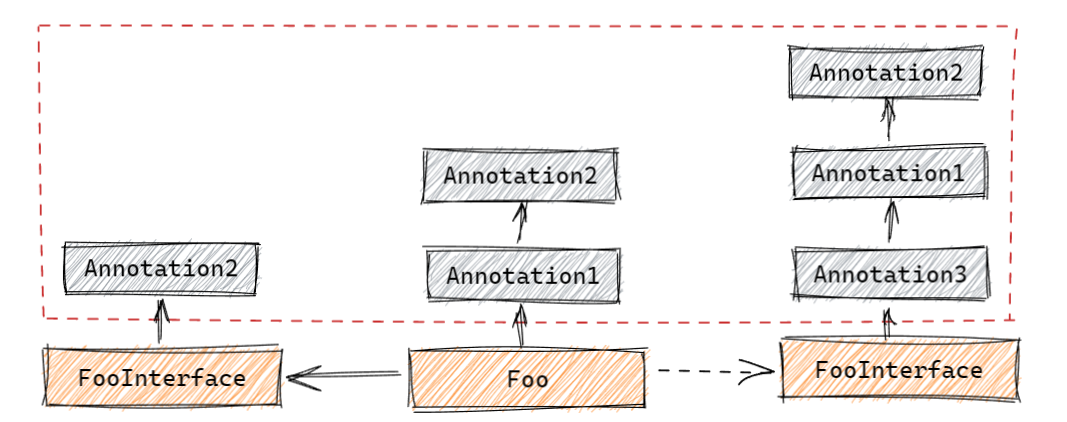 ~~~java
// 不搜索层级结构,不搜索元注解
Annotations.getDirectAnnotation(Foo.class, Annotation1.class); // annotation1
Annotations.getAllDirectAnnotations(Foo.class, Annotation2.class); // []
Annotations.getAllDirectRepeatableAnnotations(Foo.class, Annotation1.class); // [annotation1]
Annotations.isDirectAnnotationPersent(Foo.class, Annotation2.class); // false
// 不搜索层级结构以及搜索元注解
Annotations.getIndirectAnnotation(Foo.class, Annotation2.class); // annotation2
Annotations.getAllIndirectAnnotations(Foo.class, Annotation2.class); // [annotation2]
Annotations.getAllIndirectRepeatableAnnotations(Foo.class, Annotation2.class); // [annotation2]
Annotations.isIndirectAnnotationPersent(Foo.class, Annotation2.class); // true
// 搜索层级结构,不搜索元注解
Annotations.findDirectAnnotation(Foo.class, Annotation3.class); // annotation3
Annotations.findAllDirectAnnotations(Foo.class, Annotation2.class); // [annotation2]
Annotations.findAllDirectRepeatableAnnotations(Foo.class, Annotation3.class); // [annotation3]
Annotations.isDirectAnnotationFound(Foo.class, Annotation2.class); // true
// 搜索层级结构以及元注解
Annotations.findIndirectAnnotation(Foo.class, Annotation3.class); // annotation3
Annotations.findAllIndirectAnnotations(Foo.class, Annotation2.class); // [annotation2, annotation2, annotation2]
Annotations.findAllIndirectRepeatableAnnotations(Foo.class, Annotation3.class); // [annotation3]
Annotations.isIndirectAnnotationFound(Foo.class, Annotation2.class); // true
~~~
### 2.获取可重复注解
~~~java
// 不搜索层级结构,不搜索元注解
Annotations.getDirectAnnotation(Foo.class, Annotation1.class); // annotation1
Annotations.getAllDirectAnnotations(Foo.class, Annotation2.class); // []
Annotations.getAllDirectRepeatableAnnotations(Foo.class, Annotation1.class); // [annotation1]
Annotations.isDirectAnnotationPersent(Foo.class, Annotation2.class); // false
// 不搜索层级结构以及搜索元注解
Annotations.getIndirectAnnotation(Foo.class, Annotation2.class); // annotation2
Annotations.getAllIndirectAnnotations(Foo.class, Annotation2.class); // [annotation2]
Annotations.getAllIndirectRepeatableAnnotations(Foo.class, Annotation2.class); // [annotation2]
Annotations.isIndirectAnnotationPersent(Foo.class, Annotation2.class); // true
// 搜索层级结构,不搜索元注解
Annotations.findDirectAnnotation(Foo.class, Annotation3.class); // annotation3
Annotations.findAllDirectAnnotations(Foo.class, Annotation2.class); // [annotation2]
Annotations.findAllDirectRepeatableAnnotations(Foo.class, Annotation3.class); // [annotation3]
Annotations.isDirectAnnotationFound(Foo.class, Annotation2.class); // true
// 搜索层级结构以及元注解
Annotations.findIndirectAnnotation(Foo.class, Annotation3.class); // annotation3
Annotations.findAllIndirectAnnotations(Foo.class, Annotation2.class); // [annotation2, annotation2, annotation2]
Annotations.findAllIndirectRepeatableAnnotations(Foo.class, Annotation3.class); // [annotation3]
Annotations.isIndirectAnnotationFound(Foo.class, Annotation2.class); // true
~~~
### 2.获取可重复注解
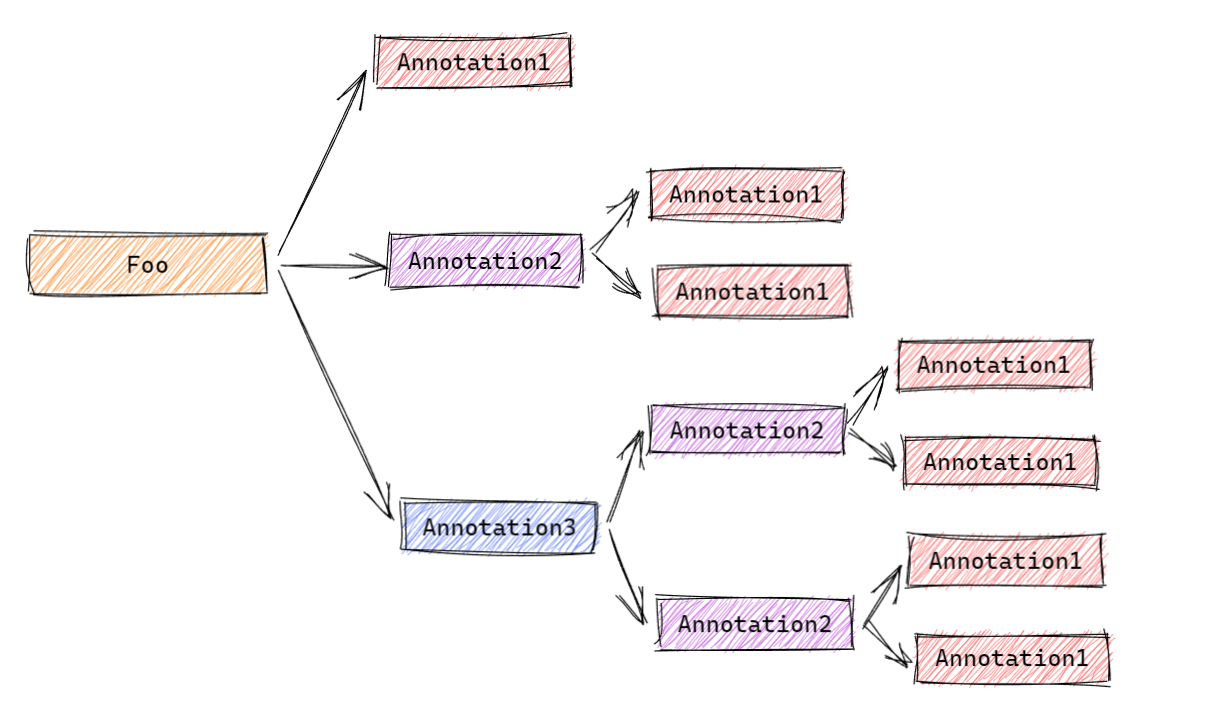 ~~~java
// 该功能支持与注解搜索配合使用
Annotations.getAllDirectRepeatableAnnotations(Foo.class, Annotation1.class); // annotation1 * 7
Annotations.getAllDirectRepeatableAnnotations(Foo.class, Annotation2.class); // annotation2 * 3
Annotations.getAllDirectRepeatableAnnotations(Foo.class, Annotation3.class); // annotation1 * 1
~~~
### 3.构建可重复注解
上述可重复注解相关 API 除支持基于 JDK 自带的 `@Repeatable` 外,还额外支持扩展注解 `@RepeatableBy`:
~~~java
// 使用@RepeatableBy指定可重复注解的容器
@RepeatableBy(annotation = Annotation2.class, attribute = "annotations")
private @interface Annotation1 {
String value() default "";
}
private @interface Annotation2 {
Annotation1[] annotations() default {};
}
~~~
该写法等同于:
~~~java
// 使用原生的@Repeatable指定可重复注解的容器
@Repeatable(Annotation2.class)
private @interface Annotation1 {
String value() default "";
}
private @interface Annotation2 {
Annotation1[] values() default {};
}
~~~
该注解支持与 `@Repeatable` 混合使用。
### 4.注解合成
合成注解使用类似 `spring` 的 `MergedAnnotation`,支持多个注解之间的“合并”,与基于属性注解的别名机制,该功能同样支持与注解搜索结合使用。
**属性镜像**
~~~java
private @interface Annotation1 {
@MirrorFor(attribute = "name")
String value() default "";
@MirrorFor(attribute = "value")
String name() default "";
}
@Annotation1("foo")
public class Foo {}
// synthesis
Annotation1 annotation = Annotations.getSynthesizedAnnotation(Foo.class, Annotation1.class);
annotation.name(); // "foo"
annotation.value(); // "foo"
~~~
**属性别名**
~~~java
private @interface Annotation1 {
@AliasFor(attribute = "name")
String value() default "";
String name() default "";
}
@Annotation1(value = "foo", name = "xxx")
public class Foo {}
// synthesis
Annotation1 annotation = Annotations.getSynthesizedAnnotation(Foo.class, Annotation1.class);
annotation.name(); // "foo"
annotation.value(); // "foo"
~~~
**元注解合成**
~~~java
// meta annotation
private @interface Annotation1 {
String name() default "";
}
// child annotation
@Annotation1("default")
private @interface Annotation2 {
@AliasFor(annotation = Annotation1.class, attribute = "name")
String value() default "";
}
// child annotation only
@Annotation2("foo")
public class Foo {}
Annotation1 annotation1 = Annotations.getSynthesizedAnnotation(Foo.class, Annotation1.class);
annotation1.value(); // "foo"
Annotation2 annotation2 = Annotations.getSynthesizedAnnotation(Foo.class, Annotation2.class);
annotation2.name(); // "foo"
~~~
## 参与贡献和技术支持
如果在使用中遇到了问题、发现了 bug ,又或者是有什么好点子,欢迎在 issues 或者加入 QQ 群:540919540 反馈!
~~~java
// 该功能支持与注解搜索配合使用
Annotations.getAllDirectRepeatableAnnotations(Foo.class, Annotation1.class); // annotation1 * 7
Annotations.getAllDirectRepeatableAnnotations(Foo.class, Annotation2.class); // annotation2 * 3
Annotations.getAllDirectRepeatableAnnotations(Foo.class, Annotation3.class); // annotation1 * 1
~~~
### 3.构建可重复注解
上述可重复注解相关 API 除支持基于 JDK 自带的 `@Repeatable` 外,还额外支持扩展注解 `@RepeatableBy`:
~~~java
// 使用@RepeatableBy指定可重复注解的容器
@RepeatableBy(annotation = Annotation2.class, attribute = "annotations")
private @interface Annotation1 {
String value() default "";
}
private @interface Annotation2 {
Annotation1[] annotations() default {};
}
~~~
该写法等同于:
~~~java
// 使用原生的@Repeatable指定可重复注解的容器
@Repeatable(Annotation2.class)
private @interface Annotation1 {
String value() default "";
}
private @interface Annotation2 {
Annotation1[] values() default {};
}
~~~
该注解支持与 `@Repeatable` 混合使用。
### 4.注解合成
合成注解使用类似 `spring` 的 `MergedAnnotation`,支持多个注解之间的“合并”,与基于属性注解的别名机制,该功能同样支持与注解搜索结合使用。
**属性镜像**
~~~java
private @interface Annotation1 {
@MirrorFor(attribute = "name")
String value() default "";
@MirrorFor(attribute = "value")
String name() default "";
}
@Annotation1("foo")
public class Foo {}
// synthesis
Annotation1 annotation = Annotations.getSynthesizedAnnotation(Foo.class, Annotation1.class);
annotation.name(); // "foo"
annotation.value(); // "foo"
~~~
**属性别名**
~~~java
private @interface Annotation1 {
@AliasFor(attribute = "name")
String value() default "";
String name() default "";
}
@Annotation1(value = "foo", name = "xxx")
public class Foo {}
// synthesis
Annotation1 annotation = Annotations.getSynthesizedAnnotation(Foo.class, Annotation1.class);
annotation.name(); // "foo"
annotation.value(); // "foo"
~~~
**元注解合成**
~~~java
// meta annotation
private @interface Annotation1 {
String name() default "";
}
// child annotation
@Annotation1("default")
private @interface Annotation2 {
@AliasFor(annotation = Annotation1.class, attribute = "name")
String value() default "";
}
// child annotation only
@Annotation2("foo")
public class Foo {}
Annotation1 annotation1 = Annotations.getSynthesizedAnnotation(Foo.class, Annotation1.class);
annotation1.value(); // "foo"
Annotation2 annotation2 = Annotations.getSynthesizedAnnotation(Foo.class, Annotation2.class);
annotation2.name(); // "foo"
~~~
## 参与贡献和技术支持
如果在使用中遇到了问题、发现了 bug ,又或者是有什么好点子,欢迎在 issues 或者加入 QQ 群:540919540 反馈!