# self-paced-ensemble **Repository Path**: IncubatorShokuhou/self-paced-ensemble ## Basic Information - **Project Name**: self-paced-ensemble - **Description**: No description available - **Primary Language**: Unknown - **License**: MIT - **Default Branch**: master - **Homepage**: None - **GVP Project**: No ## Statistics - **Stars**: 0 - **Forks**: 0 - **Created**: 2025-02-20 - **Last Updated**: 2025-02-20 ## Categories & Tags **Categories**: Uncategorized **Tags**: None ## README ![](https://raw.githubusercontent.com/ZhiningLiu1998/figures/master/spe/spe_header.png)

Self-paced Ensemble for Highly Imbalanced Massive Data Classification (ICDE 2020)

Links: Paper | Slides | Video | arXiv | PyPI | API Reference | Related Projects | Zhihu/知乎

**Self-paced Ensemble (SPE) is an ensemble learning framework for massive highly imbalanced classification. It is an easy-to-use solution to class-imbalanced problems, features outstanding computing efficiency, good performance, and wide compatibility with different learning models. This SPE implementation supports multi-class classification.**
Note: SPE is now a part of imbalanced-ensemble [Doc, PyPI]. Try it for more methods and advanced features!
## Cite Us **If you find this repository helpful in your work or research, we would greatly appreciate citations to the following [paper](https://arxiv.org/pdf/1909.03500v3.pdf):** ```bib @inproceedings{liu2020self-paced-ensemble, title={Self-paced Ensemble for Highly Imbalanced Massive Data Classification}, author={Liu, Zhining and Cao, Wei and Gao, Zhifeng and Bian, Jiang and Chen, Hechang and Chang, Yi and Liu, Tie-Yan}, booktitle={2020 IEEE 36th International Conference on Data Engineering (ICDE)}, pages={841--852}, year={2020}, organization={IEEE} } ``` ## Installation It is recommended to use **pip** for installation. Please make sure the **latest version** is installed to avoid potential problems: ```shell $ pip install self-paced-ensemble # normal install $ pip install --upgrade self-paced-ensemble # update if needed ``` Or you can install SPE by clone this repository: ```shell $ git clone https://github.com/ZhiningLiu1998/self-paced-ensemble.git $ cd self-paced-ensemble $ python setup.py install ``` Following dependencies are required: - [python](https://www.python.org/) (>=3.6) - [numpy](https://numpy.org/) (>=1.13.3) - [scipy](https://www.scipy.org/) (>=0.19.1) - [joblib](https://pypi.org/project/joblib/) (>=0.11) - [scikit-learn](https://scikit-learn.org/stable/) (>=0.24) - [imblearn](https://pypi.org/project/imblearn/) (>=0.7.0) - [imbalanced-ensemble](https://pypi.org/project/imbalanced-ensemble/) (>=0.1.3) ## Table of Contents - [Cite Us](#cite-us) - [Installation](#installation) - [Table of Contents](#table-of-contents) - [Background](#background) - [Documentation](#documentation) - [Examples](#examples) - [**API demo**](#api-demo) - [**Advanced usage example**](#advanced-usage-example) - [Save \& Load model](#save--load-model) - [**Compare SPE with other methods**](#compare-spe-with-other-methods) - [Results](#results) - [Miscellaneous](#miscellaneous) - [References](#references) - [Related Projects](#related-projects) - [Contributors ✨](#contributors-) ## Background SPE performs strictly balanced under-sampling in each iteration and is therefore very *computationally efficient*. In addition, SPE does not rely on calculating the distance between samples to perform resampling. It can be easily applied to datasets that lack well-defined distance metrics (e.g. with categorical features / missing values) without any modification. Moreover, as a *generic ensemble framework*, our methods can be easily adapted to most of the existing learning methods (e.g., C4.5, SVM, GBDT, and Neural Network) to boost their performance on imbalanced data. Compared to existing imbalance learning methods, *SPE works particularly well on datasets that are large-scale, noisy, and highly imbalanced (e.g. with imbalance ratio greater than 100:1).* Such kind of data widely exists in real-world industrial applications. The figure below gives an overview of the SPE framework. ![image](https://raw.githubusercontent.com/ZhiningLiu1998/figures/master/spe/framework.png) ## Documentation **Our SPE implementation can be used much in the same way as the [`sklearn.ensemble`](https://scikit-learn.org/stable/modules/classes.html#module-sklearn.ensemble) classifiers. Detailed documentation of ``SelfPacedEnsembleClassifier`` can be found [HERE](https://imbalanced-ensemble.readthedocs.io/en/latest/api/ensemble/_autosummary/imbens.ensemble.SelfPacedEnsembleClassifier.html).** ## Examples You can check out [**examples using SPE**](https://imbalanced-ensemble.readthedocs.io/en/latest/api/ensemble/_autosummary/imbens.ensemble.SelfPacedEnsembleClassifier.html#examples-using-imbalanced-ensemble-ensemble-selfpacedensembleclassifier) for more comprehensive usage examples. ![](https://raw.githubusercontent.com/ZhiningLiu1998/figures/master/imbalanced-ensemble/example_gallery_snapshot.png) ### **API demo** ```python from self_paced_ensemble import SelfPacedEnsembleClassifier from sklearn.tree import DecisionTreeClassifier from sklearn.datasets import make_classification from sklearn.model_selection import train_test_split # Prepare class-imbalanced train & test data X, y = make_classification(n_classes=2, random_state=42, weights=[0.1, 0.9]) X_train, X_test, y_train, y_test = train_test_split( X, y, test_size=0.5, random_state=42) # Train an SPE classifier clf = SelfPacedEnsembleClassifier( base_estimator=DecisionTreeClassifier(), n_estimators=10, ).fit(X_train, y_train) # Predict with an SPE classifier clf.predict(X_test) ``` ### **Advanced usage example** Please see [usage_example.ipynb](https://github.com/ZhiningLiu1998/self-paced-ensemble/blob/master/examples/usage_example.ipynb). ### Save & Load model We recommend to use joblib or pickle for saving and loading SPE models, e.g., ```python from joblib import dump, load # save the model dump(clf, filename='clf.joblib') # load the model clf = load('clf.joblib') ``` You can also use the alternative APIs provided in SPE: ```python from self_paced_ensemble.utils import save_model, load_model # save the model clf.save('clf.joblib') # option 1 save_model(clf, 'clf.joblib') # option 2 # load the model clf = load_model('clf.joblib') ``` ### **Compare SPE with other methods** Please see [comparison_example.ipynb](https://github.com/ZhiningLiu1998/self-paced-ensemble/blob/master/examples/comparison_example.ipynb). ## Results Dataset links: [Credit Fraud](https://www.kaggle.com/mlg-ulb/creditcardfraud), [KDDCUP](https://archive.ics.uci.edu/ml/datasets/kdd+cup+1999+data), [Record Linkage](https://archive.ics.uci.edu/ml/datasets/Record+Linkage+Comparison+Patterns), [Payment Simulation](https://www.kaggle.com/ealaxi/paysim1). ![image](https://raw.githubusercontent.com/ZhiningLiu1998/figures/master/spe/statistics.png) Comparisons of SPE with traditional resampling/ensemble methods in terms of performance & computational efficiency. ![image](https://raw.githubusercontent.com/ZhiningLiu1998/figures/master/spe/results_resampling.png) ![image](https://raw.githubusercontent.com/ZhiningLiu1998/figures/master/spe/results_ensemble.png) ![image](https://raw.githubusercontent.com/ZhiningLiu1998/figures/master/spe/results_ensemble_curve.png) ## Miscellaneous **This repository contains:** - Implementation of Self-paced Ensemble - Implementation of 5 ensemble-based imbalance learning baselines - `SMOTEBoost` [1] - `SMOTEBagging` [2] - `RUSBoost` [3] - `UnderBagging` [4] - `BalanceCascade` [5] - Implementation of resampling based imbalance learning baselines [6] - Additional experimental results **NOTE:** The implementations of other ensemble and resampling methods are based on [imbalanced-ensemble](https://github.com/ZhiningLiu1998/imbalanced-ensemble) and [imbalanced-learn](https://github.com/scikit-learn-contrib/imbalanced-learn). ## References | # | Reference | | --- | ------------------------------------------------------------------------------------------------------------------------------------------------------------------------------------------------------------------------------------------------- | | [1] | N. V. Chawla, A. Lazarevic, L. O. Hall, and K. W. Bowyer, Smoteboost: Improving prediction of the minority class in boosting. in European conference on principles of data mining and knowledge discovery. Springer, 2003, pp. 107–119 | | [2] | S. Wang and X. Yao, Diversity analysis on imbalanced data sets by using ensemble models. in 2009 IEEE Symposium on Computational Intelligence and Data Mining. IEEE, 2009, pp. 324–331. | | [3] | C. Seiffert, T. M. Khoshgoftaar, J. Van Hulse, and A. Napolitano, “Rusboost: A hybrid approach to alleviating class imbalance,” IEEE Transactions on Systems, Man, and Cybernetics-Part A: Systems and Humans, vol. 40, no. 1, pp. 185–197, 2010. | | [4] | R. Barandela, R. M. Valdovinos, and J. S. Sanchez, “New applications´ of ensembles of classifiers,” Pattern Analysis & Applications, vol. 6, no. 3, pp. 245–256, 2003. | | [5] | X.-Y. Liu, J. Wu, and Z.-H. Zhou, “Exploratory undersampling for class-imbalance learning,” IEEE Transactions on Systems, Man, and Cybernetics, Part B (Cybernetics), vol. 39, no. 2, pp. 539–550, 2009. | | [6] | Guillaume Lemaître, Fernando Nogueira, and Christos K. Aridas. Imbalanced-learn: A python toolbox to tackle the curse of imbalanced datasets in machine learning. Journal of Machine Learning Research, 18(17):1–5, 2017. | ## Related Projects **Check out [Zhining](https://zhiningliu.com/)'s other open-source projects!**

Imbalanced-Ensemble [PythonLib]

GitHub stars

Imbalanced Learning [Awesome]

GitHub stars

Machine Learning [Awesome]

GitHub stars

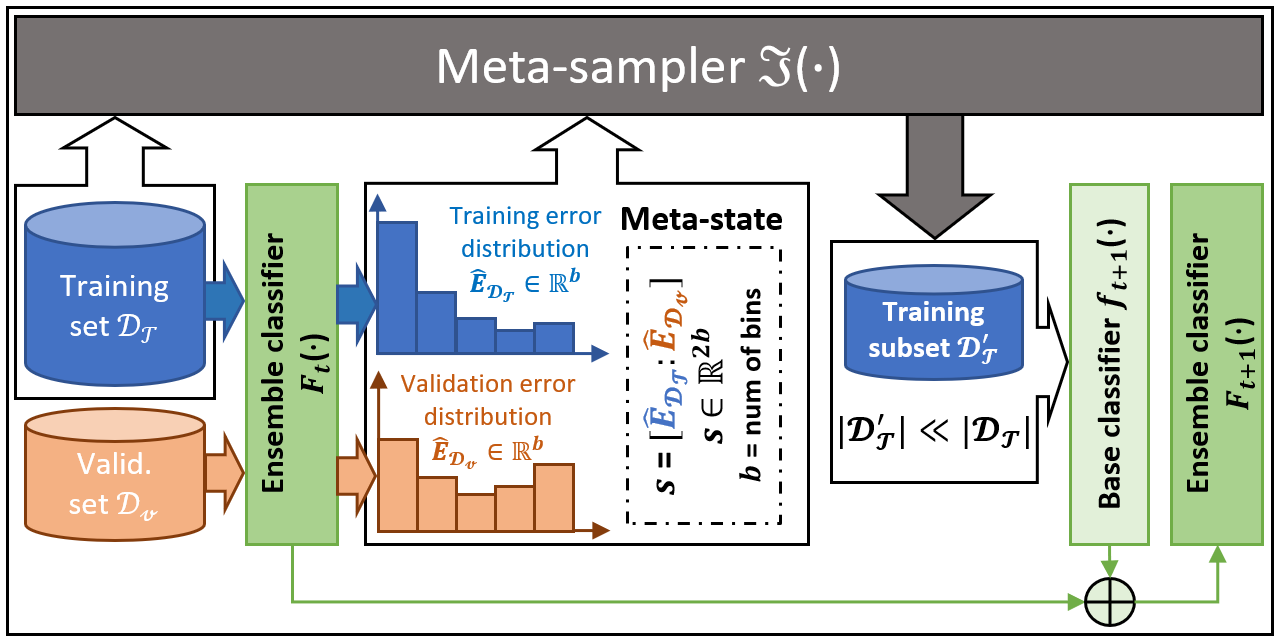
Meta-Sampler [NeurIPS]

GitHub stars
## Contributors ✨ Thanks goes to these wonderful people ([emoji key](https://allcontributors.org/docs/en/emoji-key)):

Zhining Liu

💻 📖 💡

Yuming Fu

💻 🐛

Thúlio Costa

💻 🐛

Neko Null

🚧

lirenjieArthur

🐛

AC手动机

🐛

Carlo Moro

🤔
This project follows the [all-contributors](https://github.com/all-contributors/all-contributors) specification. Contributions of any kind welcome!