# jmeter
**Repository Path**: XiaoYuan_3/jmeter
## Basic Information
- **Project Name**: jmeter
- **Description**: Apache JMeter
- **Primary Language**: Unknown
- **License**: Apache-2.0
- **Default Branch**: master
- **Homepage**: None
- **GVP Project**: No
## Statistics
- **Stars**: 0
- **Forks**: 0
- **Created**: 2020-06-28
- **Last Updated**: 2020-12-19
## Categories & Tags
**Categories**: Uncategorized
**Tags**: None
## README

Open Source application designed to load test applications and measure performance. By The Apache Software Foundation
[](https://travis-ci.org/apache/jmeter/)
[](https://codecov.io/gh/apache/jmeter)
[](http://www.apache.org/licenses/LICENSE-2.0.html)
[](https://stackoverflow.com/questions/tagged/jmeter)
[](https://maven-badges.herokuapp.com/maven-central/org.apache.jmeter/ApacheJMeter)
[](https://www.javadoc.io/doc/org.apache.jmeter/ApacheJMeter_core)
[](https://twitter.com/intent/tweet?text=Powerful%20load%20testing%20with%20Apache%20JMeter:&url=https://jmeter.apache.org)
## What is it
Apache JMeter may be used to test performance both on static and dynamic resources, Web dynamic applications.
It can be used to simulate a heavy load on a server, group of servers, network or object to test its strength or to analyze overall performance under different load types.
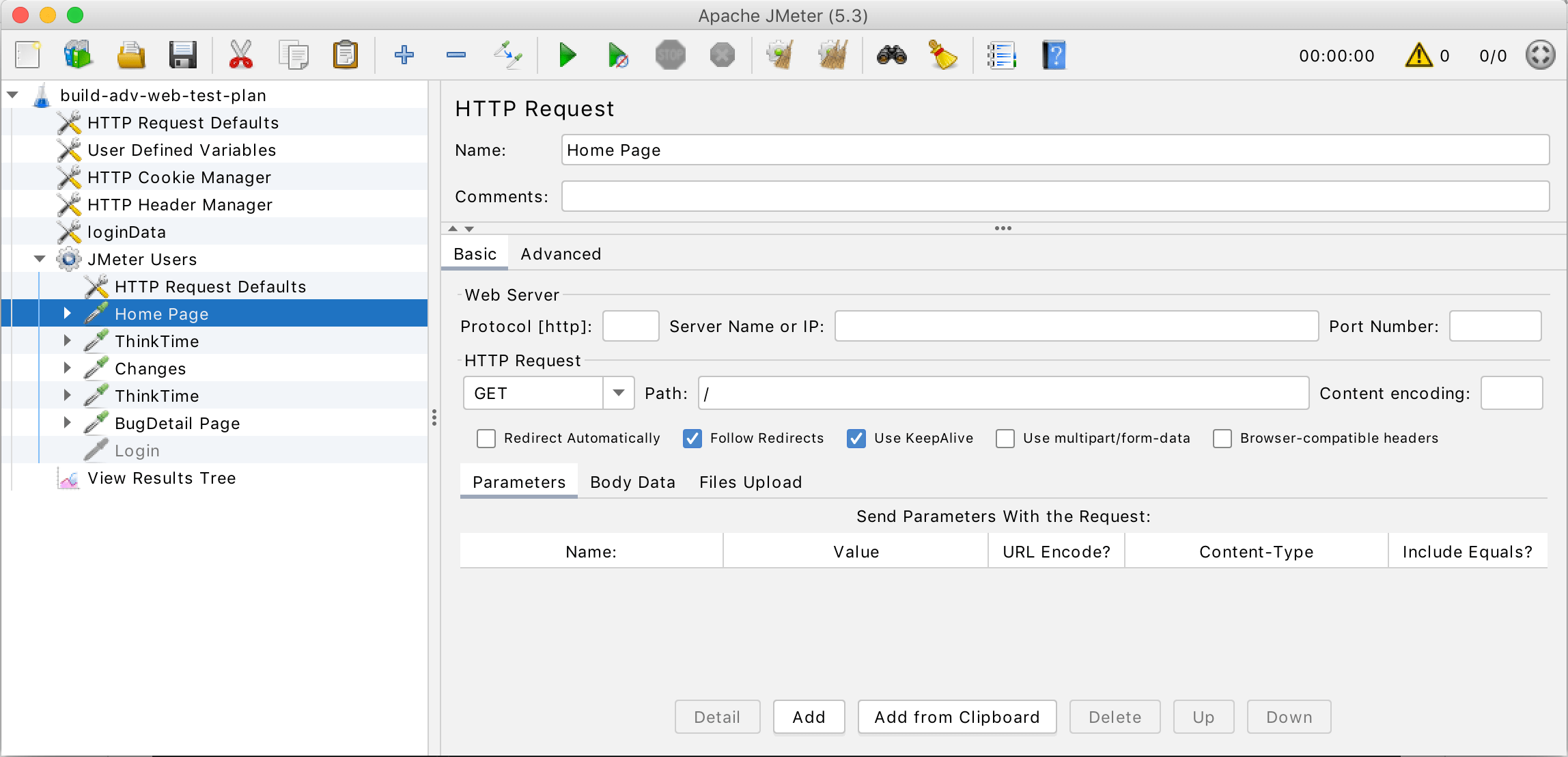 Apache JMeter features include:
Ability to load and performance test many different applications/server/protocol types:
- Web - HTTP, HTTPS (Java, NodeJS, PHP, ASP.NET,...)
- SOAP / REST Webservices
- FTP
- Database via JDBC
- LDAP
- Message-oriented Middleware (MOM) via JMS
- Mail - SMTP(S), POP3(S) and IMAP(S)
- Native commands or shell scripts
- TCP
- Java Objects
Full featured Test IDE that allows fast Test Plan **recording (from Browsers or native applications), building and debugging.**
[**Command-line mode (Non GUI / headless mode)**](http://jmeter.apache.org/usermanual/get-started.html#non_gui) to load test from any Java compatible OS (Linux, Windows, Mac OSX, ...)
A complete and [**ready to present dynamic HTML report**](http://jmeter.apache.org/usermanual/generating-dashboard.html)
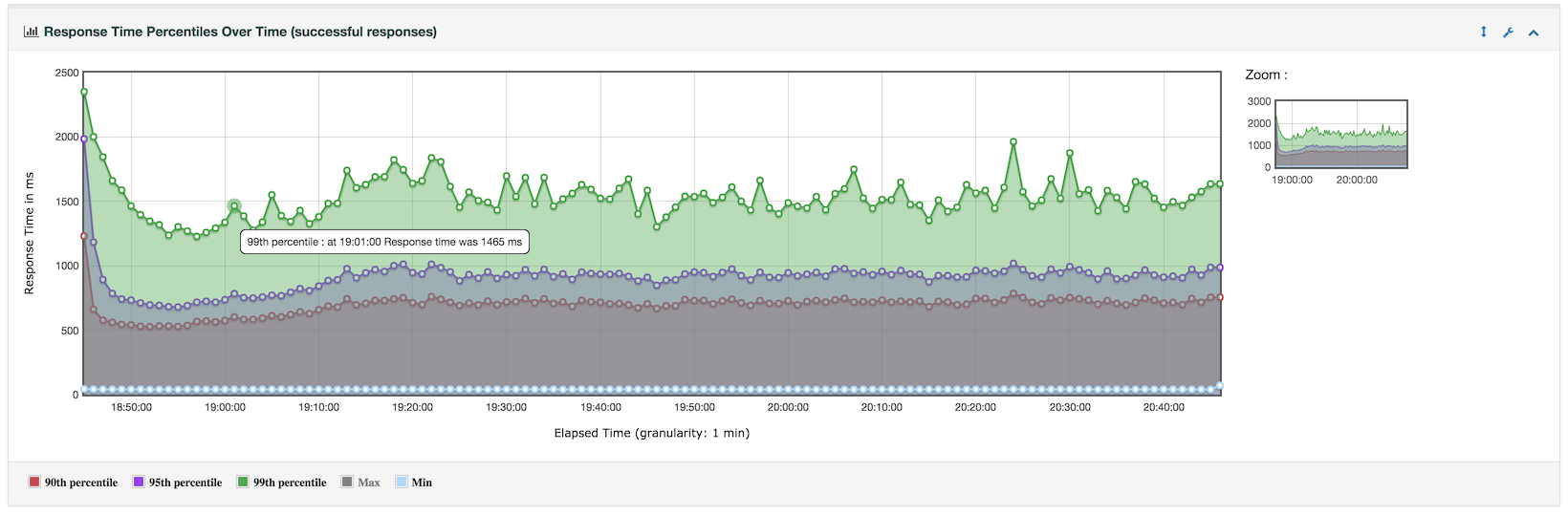
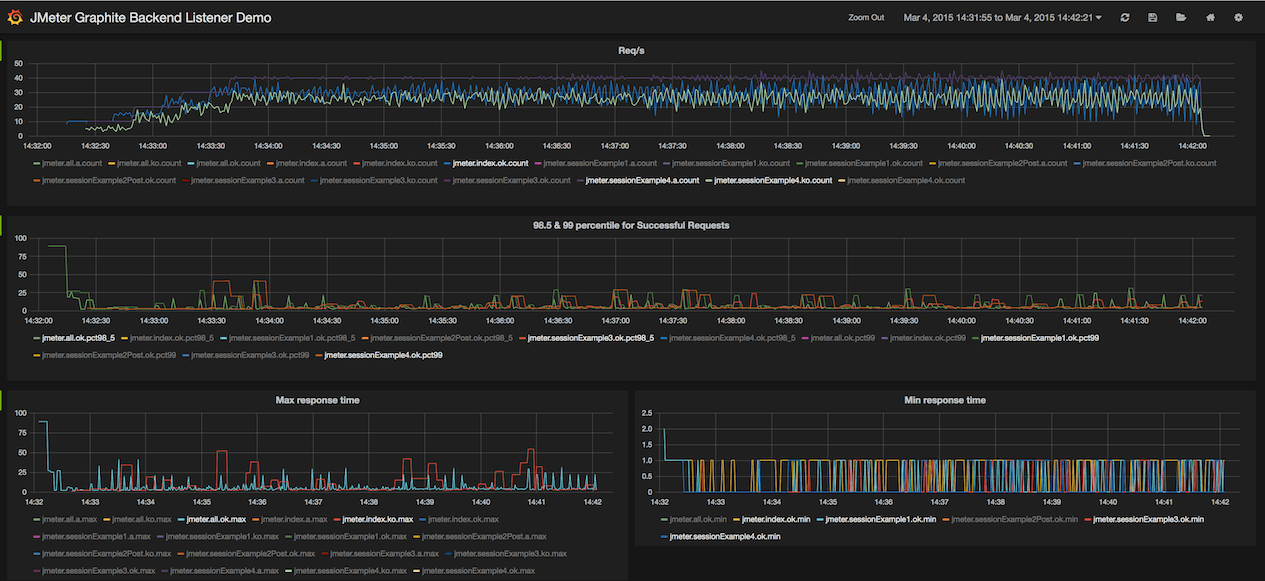
[**Live reporting**](http://jmeter.apache.org/usermanual/realtime-results.html) into 3rd party databases like InfluxDB or Graphite
Easy correlation through ability to extract data from most popular response formats, [**HTML**](http://jmeter.apache.org/usermanual/component_reference.html#CSS/JQuery_Extractor), [**JSON**](http://jmeter.apache.org/usermanual/component_reference.html#JSON_Extractor), [**XML**](http://jmeter.apache.org/usermanual/component_reference.html#XPath_Extractor) or [**any textual format**](http://jmeter.apache.org/usermanual/component_reference.html#Regular_Expression_Extractor)
Complete portability and 100% Java purity
Full multi-threading framework allows concurrent sampling by many threads
and simultaneous sampling of different functions by separate thread groups.
Caching and offline analysis/replaying of test results.
Highly Extensible core:
- Pluggable Samplers allow unlimited testing capabilities.
- **Scriptable Samplers** (JSR223-compatible languages like Groovy)
- Several load statistics may be chosen with **pluggable tiers**.
- Data analysis and **visualization plugins** allow great exensibility and personalization.
- Functions can be used to provide dynamic input to a test orprovide data manipulation.
- Easy Continuous Integration through 3rd party Open Source libraries for Maven, Gradle and Jenkins
## The Latest Version
Details of the latest version can be found on the [JMeter Apache
Project web site](https://jmeter.apache.org/)
## Requirements
The following requirements exist for running Apache JMeter:
- Java Interpreter:
A fully compliant Java 8 Runtime Environment is required
for Apache JMeter to execute. A JDK with `keytool` utility is better suited
for Recording HTTPS websites.
- Optional jars:
Some jars are not included with JMeter.
If required, these should be downloaded and placed in the lib directory
- JDBC - available from the database supplier
- JMS - available from the JMS provider
- [Bouncy Castle](http://www.bouncycastle.org/test_releases.html) -
only needed for SMIME Assertion
- Java Compiler (*OPTIONAL*):
A Java compiler is not needed since the distribution cludes a
precompiled Java binary archive.
> **Note** that a compiler is required to build plugins for Apache JMeter.
## Installation Instructions
> **Note** that spaces in directory names can cause problems.
- Release builds
Unpack the binary archive into a suitable directory structure.
## Running JMeter
1. Change to the `bin` directory
2. Run the `jmeter` (Un\*x) or `jmeter.bat` (Windows) file.
### Windows
For Windows there are also some other scripts which you can drag-and-drop
a JMX file onto:
- `jmeter-n.cmd` - runs the file as a non-GUI test
- `jmeter-n-r.cmd` - runs the file as a non-GUI remote (client-server) test
- `jmeter-t.cmd` - loads the file ready to run it as a GUI test
## Documentation
The documentation available as of the date of this release is
also included, in HTML format, in the [printable_docs](printable_docs) directory,
and it may be browsed starting from the file called [index.html](printable_docs/index.html).
## Reporting a bug/enhancement
See [Issue Tracking](https://jmeter.apache.org/issues.html)
## Build instructions
### Release builds
Unpack the source archive into a suitable directory structure.
Most of the 3rd party library files can be extracted from the binary archive
by unpacking it into the same directory structure.
Any optional jars (see above) should be placed in `lib/opt` and/or `lib`.
Jars in `lib/opt` will be used for building JMeter and running the unit tests,
but won't be used at run-time.
_This is useful for testing what happens if the optional jars are not
downloaded by other JMeter users._
If you are behind a proxy, you can set a few build properties in `~/.gradle/gradle.properties` for gradle to use the proxy:
```properties
systemProp.http.proxyHost=proxy.example.invalid
systemProp.http.proxyPort=8080
systemProp.http.proxyUser=your_user_name
systemProp.http.proxyPassword=your_password
systemProp.https.proxyHost=proxy.example.invalid
systemProp.https.proxyPort=8080
systemProp.https.proxyUser=your_user_name
systemProp.https.proxyPassword=your_password
```
### Test builds
JMeter is built using Gradle.
The following command would build and test JMeter:
```sh
./gradlew build [-Djava.awt.headless=true]
```
The optional property definition is required if the system
does not have a suitable GUI display.
The output artifacts (jars, reports) are placed to `build` folders.
For instance, binary artifacts can be found under `src/dist/build/distributions`.
The following command would compile the application and enable you to run `jmeter` from the `bin`
directory. Note: it completely refreshes `lib/` contents, so it would remove clustom plugins
should you have them installed.
```sh
./gradlew createDist
```
Alternatively you could start GUI via
```sh
./gradlew runGui
```
## Developer information
Building and contributing is explained in details at [building JMeter](https://jmeter.apache.org/building.html)
and [CONTRIBUTING.md](CONTRIBUTING.md). More information on the tasks available for
building JMeter with Gradle is available in [gradle.md](gradle.md).
The code is maintained at GitHub:
-
-
## Licensing and legal information
For legal and licensing information, please see the following files:
- [LICENSE](LICENSE)
- [NOTICE](NOTICE)
## Cryptographic Software Notice
This distribution may include software that has been designed for use
with cryptographic software. The country in which you currently reside
may have restrictions on the import, possession, use, and/or re-export
to another country, of encryption software. BEFORE using any encryption
software, please check your country's laws, regulations and policies
concerning the import, possession, or use, and re-export of encryption
software, to see if this is permitted. See
for more information.
The U.S. Government Department of Commerce, Bureau of Industry and
Security (BIS), has classified this software as Export Commodity
Control Number (ECCN) 5D002.C.1, which includes information security
software using or performing cryptographic functions with asymmetric
algorithms. The form and manner of this Apache Software Foundation
distribution makes it eligible for export under the License Exception
ENC Technology Software Unrestricted (TSU) exception (see the BIS
Export Administration Regulations, Section 740.13) for both object
code and source code.
The following provides more details on the included software that
may be subject to export controls on cryptographic software:
Apache JMeter interfaces with the
Java Secure Socket Extension (JSSE) API to provide
- HTTPS support
Apache JMeter interfaces (via Apache HttpClient4) with the
Java Cryptography Extension (JCE) API to provide
- NTLM authentication
Apache JMeter does not include any implementation of JSSE or JCE.
**Thank you for using Apache JMeter.**
Apache JMeter features include:
Ability to load and performance test many different applications/server/protocol types:
- Web - HTTP, HTTPS (Java, NodeJS, PHP, ASP.NET,...)
- SOAP / REST Webservices
- FTP
- Database via JDBC
- LDAP
- Message-oriented Middleware (MOM) via JMS
- Mail - SMTP(S), POP3(S) and IMAP(S)
- Native commands or shell scripts
- TCP
- Java Objects
Full featured Test IDE that allows fast Test Plan **recording (from Browsers or native applications), building and debugging.**
[**Command-line mode (Non GUI / headless mode)**](http://jmeter.apache.org/usermanual/get-started.html#non_gui) to load test from any Java compatible OS (Linux, Windows, Mac OSX, ...)
A complete and [**ready to present dynamic HTML report**](http://jmeter.apache.org/usermanual/generating-dashboard.html)

[**Live reporting**](http://jmeter.apache.org/usermanual/realtime-results.html) into 3rd party databases like InfluxDB or Graphite

Easy correlation through ability to extract data from most popular response formats, [**HTML**](http://jmeter.apache.org/usermanual/component_reference.html#CSS/JQuery_Extractor), [**JSON**](http://jmeter.apache.org/usermanual/component_reference.html#JSON_Extractor), [**XML**](http://jmeter.apache.org/usermanual/component_reference.html#XPath_Extractor) or [**any textual format**](http://jmeter.apache.org/usermanual/component_reference.html#Regular_Expression_Extractor)
Complete portability and 100% Java purity
Full multi-threading framework allows concurrent sampling by many threads
and simultaneous sampling of different functions by separate thread groups.
Caching and offline analysis/replaying of test results.
Highly Extensible core:
- Pluggable Samplers allow unlimited testing capabilities.
- **Scriptable Samplers** (JSR223-compatible languages like Groovy)
- Several load statistics may be chosen with **pluggable tiers**.
- Data analysis and **visualization plugins** allow great exensibility and personalization.
- Functions can be used to provide dynamic input to a test orprovide data manipulation.
- Easy Continuous Integration through 3rd party Open Source libraries for Maven, Gradle and Jenkins
## The Latest Version
Details of the latest version can be found on the [JMeter Apache
Project web site](https://jmeter.apache.org/)
## Requirements
The following requirements exist for running Apache JMeter:
- Java Interpreter:
A fully compliant Java 8 Runtime Environment is required
for Apache JMeter to execute. A JDK with `keytool` utility is better suited
for Recording HTTPS websites.
- Optional jars:
Some jars are not included with JMeter.
If required, these should be downloaded and placed in the lib directory
- JDBC - available from the database supplier
- JMS - available from the JMS provider
- [Bouncy Castle](http://www.bouncycastle.org/test_releases.html) -
only needed for SMIME Assertion
- Java Compiler (*OPTIONAL*):
A Java compiler is not needed since the distribution cludes a
precompiled Java binary archive.
> **Note** that a compiler is required to build plugins for Apache JMeter.
## Installation Instructions
> **Note** that spaces in directory names can cause problems.
- Release builds
Unpack the binary archive into a suitable directory structure.
## Running JMeter
1. Change to the `bin` directory
2. Run the `jmeter` (Un\*x) or `jmeter.bat` (Windows) file.
### Windows
For Windows there are also some other scripts which you can drag-and-drop
a JMX file onto:
- `jmeter-n.cmd` - runs the file as a non-GUI test
- `jmeter-n-r.cmd` - runs the file as a non-GUI remote (client-server) test
- `jmeter-t.cmd` - loads the file ready to run it as a GUI test
## Documentation
The documentation available as of the date of this release is
also included, in HTML format, in the [printable_docs](printable_docs) directory,
and it may be browsed starting from the file called [index.html](printable_docs/index.html).
## Reporting a bug/enhancement
See [Issue Tracking](https://jmeter.apache.org/issues.html)
## Build instructions
### Release builds
Unpack the source archive into a suitable directory structure.
Most of the 3rd party library files can be extracted from the binary archive
by unpacking it into the same directory structure.
Any optional jars (see above) should be placed in `lib/opt` and/or `lib`.
Jars in `lib/opt` will be used for building JMeter and running the unit tests,
but won't be used at run-time.
_This is useful for testing what happens if the optional jars are not
downloaded by other JMeter users._
If you are behind a proxy, you can set a few build properties in `~/.gradle/gradle.properties` for gradle to use the proxy:
```properties
systemProp.http.proxyHost=proxy.example.invalid
systemProp.http.proxyPort=8080
systemProp.http.proxyUser=your_user_name
systemProp.http.proxyPassword=your_password
systemProp.https.proxyHost=proxy.example.invalid
systemProp.https.proxyPort=8080
systemProp.https.proxyUser=your_user_name
systemProp.https.proxyPassword=your_password
```
### Test builds
JMeter is built using Gradle.
The following command would build and test JMeter:
```sh
./gradlew build [-Djava.awt.headless=true]
```
The optional property definition is required if the system
does not have a suitable GUI display.
The output artifacts (jars, reports) are placed to `build` folders.
For instance, binary artifacts can be found under `src/dist/build/distributions`.
The following command would compile the application and enable you to run `jmeter` from the `bin`
directory. Note: it completely refreshes `lib/` contents, so it would remove clustom plugins
should you have them installed.
```sh
./gradlew createDist
```
Alternatively you could start GUI via
```sh
./gradlew runGui
```
## Developer information
Building and contributing is explained in details at [building JMeter](https://jmeter.apache.org/building.html)
and [CONTRIBUTING.md](CONTRIBUTING.md). More information on the tasks available for
building JMeter with Gradle is available in [gradle.md](gradle.md).
The code is maintained at GitHub:
-
-
## Licensing and legal information
For legal and licensing information, please see the following files:
- [LICENSE](LICENSE)
- [NOTICE](NOTICE)
## Cryptographic Software Notice
This distribution may include software that has been designed for use
with cryptographic software. The country in which you currently reside
may have restrictions on the import, possession, use, and/or re-export
to another country, of encryption software. BEFORE using any encryption
software, please check your country's laws, regulations and policies
concerning the import, possession, or use, and re-export of encryption
software, to see if this is permitted. See
for more information.
The U.S. Government Department of Commerce, Bureau of Industry and
Security (BIS), has classified this software as Export Commodity
Control Number (ECCN) 5D002.C.1, which includes information security
software using or performing cryptographic functions with asymmetric
algorithms. The form and manner of this Apache Software Foundation
distribution makes it eligible for export under the License Exception
ENC Technology Software Unrestricted (TSU) exception (see the BIS
Export Administration Regulations, Section 740.13) for both object
code and source code.
The following provides more details on the included software that
may be subject to export controls on cryptographic software:
Apache JMeter interfaces with the
Java Secure Socket Extension (JSSE) API to provide
- HTTPS support
Apache JMeter interfaces (via Apache HttpClient4) with the
Java Cryptography Extension (JCE) API to provide
- NTLM authentication
Apache JMeter does not include any implementation of JSSE or JCE.
**Thank you for using Apache JMeter.**