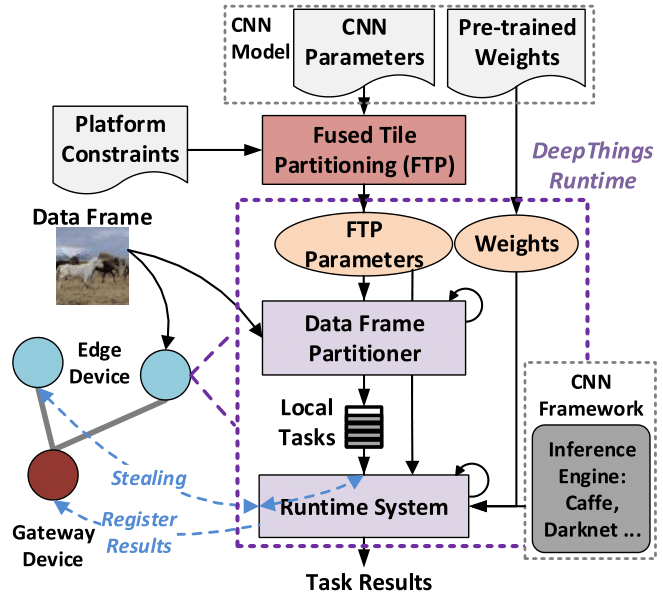
# DeepThings **Repository Path**: alian1006/DeepThings ## Basic Information - **Project Name**: DeepThings - **Description**: No description available - **Primary Language**: Unknown - **License**: MIT - **Default Branch**: master - **Homepage**: None - **GVP Project**: No ## Statistics - **Stars**: 0 - **Forks**: 0 - **Created**: 2022-02-04 - **Last Updated**: 2022-02-04 ## Categories & Tags **Categories**: Uncategorized **Tags**: None ## README # DeepThings DeepThings is a framework for locally distributed and adaptive CNN inference in resource-constrained IoT edge clusters. DeepThings mainly consists of: - A Fused Tile Partitioning (FTP) method for dividing convolutional layers into independently distributable tasks. FTP fuses layers and partitions them vertically in a grid fashion, which largely reduces communication and task migration overhead. - A distributed work stealing runtime system for IoT clusters to adaptively distribute FTP partitions in dynamic application scenarios. For more details of DeepThings, please refer to [1].

Overview of the DeepThings framework.

This repository includes a lightweight, self-contained and portable C implementation of DeepThings. It uses a [NNPACK](https://github.com/digitalbrain79/NNPACK-darknet)-accelerated [Darknet](https://github.com/zoranzhao/darknet-nnpack) as the default inference engine. More information on porting DeepThings with different inference frameworks and platforms can be found below. ## Platforms The current implementation has been tested on [Raspberry Pi 3 Model B](https://www.raspberrypi.org/products/raspberry-pi-3-model-b/) running [Raspbian](https://www.raspberrypi.org/downloads/raspbian/). ## Building Edit the configuration file [include/configure.h](https://github.com/zoranzhao/DeepThings/blob/master/include/configure.h) according to your IoT cluster parameters, then run: ```bash make clean_all make ``` This will automatically compile all related libraries and generate the DeepThings executable. If you want to run DeepThings on Raspberry Pi with NNPACK acceleration, you need first follow install [NNPACK](https://github.com/zoranzhao/darknet-nnpack/blob/2f2da6bd46b9bbfcd283e0556072f18581392f08/README.md) before running the Makefile commands, and set the options in Makefile as below: ``` NNPACK=1 ARM_NEON=1 ``` ## Downloading pre-trained CNN models and input data In order to perform distributed inference, you need to download pre-trained CNN models and put it in [./models](https://github.com/zoranzhao/DeepThings/tree/master/models) folder. Current implementation is tested with YOLOv2, which can be downloaded from [YOLOv2 model](https://github.com/zoranzhao/DeepThings/blob/master/models/yolo.cfg) and [YOLOv2 weights](https://pjreddie.com/media/files/yolo.weights). If the link doesn't work, you can also find the weights [here](https://utexas.box.com/s/ax7f0j0qwnc4yb9ghjprjd93qwk3t4uw). For input data, images need to be numbered (starting from 0) and renamed as <#>.jpg, and placed in [./data/input](https://github.com/zoranzhao/DeepThings/tree/master/data/input) folder. ## Running in a IoT cluster An overview of DeepThings command line options is listed below: ```bash #./deepthings -mode # -total_edge # -edge_id # -n # -m # -l ``` For example, assuming you have a host machine H, gateway device G, and two edge devices E0 (data source) and E1 (idle), while you want to perform a 5x5 FTP with 16 fused layers, then you need to follow the steps below: In gateway device G: ```bash ./deepthings -mode gateway -total_edge 2 -n 5 -m 5 -l 16 ``` In edge device E0: ```bash ./deepthings -mode data_src -edge_id 0 -n 5 -m 5 -l 16 ``` In edge device E1: ```bash ./deepthings -mode non_data_src -edge_id 1 -n 5 -m 5 -l 16 ``` Now all the devices will wait for a trigger signal to start. You can simply do that in your host machine H: ```bash ./deepthings -mode start ``` ## Running in a single device Many people want to first try the FTP-partitioned inference in a single device. Now you can find a single-device execution example in [./examples](https://github.com/zoranzhao/DeepThings/tree/master/examples) folder. To run it: ```bash make clean_all make make test ``` This will first initialize a gateway context and a client context in different local threads. FTP partition inference results will be transferred between queues associated with each context to emulate the inter-device communication. ## Porting DeepThings One just needs to simply modify the corresponding abstraction layer files to port DeepThings. If you want to use a different CNN inference engine, modify: - [src/inference_engine_helper.c](https://github.com/zoranzhao/DeepThings/blob/master/src/inference_engine_helper.c) - [src/inference_engine_helper.h](https://github.com/zoranzhao/DeepThings/blob/master/src/inference_engine_helper.h) If you want to port DeepThings onto a different OS (Currently using UNIX pthread), modify: - [distriot/src/thread_util.c](https://github.com/zoranzhao/DeepThings/blob/master/distriot/src/thread_util.c) - [distriot/src/thread_util.h](https://github.com/zoranzhao/DeepThings/blob/master/distriot/src/thread_util.h) If you want to use DeepThings with different networking APIs (Currently using UNIX socket), modify: - [distriot/src/network_util.c](https://github.com/zoranzhao/DeepThings/blob/master/distriot/src/network_util.c) - [distriot/src/network_util.h](https://github.com/zoranzhao/DeepThings/blob/master/distriot/src/network_util.h) ## References: [1] Z. Zhao, K. Mirzazad and A. Gerstlauer, "[DeepThings: Distributed Adaptive Deep Learning Inference on Resource-Constrained IoT Edge Clusters](https://zoranzhao.github.io/docs/deepthings_2018.pdf)," CODES+ISSS 2018, special issue of IEEE Transactions on Computer-Aided Design of Integrated Circuits and Systems (TCAD). ## Contact: Zhuoran Zhao,