# PCF8591_micropython_library
**Repository Path**: brainliang/PCF8591_micropython_library
## Basic Information
- **Project Name**: PCF8591_micropython_library
- **Description**: No description available
- **Primary Language**: Unknown
- **License**: Not specified
- **Default Branch**: master
- **Homepage**: None
- **GVP Project**: No
## Statistics
- **Stars**: 0
- **Forks**: 0
- **Created**: 2023-11-21
- **Last Updated**: 2024-10-23
## Categories & Tags
**Categories**: Uncategorized
**Tags**: None
## README
#
#### www.mischianti.org
### MicroPython Library to use i2c analog IC with arduino and esp8266. Can read analog value and write analog value with only 2 wire (perfect for ESP-01).
#### Changelog
- 07/11/2023: v0.0.3 Fix on read when write is active and running [#Forum](https://mischianti.org/forums/topic/micropython-i2c-pcf8591-round-value-problem-raspberry-pi-pico/#post-28043)
- 16/05/2023: v0.0.2 Minor fix on read and write [#Forum](https://www.mischianti.org/forums/topic/micropython-i2c-pcf8591-round-value-problem-raspberry-pi-pico/)
- 18/04/2023: v0.0.1 Initial commit of stable version.
I try to simplify the use of this IC, with a minimal set of operation.
#### Installation
To install the library execute the following command:
```bash
pip install pcf8591-library
```
**Constructor:**
Pass the address of I2C
```python
from PCF8591 import PCF8591
from machine import I2C, Pin
# Initialize the I2C bus
i2c = I2C(0, scl=Pin(22), sda=Pin(21))
# Initialize the PCF8591
pcf8591 = PCF8591(0x48, i2c)
if pcf8591.begin():
print("PCF8591 found")
```
or
```python
from PCF8591 import PCF8591
pcf8591 = PCF8591(0x48, sda=21, scl=22)
if pcf8591.begin():
print("PCF8591 found")
```
To read all analog input in one
```python
# Main loop
while True:
# Read all analog input channels
ain0, ain1, ain2, ain3 = pcf8591.analog_read_all()
# Print the results
print("AIN0:", ain0, "AIN1:", ain1, "AIN2:", ain2, "AIN3:", ain3)
# Wait for 1 second
utime.sleep(1)
```
If you want to read a single input:
```python
print("AIN0 ", pcf8591.analog_read(PCF8591.AIN0))
print("AIN1 ", pcf8591.analog_read(PCF8591.AIN1))
print("AIN2 ", pcf8591.analog_read(PCF8591.AIN2))
print("AIN3 ", pcf8591.analog_read(PCF8591.AIN3))
```
If you want to write a value:
```python
pcf8591.analog_write(255)
utime.sleep(1)
pcf8591.analog_write(128)
utime.sleep(1)
pcf8591.analog_write(0)
```
You can also read and write voltage
```python
pcf8591.voltage_write(3.3)
utime.sleep(1)
pcf8591.voltage_write(1.65)
utime.sleep(1)
pcf8591.voltage_write(0)
```
or
```python
print("AIN0 ", pcf8591.voltage_read(PCF8591.AIN0))
print("AIN1 ", pcf8591.voltage_read(PCF8591.AIN1))
print("AIN2 ", pcf8591.voltage_read(PCF8591.AIN2))
print("AIN3 ", pcf8591.voltage_read(PCF8591.AIN3))
```
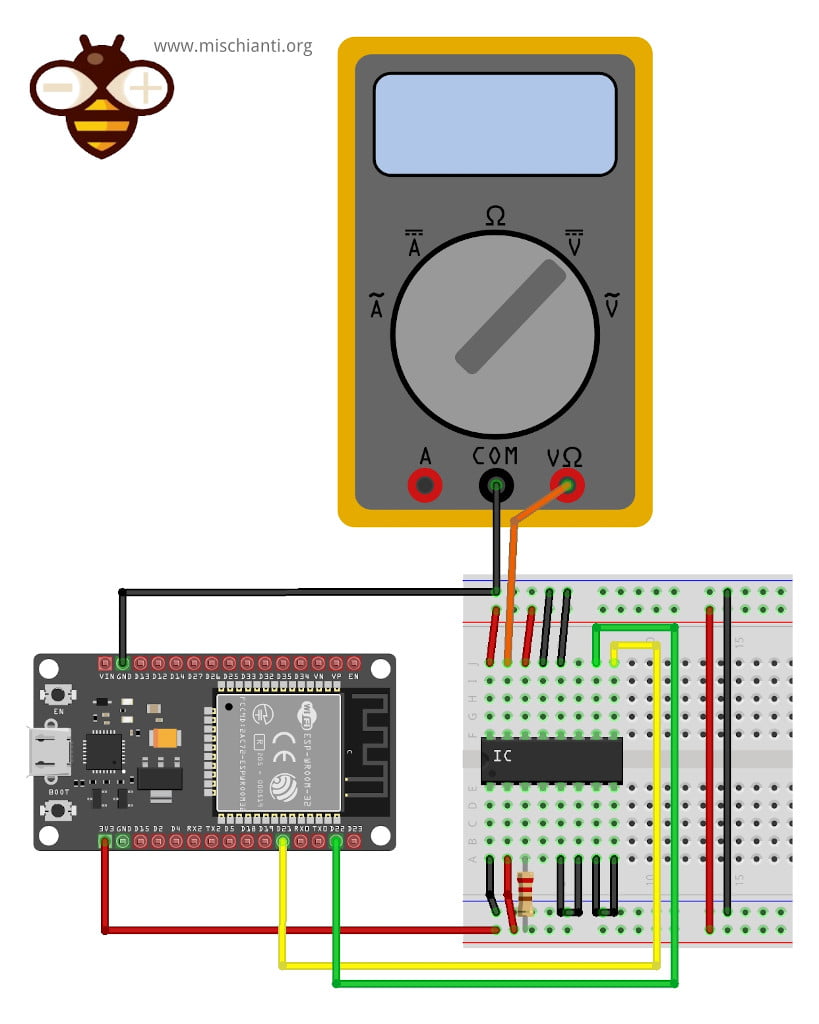
For the examples I use this wire schema on breadboard: