# Dagster
**Repository Path**: cctvbtx/dagster
## Basic Information
- **Project Name**: Dagster
- **Description**: Dagster 是一个业务流程协调程序,旨在开发和维护数据资产,例如表、数据集、机器学习模型和报表。
声明要运行的函数以及这些函数生成或更新的数据资产。然后,Dagster 可帮助您在正确的时间运行函数,并使资产保持最新状态。
Dagster 旨在用于数据开发生命周期的每个阶段 - 本地开发、单元测试、集成测试、暂存环境,一直到生产。
- **Primary Language**: Unknown
- **License**: Apache-2.0
- **Default Branch**: master
- **Homepage**: https://dagster.io/
- **GVP Project**: No
## Statistics
- **Stars**: 0
- **Forks**: 1
- **Created**: 2024-12-25
- **Last Updated**: 2024-12-25
## Categories & Tags
**Categories**: Uncategorized
**Tags**: None
## README
**Dagster is a cloud-native data pipeline orchestrator for the whole development lifecycle, with integrated lineage and observability, a declarative programming model, and best-in-class testability.**
It is designed for **developing and maintaining data assets**, such as tables, data sets, machine learning models, and reports.
With Dagster, you declare—as Python functions—the data assets that you want to build. Dagster then helps you run your functions at the right time and keep your assets up-to-date.
Here is an example of a graph of three assets defined in Python:
```python
from dagster import asset
from pandas import DataFrame, read_html, get_dummies
from sklearn.linear_model import LinearRegression
@asset
def country_populations() -> DataFrame:
df = read_html("https://tinyurl.com/mry64ebh")[0]
df.columns = ["country", "continent", "rg", "pop2018", "pop2019", "change"]
df["change"] = df["change"].str.rstrip("%").str.replace("−", "-").astype("float")
return df
@asset
def continent_change_model(country_populations: DataFrame) -> LinearRegression:
data = country_populations.dropna(subset=["change"])
return LinearRegression().fit(get_dummies(data[["continent"]]), data["change"])
@asset
def continent_stats(country_populations: DataFrame, continent_change_model: LinearRegression) -> DataFrame:
result = country_populations.groupby("continent").sum()
result["pop_change_factor"] = continent_change_model.coef_
return result
```
The graph loaded into Dagster's web UI:

Dagster is built to be used at every stage of the data development lifecycle - local development, unit tests, integration tests, staging environments, all the way up to production.
## Quick Start:
If you're new to Dagster, we recommend reading about its [core concepts](https://docs.dagster.io/concepts) or learning with the hands-on [tutorial](https://docs.dagster.io/tutorial).
Dagster is available on PyPI and officially supports Python 3.8, Python 3.9, Python 3.10, and Python 3.11.
```bash
pip install dagster dagster-webserver
```
This installs two packages:
- `dagster`: The core programming model.
- `dagster-webserver`: The server that hosts Dagster's web UI for developing and operating Dagster jobs and assets.
Running on Using a Mac with an M1 or M2 chip? Check the [install details here](https://docs.dagster.io/getting-started/install#installing-dagster-into-an-existing-python-environment).
## Documentation
You can find the full Dagster documentation [here](https://docs.dagster.io), including the ['getting started' guide](https://docs.dagster.io/getting-started).
## Key Features:
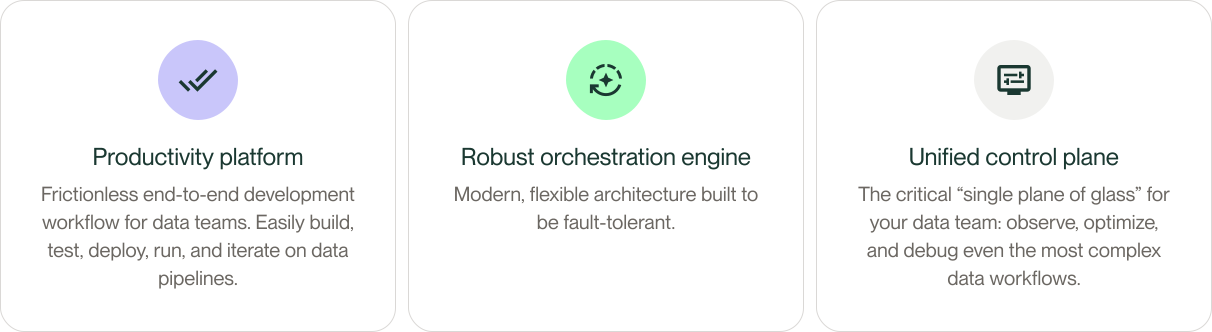
### Dagster as a productivity platform
Identify the key assets you need to create using a declarative approach, or you can focus on running basic tasks. Embrace CI/CD best practices from the get-go: build reusable components, spot data quality issues, and flag bugs early.
### Dagster as a robust orchestration engine
Put your pipelines into production with a robust multi-tenant, multi-tool engine that scales technically and organizationally.
### Dagster as a unified control plane
Maintain control over your data as the complexity scales. Centralize your metadata in one tool with built-in observability, diagnostics, cataloging, and lineage. Spot any issues and identify performance improvement opportunities.
## Master the Modern Data Stack with integrations
Dagster provides a growing library of integrations for today’s most popular data tools. Integrate with the tools you already use, and deploy to your infrastructure.

## Community
Connect with thousands of other data practitioners building with Dagster. Share knowledge, get help,
and contribute to the open-source project. To see featured material and upcoming events, check out
our [Dagster Community](https://dagster.io/community) page.
Join our community here:
- 🌟 [Star us on GitHub](https://github.com/dagster-io/dagster)
- 📥 [Subscribe to our Newsletter](https://dagster.io/newsletter-signup)
- 🐦 [Follow us on Twitter](https://twitter.com/dagster)
- 🕴️ [Follow us on LinkedIn](https://linkedin.com/showcase/dagster)
- 📺 [Subscribe to our YouTube channel](https://www.youtube.com/@dagsterio)
- 📚 [Read our blog posts](https://dagster.io/blog)
- 👋 [Join us on Slack](https://dagster.io/slack)
- 🗃 [Browse Slack archives](https://discuss.dagster.io)
- ✏️ [Start a GitHub Discussion](https://github.com/dagster-io/dagster/discussions)
## Contributing
For details on contributing or running the project for development, check out our [contributing
guide](https://docs.dagster.io/community/contributing/).
## License
Dagster is [Apache 2.0 licensed](https://github.com/dagster-io/dagster/blob/master/LICENSE).