# waveshare-watch-rs
**Repository Path**: genvex/waveshare-watch-rs
## Basic Information
- **Project Name**: waveshare-watch-rs
- **Description**: No description available
- **Primary Language**: Unknown
- **License**: Apache-2.0
- **Default Branch**: main
- **Homepage**: None
- **GVP Project**: No
## Statistics
- **Stars**: 0
- **Forks**: 0
- **Created**: 2026-05-29
- **Last Updated**: 2026-05-29
## Categories & Tags
**Categories**: Uncategorized
**Tags**: None
## README
# waveshare-watch-rs
[](https://oosmetrics.com/repo/infinition/waveshare-watch-rs)
 100% Rust `no_std` smartwatch firmware for the **Waveshare ESP32-S3-Touch-AMOLED-2.06**.
Complete conversion of the original C/C++ project (ESP-IDF + Arduino GFX + LVGL) to a single-binary Rust codebase relying on `esp-hal` 1.0, `esp-rtos`, Embassy, and custom drivers for each of the board's peripherals.
The firmware handles the 410×502 QSPI display in 80 MHz DMA, the I2S audio codec, 2.4 GHz WiFi with NTP sync, SD card, capacitive touch, gyroscope, hardware RTC, AXP2101 power management, a launcher with 5 mini-games, a T9 keyboard, an MP3 player (UI), a Smart Home app (HTTP), a sleep/wake mode with an Apple Watch style Always-On Display, and an event-driven main loop based on GPIO interrupts to leave the CPU asleep >99% of the time on the watchface.
---
## Hardware target
| Component | Reference | Bus |
|------------------|--------------------------------------------------|----------------|
| SoC | ESP32-S3R8 (Xtensa LX7 dual-core, 8 MB PSRAM) | — |
| Display | CO5300 AMOLED 410×502, rounded edge | QSPI 80 MHz |
| PMIC | AXP2101 (charging, power rails) | I2C 400 kHz |
| Touch | FT3168 | I2C + INT GPIO |
| IMU | QMI8658 (accelerometer + gyroscope + temp) | I2C |
| RTC | PCF85063A | I2C |
| Audio codec | ES8311 + amp | I2C + I2S |
| Memory | 32 MB flash, 8 MB octal PSRAM | — |
| SD Card | SDHC SPI | SPI3 |
| WiFi + BLE | Integrated 2.4 GHz | — |
| Tearing Effect | GPIO13 | IRQ |
Waveshare Wiki reference: [https://www.waveshare.com/wiki/ESP32-S3-Touch-AMOLED-2.06](https://www.waveshare.com/wiki/ESP32-S3-Touch-AMOLED-2.06)
Full pinout in `src/board.rs`.
---
## Software stack
| Layer | Crate | Role |
|--------------|---------------------------------|--------------------------------------------------------|
| HAL | `esp-hal` 1.0 | Peripherals (GPIO, I2C, SPI, I2S, DMA, timers, PSRAM) |
| Runtime | `esp-rtos` 0.2 | Boot, executor, radio integration |
| Async | `embassy-executor` 0.9 | Cooperative scheduler, tasks, timers |
| | `embassy-time`, `embassy-futures` | `select`, `Timer::after`, `Duration` |
| | `embassy-net` 0.9 | smoltcp TCP/IP stack (DHCPv4, TCP, UDP, DNS) |
| Radio | `esp-radio` 0.17 | WiFi driver + Embassy interface |
| Graphics | `embedded-graphics` 0.8 | 2D primitives, fonts, text layout |
| Storage | `embedded-sdmmc` 0.8 | FAT32 on SD card |
| Codec | `nanomp3` 0.1 | `no_std` MP3 decoder (prepared, not wired) |
| Allocator | `esp-alloc` | 64 KB SRAM heap + 8 MB PSRAM heap |
| Panic | `esp-backtrace` | Symbolic backtrace via `esp-println` |
Zero C code, zero ESP-IDF components compiled into the final target. The bootloader is `esp-bootloader-esp-idf` on the loader side only.
---
## Architecture
```
main.rs
│
├── esp_hal::init(CpuClock::_160MHz)
├── PSRAM allocator init
├── esp_rtos::start(timer) ← Embassy executor
│
├── [Peripherals init] ──── drivers/ + peripherals/
│ ├── Shared I2C bus (RefCell + RefCellDevice)
│ ├── AXP2101 power rails + battery monitor
│ ├── QSPI SPI2 80 MHz DMA 8 KB → Co5300Display
│ ├── PSRAM Framebuffer double buffer (2 × 402 KB)
│ ├── FT3168 touch + GPIO38 INT
│ ├── PCF85063A RTC
│ ├── QMI8658 IMU (power_down by default)
│ ├── SD SPI3 4 MHz
│ ├── ES8311 codec + I2S0 DMA
│ └── WiFi esp-radio + embassy-net DHCPv4 + NTP sync
│
├── [Event-driven loop]
│ │
│ ├── select3(
│ │ Timer::after(adaptive_tick),
│ │ touch_int.wait_for_falling_edge(),
│ │ boot_button.wait_for_falling_edge(),
│ │ ).await
│ │
│ ├── Sensors I/O (gated by screen_state + business need)
│ ├── Touch poll I2C (only if finger is pressed or just lifted)
│ ├── State machine sleep/wake (4 levels + AOD)
│ ├── WiFi auto-disconnect idle >5min
│ └── App state machine
│ ├── Watchface (3 pages: Clock / Sensors / System)
│ ├── Launcher
│ ├── Snake, 2048, Tetris, Flappy, Maze
│ ├── MP3 Player (UI)
│ ├── Settings + T9 keyboard
│ └── SmartHome (buttons → HTTP)
```
---
## Module organization
```
src/
├── main.rs Hardware init + async main loop
├── board.rs Pinout + display dimensions
│
├── drivers/ Low-level drivers (direct hardware)
│ ├── qspi_bus.rs QSPI bus quad-mode half-duplex, begin/stream/end
│ ├── co5300.rs CO5300 init sequence, addr window, set_brightness,
│ │ display_on/off (MIPI DCS), TEARON
│ └── framebuffer.rs 410×502 RGB565 PSRAM FB, double buffer, flush_vsync
│
├── peripherals/ High-level I2C / SPI / I2S drivers
│ ├── power.rs AXP2101: battery %, voltage, is_charging, power rails
│ ├── touch.rs FT3168: read, tracking swipe/tap, SwipeDirection
│ ├── rtc.rs PCF85063A: get_time, set_time, DateTime
│ ├── imu.rs QMI8658: read_accel/gyro/temp, power_up/down
│ ├── audio.rs ES8311: Waveshare registers init, mute/unmute, beep
│ ├── sdcard.rs Stub wrapper around embedded-sdmmc
│ ├── wifi.rs WiFi types (scan stub)
│ └── http.rs HTTP GET/POST client via embassy-net TCP
│
├── ui/ UI components rendered on DrawTarget
│ ├── watchface.rs Clock + gyro ball + battery + FR date + AOD
│ ├── segments.rs 7-segment digits for time
│ ├── pages.rs Clock / Sensors / System pages
│ ├── launcher.rs App list, interpolated scroll
│ └── t9_keyboard.rs Alphanumeric T9 keyboard
│
└── apps/ Applications (implement the App trait)
├── snake.rs Snake with I2S beep on consume
├── game2048.rs 2048 swipe merge
├── tetris.rs Tetris gyro + touch
├── flappy.rs Flappy Bird (direct rendering + framebuffer)
├── maze.rs Maze with IMU ball
├── settings.rs WiFi SSID/password + T9
├── mp3player.rs MP3 player UI (decoding to be wired)
└── smarthome.rs Button grid → HTTP GET/POST
```
---
## Power management
The firmware is designed to leave the CPU parked most of the time.
The Embassy executor only wakes the core on:
- the GPIO38 touch interrupt (FT3168 in monitor mode)
- the GPIO0 button interrupt
- a periodic timer whose period depends on the current state
### Screen states (4 levels + AOD)
| State | Brightness | Idle trigger | Behavior |
|-------|------------|--------------|----------------------------------------------------------------------------------|
| 3 | 0xD0 | — | Normal interactive, full bright |
| 2 | 0x40 | 20 s | Dimming (transition), still interactive |
| 1 | 0x18 | 40 s | **AOD**: minimal HH:MM, pure black background (AMOLED pixels OFF), 1 update/min |
| 0 | DISPOFF | 10 min in AOD| SLPIN panel, QSPI idle, only GPIO IRQ for wake |
On wake via touch/button: immediate return to state 3, framebuffer forced into full redraw.
### Adaptive main loop ticks
| Context | Tick | Effective frequency |
|------------------------------------|----------|---------------------|
| Screen OFF (state 0) | 30 s | 0.033 Hz |
| AOD (state 1) | 10 s | 0.1 Hz |
| Watchface clock, gyro off | 1 s | 1 Hz |
| Watchface clock, gyro on | 33 ms | ~30 Hz |
| Sensors page | 100 ms | 10 Hz |
| System page | 2 s | 0.5 Hz |
| Launcher / Settings / MP3 / SmartHome | 100 ms| 10 Hz |
| Snake / 2048 / Tetris / Maze | 16 ms | ~60 Hz |
| Flappy | 8 ms | 125 Hz |
| Finger held on the screen | 16 ms | 60 Hz (override) |
### Extra optimizations
- **160 MHz CPU** by default (instead of 240 MHz), ~30% CPU power saving.
- **IMU power-down**: `CTRL7 = 0x00` at boot, power-up only when requested by a consumer.
- **Touch I2C** polled only when the finger is placed (GPIO38 LOW) or just lifted.
- **RTC** polled at 1 Hz (instead of 5 Hz before optimization).
- **Battery** polled at 1/60 Hz (1/300 Hz when the screen is off).
- **Conditional Watchface flush**: the PSRAM FB is flushed only if `needs_render()` signals an actual change.
- **WiFi auto-disconnect** after 5 mins of inactivity: `wifi_controller.disconnect_async()` — the 2.4 GHz radio is the biggest constant consumer. Automatic reconnect on next wake.
- **TE VSync spin** limited to 400 iterations (instead of 2000) to avoid wasting cycles when TE doesn't pulse.
- **Blocking delays** replaced by `Timer::after(...).await` so the CPU stays parked during button debounces.
- **Audio PA amp** (GPIO46) held LOW at boot, codec muted (DAC power-down + HP drive off) immediately after init. The amp is pulled HIGH only while writing the beep via DMA, then pulled back down.
- **AOD Anti burn-in**: the position of the HH:MM block in AOD is shifted by `(minutes % 9) - 4` pixels in X and Y, like Apple Watch.
### Transition order
```
touch/button interaction +0s state 3 (full)
└─ +20s idle ────────────────→ state 2 (dim)
└─ +40s idle ────────────────→ state 1 (AOD, if Clock page) or state 0 (otherwise)
└─ +300s idle ────────────────→ WiFi disconnect
└─ +600s idle ────────────────→ state 0 (full OFF)
touch or button GPIO IRQ → immediate state 3, WiFi reconnect follows
```
---
## Display pipeline
```
Embedded-graphics draw calls
│
▼
410×502 u16 RGB565 PSRAM Framebuffer (402 KB back buffer)
│
│ fb.flush() OR fb.flush_vsync(te_pin)
▼
Co5300Display::set_addr_window(...)
│
▼
QspiBus::write_pixels()
│
▼
esp-hal SPI2 half_duplex_write(
DataMode::Quad, ← 4-bit QSPI mode
Command::_8Bit(0x12), ← write memory
Address::_24Bit(0x003C00),
dummy = 0,
buffer, ← pixel data in quad mode
)
│
▼
DMA_CH0 → GPIO SIO0..SIO3 @ 80 MHz
```
- `swap_and_flush()`: double buffer, for games (Flappy) — zero tearing.
- `flush_vsync()`: single buffer, waits for a TE pulse (GPIO13) before sending pixels.
- `flush_region(x, y, w, h)`: partial update, used by watchface partial updates.
---
## Build setup
### Prerequisites
- **Xtensa ESP Rust toolchain** (installed via [espup](https://github.com/esp-rs/espup)):
```bash
cargo install espup
espup install
```
`rust-toolchain.toml` pins `channel = "esp"`.
- **MSVC linker** (Windows): needed for host build scripts. Install "Desktop development with C++" via Visual Studio Installer. The `link.exe` must be in the PATH when running cargo. On this project we typically have:
```bash
export PATH="/c/Program Files/Microsoft Visual Studio/18/Community/VC/Tools/MSVC/14.50.35717/bin/Hostx64/x64:$PATH"
```
- **espflash**:
```bash
cargo install espflash
```
### WiFi credentials
SSID and password are read at compile-time via `env!()`. They must be defined before building:
```bash
# Linux / macOS / Git Bash (Windows)
export WIFI_SSID="MyNetwork"
export WIFI_PASS="MyPassword"
```
```powershell
# PowerShell
$env:WIFI_SSID = "MyNetwork"
$env:WIFI_PASS = "MyPassword"
```
### Build
```bash
WIFI_SSID="MyNetwork" WIFI_PASS="MyPassword" cargo build --release
```
The final binary is around **579 KB** (full firmware with WiFi stack + games + UI).
### Flash + serial monitor
```bash
espflash flash --port COM7 --monitor target/xtensa-esp32s3-none-elf/release/waveshare-watch-rs
```
On Linux: `/dev/ttyACM0` or `/dev/ttyUSB0` depending on the USB bridge.
### Build config
- `opt-level = "s"` in dev AND release (size optimized).
- `lto = true` in release (global inlining, reduces size by ~20%).
- 64 KB SRAM heap (for the WiFi stack), 8 MB PSRAM heap (framebuffers + Vecs).
---
## Features
### Integrated and working
- 410×502 QSPI 80 MHz DMA double-buffer display
- PSRAM framebuffer + DMA flush
- Tearing Effect VSync anti-tearing
- FT3168 touch + iOS-like swipe detection + tap + diagonal rejection
- QMI8658 IMU accel + gyro + temperature with power management
- PCF85063A RTC + NTP sync via embassy-net UDP
- WiFi STA: DHCPv4, NTP, HTTP GET/POST, auto-disconnect idle
- ES8311 audio + I2S DMA (Snake beep)
- SD Card 4 GB detection (FAT32 /mp3 scan in place, stable mount if MBR is valid)
- Watchface 3 pages: Clock (7-segment time + battery + FR date + gyro ball), Sensors, System
- Launcher app list with smooth scroll
- Games: Snake, 2048, Tetris, Flappy Bird, Maze (gyro)
- Settings: WiFi SSID/password fields with T9 keyboard
- SmartHome: configurable 6-button HTTP grid
- MP3 Player: UI (play/pause, prev/next, progress bar)
- Screen sleep/wake 4 levels with minute-by-minute Always-On Display
- Boot button = launcher, swipe up = launcher
### Partially wired / stubbed
- **MP3 decoding**: `nanomp3` compiled and as a dependency, UI ready, SD → I2S stream to be wired.
- **BLE**: `esp-radio` compiled with stub feature, init disabled due to a panic `btdm_controller_init -4` in coex with WiFi (requires additional `coex` config).
- **WiFi scan list**: `ScanResult` types ready, Settings UI shows the field but without scan.
- **USB Mass Storage**: not wired (copy-from-PC would require `usb-device` + `usbd-storage`).
- **ESP deep sleep**: no `esp_hal::system::Sleep` — we stay in light sleep via the Embassy executor, sufficient for watch usage.
---
## Detailed custom drivers
### `drivers/qspi_bus.rs` — QspiBus
Half-duplex quad-SPI bus for the CO5300. API:
```rust
fn write_command(&mut self, cmd: u8)
fn write_c8d8(&mut self, cmd: u8, data: u8)
fn write_pixels(&mut self, pixels: &[u16])
fn begin_pixels(&mut self)
fn stream_pixels(&mut self, pixels: &[u16])
fn end_pixels(&mut self)
```
Uses esp-hal `Spi::half_duplex_write()` with `Command::_8Bit` + `Address::_24Bit`. `DataMode::Single` is used for commands, `DataMode::Quad` for pixels.
### `drivers/co5300.rs` — Co5300Display
Init sequence faithful to the C Arduino Waveshare driver `Arduino_CO5300.cpp`:
- Hardware reset (10ms low, 120ms high)
- SLPOUT (0x11) + delay 120 ms
- 0xFE 0x00 (vendor register access)
- 0xC4 0x80 (SPI mode control)
- 0x3A 0x55 (RGB565 pixel format)
- 0x53 0x20 (write CTRL display)
- 0x63 0xFF (HBM brightness)
- DISPON (0x29)
- 0x51 0xD0 (brightness)
- 0x35 0x00 (TEARON VBlank only)
Functions: `init`, `set_addr_window`, `set_brightness`, `display_on`, `display_off`, `bus_mut`.
### `peripherals/audio.rs` — Es8311
ES8311 init based on the Waveshare C driver. Critical registers missing in my first attempt:
- `0x00 = 0x1F` (reset) → `0x00 = 0x00` → **`0x00 = 0x80`** (power-on command, initially forgotten)
- Clock coefficients for 4.096 MHz MCLK @ 16 kHz sample rate
- `0x0D = 0x01`, `0x0E = 0x02` (power up analog)
- `0x12 = 0x00` (DAC power up), `0x13 = 0x10` (HP drive)
- `0x32 = 0xD9` (volume 85%)
API: `init`, `mute` (DAC power-down + HP off + vol 0), `unmute`, `set_volume`.
### `peripherals/power.rs` — Axp2101Power
Wrapper around `axp2101-embedded` for battery monitoring + power rails.
### `peripherals/touch.rs` — Ft3168Touch
**Monitor** mode (`REG_POWER_MODE = 0x01`): the chip asserts GPIO38 only on a touch event. Internal state machine to distinguish tap / swipe up/down/left/right with:
- minimum 30 px threshold to qualify a swipe
- 1.5× ratio on the dominant axis to reject diagonal swipes
- tracking start/end coordinates
### `peripherals/imu.rs` — Qmi8658Imu
Init accel ±2g @ 500 Hz, gyro ±512 dps @ 119 Hz, LPF enabled.
```rust
fn read_accel() -> AccelData // m.x, y, z in g
fn read_gyro() -> GyroData // °/s
fn read_temperature() -> f32 // °C
fn power_up() / power_down() // CTRL7 0x03 / 0x00
```
### `peripherals/rtc.rs` — Pcf85063aRtc
BCD read/write of registers 0x04..0x0A. Auto conversion to `DateTime { year, month, day, hours, minutes, seconds }`.
### `peripherals/http.rs` — http_get / http_post
Minimal HTTP client without external crate: parse URL, `TcpSocket::connect`, format request manually, custom `write_all` (handling partial writes), read until close, parse status code + body truncated to 128 bytes.
---
## Runtime data flow
### On boot
1. `esp_hal::init(CpuClock::_160MHz)`
2. `esp_alloc::psram_allocator!` — 8 MB PSRAM heap
3. `esp_rtos::start(timg0.timer0)` — Embassy executor
4. Sequential init of all I2C/SPI/I2S drivers
5. `wifi_controller.connect_async().await`
6. `embassy_net::Stack` + `StackResources<3>`, spawn `net_task` task
7. Wait for DHCP IP
8. `ntp_sync()` — UDP to 216.239.35.0:123, parse timestamp, `rtc.set_time()`
9. Initial watchface render
10. Enter main loop
### In the loop
```rust
loop {
// Choose tick based on state
let tick = match (screen_state, app_state, current_page, gyro_enabled) { ... };
// Sleep until next event
select3(
Timer::after(tick),
touch_int.wait_for_falling_edge(),
boot_button.wait_for_falling_edge(),
).await;
// Sensors throttled by need + screen_state
if need_imu { imu.read_accel(); ... }
if screen_state >= 2 && now >= next_rtc { rtc.get_time(); ... }
if now >= next_battery { power.get_battery_percent(); ... }
// Conditional touch poll (finger placed or just lifted)
if touch_active { touch.poll(); ... }
// Sleep/wake state machine → transitions 3→2→1→0
// WiFi auto-disconnect
// AOD render path (1x/min) → continue
// Screen OFF → continue
// App state machine → render + conditional flush
}
```
---
## Project metrics
| Metric | Value |
|------------------------|------------|
| Lines of Rust | 5 545 |
| Source files | 23 |
| Release binary | 579 KB |
| Dependency crates | ~35 |
| Lines of C/C++ | 0 |
| SRAM Heap | 64 KB |
| Allocated PSRAM | ~1.2 MB |
| Framebuffers | 2 x 402 KB |
| Handwritten drivers | 8 (QSPI, CO5300, AXP2101, FT3168, QMI8658, PCF85063A, ES8311, HTTP) |
---
## C++ vs Rust comparison
| Aspect | C++ (ESP-IDF + Arduino) | Rust (esp-hal + Embassy) |
|----------------------------|--------------------------------------|----------------------------------------------------|
| Runtime | FreeRTOS (preemptive, ~20 KB RAM) | Embassy async (cooperative, ~0 KB overhead) |
| UI Stack | LVGL (C, ~100 KB RAM) | embedded-graphics (Rust, zero alloc) |
| Display driver | Arduino GFX (Arduino_CO5300.cpp) | Custom driver qspi_bus.rs + co5300.rs |
| SPI Bus | ESP-IDF spi_device, polling | esp-hal half_duplex_write, DMA 8 KB |
| Power management | XPowersLib (C++) | Custom driver power.rs on embedded-hal I2C |
| Audio | ES8311 Arduino driver | Custom driver audio.rs (registers faithful to C) |
| WiFi | ESP-IDF wifi_init + lwIP | esp-radio + embassy-net (smoltcp) |
| Sleep | Not implemented | 4 levels + AOD, event-driven select3 |
| Build system | PlatformIO / Arduino IDE | Cargo, Xtensa cross-compile via espup |
| Safety | Raw pointers, buffer overflows | Ownership, borrow checker, no UB |
| Firmware size | ~1.2 MB (ESP-IDF + LVGL + WiFi) | 579 KB (all included) |
---
## Conversion history (C++ to Rust)
The original C++ project used:
- ESP-IDF + FreeRTOS
- Arduino GFX for the CO5300
- LVGL for the UI
- ES8311 codec via Arduino driver
- XPowersLib for the AXP2101
Major steps of the rewrite:
1. **QSPI bus + CO5300** — The hardest part: discovering that esp-hal `half_duplex_write` supports `DataMode::Quad` via the `Command` + `Address` machinery. Initial bug: using `with_miso` (input) instead of `with_sio1` (output) caused SIO1 to float → all blacks appeared green.
2. **AXP2101** — Activating the DC1 (3.3 V main) and ALDO1 (panel) rails via registers 0x80 and 0x92, otherwise the screen stays black even with the CO5300 correctly initialized.
3. **PSRAM Framebuffer** — Alignment issue: the CO5300 is strict on even widths for partial writes. Added even-rounding logic in `flush_region`. The PSRAM allocator requires `features = ["psram"]` on `esp-hal` + `esp_alloc::psram_allocator!` macro after `esp_hal::init`.
4. **ES8311 Audio** — 4 attempts before getting sound: the correct public method to play via I2S is **`write_dma()`** (not `write()` which is private). The init must exactly match the C sequence, particularly the `write_reg(0x00, 0x80)` after the reset, otherwise the codec stays in power-down.
5. **Event-driven loop** — Converted from `loop { Timer::after(5ms).await; ... }` to `select3(Timer, touch_edge, button_edge)`. Gain: CPU wake-ups reduced by ~6000× in screen OFF and ~200× in idle watchface.
6. **BLE** — Init attempt with `esp_radio::ble::BleConnector::new` → panic `btdm_controller_init returned -4`. BLE disabled in `Cargo.toml` features pending a correct coex configuration.
7. **Sleep/wake** — Initial bug: the `display_on()` sequence did DISPON then SLPOUT (incorrect order), so DISPON happened while the panel was still in SLPIN. Fixed to SLPOUT (120 ms) → DISPON (20 ms), standard MIPI DCS order.
---
## License
Licensed under either of
- Apache License, Version 2.0 ([LICENSE-APACHE](LICENSE-APACHE) or )
- MIT License ([LICENSE-MIT](LICENSE-MIT) or )
at your option.
Hardware drivers were written from scratch, informed by Waveshare's C/C++ examples and the [esp-hal](https://github.com/esp-rs/esp-hal) ecosystem.
---
## Resources
- Waveshare Wiki: [https://www.waveshare.com/wiki/ESP32-S3-Touch-AMOLED-2.06](https://www.waveshare.com/wiki/ESP32-S3-Touch-AMOLED-2.06)
- esp-hal: [https://github.com/esp-rs/esp-hal](https://github.com/esp-rs/esp-hal)
- esp-rtos: [https://github.com/esp-rs/esp-rtos](https://github.com/esp-rs/esp-rtos)
- Embassy: [https://embassy.dev](https://embassy.dev)
- embedded-graphics: [https://docs.rs/embedded-graphics](https://docs.rs/embedded-graphics)
- CO5300 datasheet: provided by Waveshare on the wiki
- AXP2101 datasheet: X-Powers
- ES8311 datasheet: Everest Semiconductor
- QMI8658 datasheet: QST Corporation
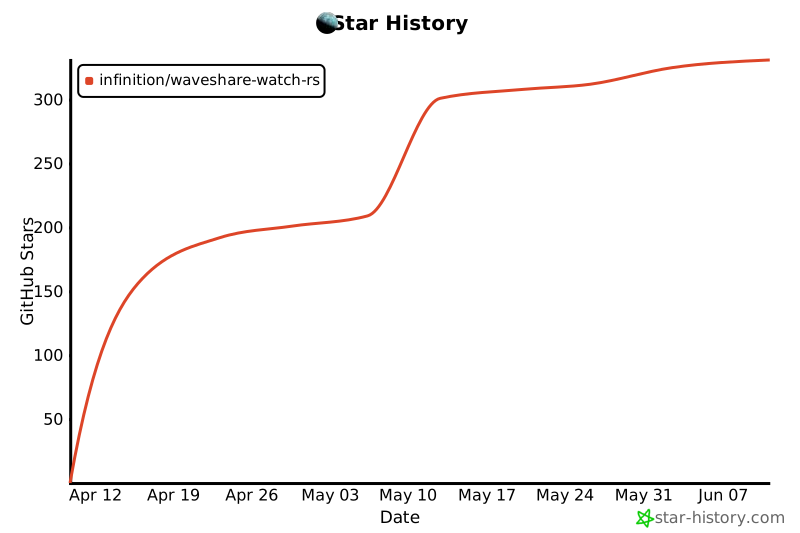
## Star History
100% Rust `no_std` smartwatch firmware for the **Waveshare ESP32-S3-Touch-AMOLED-2.06**.
Complete conversion of the original C/C++ project (ESP-IDF + Arduino GFX + LVGL) to a single-binary Rust codebase relying on `esp-hal` 1.0, `esp-rtos`, Embassy, and custom drivers for each of the board's peripherals.
The firmware handles the 410×502 QSPI display in 80 MHz DMA, the I2S audio codec, 2.4 GHz WiFi with NTP sync, SD card, capacitive touch, gyroscope, hardware RTC, AXP2101 power management, a launcher with 5 mini-games, a T9 keyboard, an MP3 player (UI), a Smart Home app (HTTP), a sleep/wake mode with an Apple Watch style Always-On Display, and an event-driven main loop based on GPIO interrupts to leave the CPU asleep >99% of the time on the watchface.
---
## Hardware target
| Component | Reference | Bus |
|------------------|--------------------------------------------------|----------------|
| SoC | ESP32-S3R8 (Xtensa LX7 dual-core, 8 MB PSRAM) | — |
| Display | CO5300 AMOLED 410×502, rounded edge | QSPI 80 MHz |
| PMIC | AXP2101 (charging, power rails) | I2C 400 kHz |
| Touch | FT3168 | I2C + INT GPIO |
| IMU | QMI8658 (accelerometer + gyroscope + temp) | I2C |
| RTC | PCF85063A | I2C |
| Audio codec | ES8311 + amp | I2C + I2S |
| Memory | 32 MB flash, 8 MB octal PSRAM | — |
| SD Card | SDHC SPI | SPI3 |
| WiFi + BLE | Integrated 2.4 GHz | — |
| Tearing Effect | GPIO13 | IRQ |
Waveshare Wiki reference: [https://www.waveshare.com/wiki/ESP32-S3-Touch-AMOLED-2.06](https://www.waveshare.com/wiki/ESP32-S3-Touch-AMOLED-2.06)
Full pinout in `src/board.rs`.
---
## Software stack
| Layer | Crate | Role |
|--------------|---------------------------------|--------------------------------------------------------|
| HAL | `esp-hal` 1.0 | Peripherals (GPIO, I2C, SPI, I2S, DMA, timers, PSRAM) |
| Runtime | `esp-rtos` 0.2 | Boot, executor, radio integration |
| Async | `embassy-executor` 0.9 | Cooperative scheduler, tasks, timers |
| | `embassy-time`, `embassy-futures` | `select`, `Timer::after`, `Duration` |
| | `embassy-net` 0.9 | smoltcp TCP/IP stack (DHCPv4, TCP, UDP, DNS) |
| Radio | `esp-radio` 0.17 | WiFi driver + Embassy interface |
| Graphics | `embedded-graphics` 0.8 | 2D primitives, fonts, text layout |
| Storage | `embedded-sdmmc` 0.8 | FAT32 on SD card |
| Codec | `nanomp3` 0.1 | `no_std` MP3 decoder (prepared, not wired) |
| Allocator | `esp-alloc` | 64 KB SRAM heap + 8 MB PSRAM heap |
| Panic | `esp-backtrace` | Symbolic backtrace via `esp-println` |
Zero C code, zero ESP-IDF components compiled into the final target. The bootloader is `esp-bootloader-esp-idf` on the loader side only.
---
## Architecture
```
main.rs
│
├── esp_hal::init(CpuClock::_160MHz)
├── PSRAM allocator init
├── esp_rtos::start(timer) ← Embassy executor
│
├── [Peripherals init] ──── drivers/ + peripherals/
│ ├── Shared I2C bus (RefCell + RefCellDevice)
│ ├── AXP2101 power rails + battery monitor
│ ├── QSPI SPI2 80 MHz DMA 8 KB → Co5300Display
│ ├── PSRAM Framebuffer double buffer (2 × 402 KB)
│ ├── FT3168 touch + GPIO38 INT
│ ├── PCF85063A RTC
│ ├── QMI8658 IMU (power_down by default)
│ ├── SD SPI3 4 MHz
│ ├── ES8311 codec + I2S0 DMA
│ └── WiFi esp-radio + embassy-net DHCPv4 + NTP sync
│
├── [Event-driven loop]
│ │
│ ├── select3(
│ │ Timer::after(adaptive_tick),
│ │ touch_int.wait_for_falling_edge(),
│ │ boot_button.wait_for_falling_edge(),
│ │ ).await
│ │
│ ├── Sensors I/O (gated by screen_state + business need)
│ ├── Touch poll I2C (only if finger is pressed or just lifted)
│ ├── State machine sleep/wake (4 levels + AOD)
│ ├── WiFi auto-disconnect idle >5min
│ └── App state machine
│ ├── Watchface (3 pages: Clock / Sensors / System)
│ ├── Launcher
│ ├── Snake, 2048, Tetris, Flappy, Maze
│ ├── MP3 Player (UI)
│ ├── Settings + T9 keyboard
│ └── SmartHome (buttons → HTTP)
```
---
## Module organization
```
src/
├── main.rs Hardware init + async main loop
├── board.rs Pinout + display dimensions
│
├── drivers/ Low-level drivers (direct hardware)
│ ├── qspi_bus.rs QSPI bus quad-mode half-duplex, begin/stream/end
│ ├── co5300.rs CO5300 init sequence, addr window, set_brightness,
│ │ display_on/off (MIPI DCS), TEARON
│ └── framebuffer.rs 410×502 RGB565 PSRAM FB, double buffer, flush_vsync
│
├── peripherals/ High-level I2C / SPI / I2S drivers
│ ├── power.rs AXP2101: battery %, voltage, is_charging, power rails
│ ├── touch.rs FT3168: read, tracking swipe/tap, SwipeDirection
│ ├── rtc.rs PCF85063A: get_time, set_time, DateTime
│ ├── imu.rs QMI8658: read_accel/gyro/temp, power_up/down
│ ├── audio.rs ES8311: Waveshare registers init, mute/unmute, beep
│ ├── sdcard.rs Stub wrapper around embedded-sdmmc
│ ├── wifi.rs WiFi types (scan stub)
│ └── http.rs HTTP GET/POST client via embassy-net TCP
│
├── ui/ UI components rendered on DrawTarget
│ ├── watchface.rs Clock + gyro ball + battery + FR date + AOD
│ ├── segments.rs 7-segment digits for time
│ ├── pages.rs Clock / Sensors / System pages
│ ├── launcher.rs App list, interpolated scroll
│ └── t9_keyboard.rs Alphanumeric T9 keyboard
│
└── apps/ Applications (implement the App trait)
├── snake.rs Snake with I2S beep on consume
├── game2048.rs 2048 swipe merge
├── tetris.rs Tetris gyro + touch
├── flappy.rs Flappy Bird (direct rendering + framebuffer)
├── maze.rs Maze with IMU ball
├── settings.rs WiFi SSID/password + T9
├── mp3player.rs MP3 player UI (decoding to be wired)
└── smarthome.rs Button grid → HTTP GET/POST
```
---
## Power management
The firmware is designed to leave the CPU parked most of the time.
The Embassy executor only wakes the core on:
- the GPIO38 touch interrupt (FT3168 in monitor mode)
- the GPIO0 button interrupt
- a periodic timer whose period depends on the current state
### Screen states (4 levels + AOD)
| State | Brightness | Idle trigger | Behavior |
|-------|------------|--------------|----------------------------------------------------------------------------------|
| 3 | 0xD0 | — | Normal interactive, full bright |
| 2 | 0x40 | 20 s | Dimming (transition), still interactive |
| 1 | 0x18 | 40 s | **AOD**: minimal HH:MM, pure black background (AMOLED pixels OFF), 1 update/min |
| 0 | DISPOFF | 10 min in AOD| SLPIN panel, QSPI idle, only GPIO IRQ for wake |
On wake via touch/button: immediate return to state 3, framebuffer forced into full redraw.
### Adaptive main loop ticks
| Context | Tick | Effective frequency |
|------------------------------------|----------|---------------------|
| Screen OFF (state 0) | 30 s | 0.033 Hz |
| AOD (state 1) | 10 s | 0.1 Hz |
| Watchface clock, gyro off | 1 s | 1 Hz |
| Watchface clock, gyro on | 33 ms | ~30 Hz |
| Sensors page | 100 ms | 10 Hz |
| System page | 2 s | 0.5 Hz |
| Launcher / Settings / MP3 / SmartHome | 100 ms| 10 Hz |
| Snake / 2048 / Tetris / Maze | 16 ms | ~60 Hz |
| Flappy | 8 ms | 125 Hz |
| Finger held on the screen | 16 ms | 60 Hz (override) |
### Extra optimizations
- **160 MHz CPU** by default (instead of 240 MHz), ~30% CPU power saving.
- **IMU power-down**: `CTRL7 = 0x00` at boot, power-up only when requested by a consumer.
- **Touch I2C** polled only when the finger is placed (GPIO38 LOW) or just lifted.
- **RTC** polled at 1 Hz (instead of 5 Hz before optimization).
- **Battery** polled at 1/60 Hz (1/300 Hz when the screen is off).
- **Conditional Watchface flush**: the PSRAM FB is flushed only if `needs_render()` signals an actual change.
- **WiFi auto-disconnect** after 5 mins of inactivity: `wifi_controller.disconnect_async()` — the 2.4 GHz radio is the biggest constant consumer. Automatic reconnect on next wake.
- **TE VSync spin** limited to 400 iterations (instead of 2000) to avoid wasting cycles when TE doesn't pulse.
- **Blocking delays** replaced by `Timer::after(...).await` so the CPU stays parked during button debounces.
- **Audio PA amp** (GPIO46) held LOW at boot, codec muted (DAC power-down + HP drive off) immediately after init. The amp is pulled HIGH only while writing the beep via DMA, then pulled back down.
- **AOD Anti burn-in**: the position of the HH:MM block in AOD is shifted by `(minutes % 9) - 4` pixels in X and Y, like Apple Watch.
### Transition order
```
touch/button interaction +0s state 3 (full)
└─ +20s idle ────────────────→ state 2 (dim)
└─ +40s idle ────────────────→ state 1 (AOD, if Clock page) or state 0 (otherwise)
└─ +300s idle ────────────────→ WiFi disconnect
└─ +600s idle ────────────────→ state 0 (full OFF)
touch or button GPIO IRQ → immediate state 3, WiFi reconnect follows
```
---
## Display pipeline
```
Embedded-graphics draw calls
│
▼
410×502 u16 RGB565 PSRAM Framebuffer (402 KB back buffer)
│
│ fb.flush() OR fb.flush_vsync(te_pin)
▼
Co5300Display::set_addr_window(...)
│
▼
QspiBus::write_pixels()
│
▼
esp-hal SPI2 half_duplex_write(
DataMode::Quad, ← 4-bit QSPI mode
Command::_8Bit(0x12), ← write memory
Address::_24Bit(0x003C00),
dummy = 0,
buffer, ← pixel data in quad mode
)
│
▼
DMA_CH0 → GPIO SIO0..SIO3 @ 80 MHz
```
- `swap_and_flush()`: double buffer, for games (Flappy) — zero tearing.
- `flush_vsync()`: single buffer, waits for a TE pulse (GPIO13) before sending pixels.
- `flush_region(x, y, w, h)`: partial update, used by watchface partial updates.
---
## Build setup
### Prerequisites
- **Xtensa ESP Rust toolchain** (installed via [espup](https://github.com/esp-rs/espup)):
```bash
cargo install espup
espup install
```
`rust-toolchain.toml` pins `channel = "esp"`.
- **MSVC linker** (Windows): needed for host build scripts. Install "Desktop development with C++" via Visual Studio Installer. The `link.exe` must be in the PATH when running cargo. On this project we typically have:
```bash
export PATH="/c/Program Files/Microsoft Visual Studio/18/Community/VC/Tools/MSVC/14.50.35717/bin/Hostx64/x64:$PATH"
```
- **espflash**:
```bash
cargo install espflash
```
### WiFi credentials
SSID and password are read at compile-time via `env!()`. They must be defined before building:
```bash
# Linux / macOS / Git Bash (Windows)
export WIFI_SSID="MyNetwork"
export WIFI_PASS="MyPassword"
```
```powershell
# PowerShell
$env:WIFI_SSID = "MyNetwork"
$env:WIFI_PASS = "MyPassword"
```
### Build
```bash
WIFI_SSID="MyNetwork" WIFI_PASS="MyPassword" cargo build --release
```
The final binary is around **579 KB** (full firmware with WiFi stack + games + UI).
### Flash + serial monitor
```bash
espflash flash --port COM7 --monitor target/xtensa-esp32s3-none-elf/release/waveshare-watch-rs
```
On Linux: `/dev/ttyACM0` or `/dev/ttyUSB0` depending on the USB bridge.
### Build config
- `opt-level = "s"` in dev AND release (size optimized).
- `lto = true` in release (global inlining, reduces size by ~20%).
- 64 KB SRAM heap (for the WiFi stack), 8 MB PSRAM heap (framebuffers + Vecs).
---
## Features
### Integrated and working
- 410×502 QSPI 80 MHz DMA double-buffer display
- PSRAM framebuffer + DMA flush
- Tearing Effect VSync anti-tearing
- FT3168 touch + iOS-like swipe detection + tap + diagonal rejection
- QMI8658 IMU accel + gyro + temperature with power management
- PCF85063A RTC + NTP sync via embassy-net UDP
- WiFi STA: DHCPv4, NTP, HTTP GET/POST, auto-disconnect idle
- ES8311 audio + I2S DMA (Snake beep)
- SD Card 4 GB detection (FAT32 /mp3 scan in place, stable mount if MBR is valid)
- Watchface 3 pages: Clock (7-segment time + battery + FR date + gyro ball), Sensors, System
- Launcher app list with smooth scroll
- Games: Snake, 2048, Tetris, Flappy Bird, Maze (gyro)
- Settings: WiFi SSID/password fields with T9 keyboard
- SmartHome: configurable 6-button HTTP grid
- MP3 Player: UI (play/pause, prev/next, progress bar)
- Screen sleep/wake 4 levels with minute-by-minute Always-On Display
- Boot button = launcher, swipe up = launcher
### Partially wired / stubbed
- **MP3 decoding**: `nanomp3` compiled and as a dependency, UI ready, SD → I2S stream to be wired.
- **BLE**: `esp-radio` compiled with stub feature, init disabled due to a panic `btdm_controller_init -4` in coex with WiFi (requires additional `coex` config).
- **WiFi scan list**: `ScanResult` types ready, Settings UI shows the field but without scan.
- **USB Mass Storage**: not wired (copy-from-PC would require `usb-device` + `usbd-storage`).
- **ESP deep sleep**: no `esp_hal::system::Sleep` — we stay in light sleep via the Embassy executor, sufficient for watch usage.
---
## Detailed custom drivers
### `drivers/qspi_bus.rs` — QspiBus
Half-duplex quad-SPI bus for the CO5300. API:
```rust
fn write_command(&mut self, cmd: u8)
fn write_c8d8(&mut self, cmd: u8, data: u8)
fn write_pixels(&mut self, pixels: &[u16])
fn begin_pixels(&mut self)
fn stream_pixels(&mut self, pixels: &[u16])
fn end_pixels(&mut self)
```
Uses esp-hal `Spi::half_duplex_write()` with `Command::_8Bit` + `Address::_24Bit`. `DataMode::Single` is used for commands, `DataMode::Quad` for pixels.
### `drivers/co5300.rs` — Co5300Display
Init sequence faithful to the C Arduino Waveshare driver `Arduino_CO5300.cpp`:
- Hardware reset (10ms low, 120ms high)
- SLPOUT (0x11) + delay 120 ms
- 0xFE 0x00 (vendor register access)
- 0xC4 0x80 (SPI mode control)
- 0x3A 0x55 (RGB565 pixel format)
- 0x53 0x20 (write CTRL display)
- 0x63 0xFF (HBM brightness)
- DISPON (0x29)
- 0x51 0xD0 (brightness)
- 0x35 0x00 (TEARON VBlank only)
Functions: `init`, `set_addr_window`, `set_brightness`, `display_on`, `display_off`, `bus_mut`.
### `peripherals/audio.rs` — Es8311
ES8311 init based on the Waveshare C driver. Critical registers missing in my first attempt:
- `0x00 = 0x1F` (reset) → `0x00 = 0x00` → **`0x00 = 0x80`** (power-on command, initially forgotten)
- Clock coefficients for 4.096 MHz MCLK @ 16 kHz sample rate
- `0x0D = 0x01`, `0x0E = 0x02` (power up analog)
- `0x12 = 0x00` (DAC power up), `0x13 = 0x10` (HP drive)
- `0x32 = 0xD9` (volume 85%)
API: `init`, `mute` (DAC power-down + HP off + vol 0), `unmute`, `set_volume`.
### `peripherals/power.rs` — Axp2101Power
Wrapper around `axp2101-embedded` for battery monitoring + power rails.
### `peripherals/touch.rs` — Ft3168Touch
**Monitor** mode (`REG_POWER_MODE = 0x01`): the chip asserts GPIO38 only on a touch event. Internal state machine to distinguish tap / swipe up/down/left/right with:
- minimum 30 px threshold to qualify a swipe
- 1.5× ratio on the dominant axis to reject diagonal swipes
- tracking start/end coordinates
### `peripherals/imu.rs` — Qmi8658Imu
Init accel ±2g @ 500 Hz, gyro ±512 dps @ 119 Hz, LPF enabled.
```rust
fn read_accel() -> AccelData // m.x, y, z in g
fn read_gyro() -> GyroData // °/s
fn read_temperature() -> f32 // °C
fn power_up() / power_down() // CTRL7 0x03 / 0x00
```
### `peripherals/rtc.rs` — Pcf85063aRtc
BCD read/write of registers 0x04..0x0A. Auto conversion to `DateTime { year, month, day, hours, minutes, seconds }`.
### `peripherals/http.rs` — http_get / http_post
Minimal HTTP client without external crate: parse URL, `TcpSocket::connect`, format request manually, custom `write_all` (handling partial writes), read until close, parse status code + body truncated to 128 bytes.
---
## Runtime data flow
### On boot
1. `esp_hal::init(CpuClock::_160MHz)`
2. `esp_alloc::psram_allocator!` — 8 MB PSRAM heap
3. `esp_rtos::start(timg0.timer0)` — Embassy executor
4. Sequential init of all I2C/SPI/I2S drivers
5. `wifi_controller.connect_async().await`
6. `embassy_net::Stack` + `StackResources<3>`, spawn `net_task` task
7. Wait for DHCP IP
8. `ntp_sync()` — UDP to 216.239.35.0:123, parse timestamp, `rtc.set_time()`
9. Initial watchface render
10. Enter main loop
### In the loop
```rust
loop {
// Choose tick based on state
let tick = match (screen_state, app_state, current_page, gyro_enabled) { ... };
// Sleep until next event
select3(
Timer::after(tick),
touch_int.wait_for_falling_edge(),
boot_button.wait_for_falling_edge(),
).await;
// Sensors throttled by need + screen_state
if need_imu { imu.read_accel(); ... }
if screen_state >= 2 && now >= next_rtc { rtc.get_time(); ... }
if now >= next_battery { power.get_battery_percent(); ... }
// Conditional touch poll (finger placed or just lifted)
if touch_active { touch.poll(); ... }
// Sleep/wake state machine → transitions 3→2→1→0
// WiFi auto-disconnect
// AOD render path (1x/min) → continue
// Screen OFF → continue
// App state machine → render + conditional flush
}
```
---
## Project metrics
| Metric | Value |
|------------------------|------------|
| Lines of Rust | 5 545 |
| Source files | 23 |
| Release binary | 579 KB |
| Dependency crates | ~35 |
| Lines of C/C++ | 0 |
| SRAM Heap | 64 KB |
| Allocated PSRAM | ~1.2 MB |
| Framebuffers | 2 x 402 KB |
| Handwritten drivers | 8 (QSPI, CO5300, AXP2101, FT3168, QMI8658, PCF85063A, ES8311, HTTP) |
---
## C++ vs Rust comparison
| Aspect | C++ (ESP-IDF + Arduino) | Rust (esp-hal + Embassy) |
|----------------------------|--------------------------------------|----------------------------------------------------|
| Runtime | FreeRTOS (preemptive, ~20 KB RAM) | Embassy async (cooperative, ~0 KB overhead) |
| UI Stack | LVGL (C, ~100 KB RAM) | embedded-graphics (Rust, zero alloc) |
| Display driver | Arduino GFX (Arduino_CO5300.cpp) | Custom driver qspi_bus.rs + co5300.rs |
| SPI Bus | ESP-IDF spi_device, polling | esp-hal half_duplex_write, DMA 8 KB |
| Power management | XPowersLib (C++) | Custom driver power.rs on embedded-hal I2C |
| Audio | ES8311 Arduino driver | Custom driver audio.rs (registers faithful to C) |
| WiFi | ESP-IDF wifi_init + lwIP | esp-radio + embassy-net (smoltcp) |
| Sleep | Not implemented | 4 levels + AOD, event-driven select3 |
| Build system | PlatformIO / Arduino IDE | Cargo, Xtensa cross-compile via espup |
| Safety | Raw pointers, buffer overflows | Ownership, borrow checker, no UB |
| Firmware size | ~1.2 MB (ESP-IDF + LVGL + WiFi) | 579 KB (all included) |
---
## Conversion history (C++ to Rust)
The original C++ project used:
- ESP-IDF + FreeRTOS
- Arduino GFX for the CO5300
- LVGL for the UI
- ES8311 codec via Arduino driver
- XPowersLib for the AXP2101
Major steps of the rewrite:
1. **QSPI bus + CO5300** — The hardest part: discovering that esp-hal `half_duplex_write` supports `DataMode::Quad` via the `Command` + `Address` machinery. Initial bug: using `with_miso` (input) instead of `with_sio1` (output) caused SIO1 to float → all blacks appeared green.
2. **AXP2101** — Activating the DC1 (3.3 V main) and ALDO1 (panel) rails via registers 0x80 and 0x92, otherwise the screen stays black even with the CO5300 correctly initialized.
3. **PSRAM Framebuffer** — Alignment issue: the CO5300 is strict on even widths for partial writes. Added even-rounding logic in `flush_region`. The PSRAM allocator requires `features = ["psram"]` on `esp-hal` + `esp_alloc::psram_allocator!` macro after `esp_hal::init`.
4. **ES8311 Audio** — 4 attempts before getting sound: the correct public method to play via I2S is **`write_dma()`** (not `write()` which is private). The init must exactly match the C sequence, particularly the `write_reg(0x00, 0x80)` after the reset, otherwise the codec stays in power-down.
5. **Event-driven loop** — Converted from `loop { Timer::after(5ms).await; ... }` to `select3(Timer, touch_edge, button_edge)`. Gain: CPU wake-ups reduced by ~6000× in screen OFF and ~200× in idle watchface.
6. **BLE** — Init attempt with `esp_radio::ble::BleConnector::new` → panic `btdm_controller_init returned -4`. BLE disabled in `Cargo.toml` features pending a correct coex configuration.
7. **Sleep/wake** — Initial bug: the `display_on()` sequence did DISPON then SLPOUT (incorrect order), so DISPON happened while the panel was still in SLPIN. Fixed to SLPOUT (120 ms) → DISPON (20 ms), standard MIPI DCS order.
---
## License
Licensed under either of
- Apache License, Version 2.0 ([LICENSE-APACHE](LICENSE-APACHE) or )
- MIT License ([LICENSE-MIT](LICENSE-MIT) or )
at your option.
Hardware drivers were written from scratch, informed by Waveshare's C/C++ examples and the [esp-hal](https://github.com/esp-rs/esp-hal) ecosystem.
---
## Resources
- Waveshare Wiki: [https://www.waveshare.com/wiki/ESP32-S3-Touch-AMOLED-2.06](https://www.waveshare.com/wiki/ESP32-S3-Touch-AMOLED-2.06)
- esp-hal: [https://github.com/esp-rs/esp-hal](https://github.com/esp-rs/esp-hal)
- esp-rtos: [https://github.com/esp-rs/esp-rtos](https://github.com/esp-rs/esp-rtos)
- Embassy: [https://embassy.dev](https://embassy.dev)
- embedded-graphics: [https://docs.rs/embedded-graphics](https://docs.rs/embedded-graphics)
- CO5300 datasheet: provided by Waveshare on the wiki
- AXP2101 datasheet: X-Powers
- ES8311 datasheet: Everest Semiconductor
- QMI8658 datasheet: QST Corporation
## Star History