# keras-tcn
**Repository Path**: john_ai/keras-tcn
## Basic Information
- **Project Name**: keras-tcn
- **Description**: Keras Temporal Convolutional Network.
- **Primary Language**: Unknown
- **License**: MIT
- **Default Branch**: master
- **Homepage**: None
- **GVP Project**: No
## Statistics
- **Stars**: 0
- **Forks**: 1
- **Created**: 2021-04-02
- **Last Updated**: 2021-04-02
## Categories & Tags
**Categories**: Uncategorized
**Tags**: None
## README
# Keras TCN
[](https://pepy.tech/project/keras-tcn)
[](https://pepy.tech/project/keras-tcn)
```bash
pip install keras-tcn
```
*Keras Temporal Convolutional Network*
* [Keras TCN](#keras-tcn)
* [Why Temporal Convolutional Network?](#why-temporal-convolutional-network)
* [API](#api)
* [Arguments](#arguments)
* [Input shape](#input-shape)
* [Output shape](#output-shape)
* [Supported task types](#supported-task-types)
* [Receptive field](#receptive-field)
* [Non-causal TCN](#non-causal-tcn)
* [Installation (Python 3)](#installation-python-3)
* [Run](#run)
* [Reproducible results](#reproducible-results)
* [Tasks](#tasks)
* [Adding Task](#adding-task)
* [Explanation](#explanation)
* [Implementation results](#implementation-results)
* [Copy Memory Task](#copy-memory-task)
* [Explanation](#explanation-1)
* [Implementation results (first epochs)](#implementation-results-first-epochs)
* [Sequential MNIST](#sequential-mnist)
* [Explanation](#explanation-2)
* [Implementation results](#implementation-results-1)
* [Testing](#testing)
* [References](#references)
* [Related](#related)
## Why Temporal Convolutional Network?
- TCNs exhibit longer memory than recurrent architectures with the same capacity.
- Constantly performs better than LSTM/GRU architectures on a vast range of tasks (Seq. MNIST, Adding Problem, Copy Memory, Word-level PTB...).
- Parallelism, flexible receptive field size, stable gradients, low memory requirements for training, variable length inputs...
 Visualization of a stack of dilated causal convolutional layers (Wavenet, 2016)
## API
The usual way is to import the TCN layer and use it inside a Keras model. An example is provided below for a regression task (cf. `tasks/` for other examples):
```python
from tensorflow.keras.layers import Dense
from tensorflow.keras import Input, Model
from tcn import TCN
batch_size, timesteps, input_dim = None, 20, 1
def get_x_y(size=1000):
import numpy as np
pos_indices = np.random.choice(size, size=int(size // 2), replace=False)
x_train = np.zeros(shape=(size, timesteps, 1))
y_train = np.zeros(shape=(size, 1))
x_train[pos_indices, 0] = 1.0
y_train[pos_indices, 0] = 1.0
return x_train, y_train
i = Input(batch_shape=(batch_size, timesteps, input_dim))
o = TCN(return_sequences=False)(i) # The TCN layers are here.
o = Dense(1)(o)
m = Model(inputs=[i], outputs=[o])
m.compile(optimizer='adam', loss='mse')
x, y = get_x_y()
m.fit(x, y, epochs=10, validation_split=0.2)
```
In the example above, TCNs can also be stacked together, like this:
```python
o = TCN(return_sequences=True)(i)
o = TCN(return_sequences=False)(o)
```
A ready-to-use TCN model can be used that way (cf. `tasks/` for the full code):
```python
from tcn import compiled_tcn
model = compiled_tcn(...)
model.fit(x, y) # Keras model.
```
### Arguments
`TCN(nb_filters=64, kernel_size=2, nb_stacks=1, dilations=[1, 2, 4, 8, 16, 32], padding='causal', use_skip_connections=True, dropout_rate=0.0, return_sequences=True, activation='linear', kernel_initializer='he_normal', use_batch_norm=False, **kwargs)`
- `nb_filters`: Integer. The number of filters to use in the convolutional layers. Would be similar to `units` for LSTM.
- `kernel_size`: Integer. The size of the kernel to use in each convolutional layer.
- `dilations`: List. A dilation list. Example is: [1, 2, 4, 8, 16, 32, 64].
- `nb_stacks`: Integer. The number of stacks of residual blocks to use.
- `padding`: String. The padding to use in the convolutions. 'causal' for a causal network (as in the original implementation) and 'same' for a non-causal network.
- `use_skip_connections`: Boolean. If we want to add skip connections from input to each residual block.
- `return_sequences`: Boolean. Whether to return the last output in the output sequence, or the full sequence.
- `dropout_rate`: Float between 0 and 1. Fraction of the input units to drop.
- `activation`: The activation used in the residual blocks o = activation(x + F(x)).
- `kernel_initializer`: Initializer for the kernel weights matrix (Conv1D).
- `use_batch_norm`: Whether to use batch normalization in the residual layers or not.
- `kwargs`: Any other arguments for configuring parent class Layer. For example "name=str", Name of the model. Use unique names when using multiple TCN.
### Input shape
3D tensor with shape `(batch_size, timesteps, input_dim)`.
`timesteps` can be None. This can be useful if each sequence is of a different length: [Multiple Length Sequence Example](tasks/multi_length_sequences.py).
### Output shape
- if `return_sequences=True`: 3D tensor with shape `(batch_size, timesteps, nb_filters)`.
- if `return_sequences=False`: 2D tensor with shape `(batch_size, nb_filters)`.
### Supported task types
- Regression (Many to one) e.g. adding problem
- Classification (Many to many) e.g. copy memory task
- Classification (Many to one) e.g. sequential mnist task
For a Many to Many regression, a cheap fix for now is to change the [number of units of the final Dense layer](https://github.com/philipperemy/keras-tcn/blob/8151b4a87f906fd856fd1c113c48392d542d0994/tcn/tcn.py#L90).
### Receptive field
- Receptive field = **nb_stacks_of_residuals_blocks * kernel_size * last_dilation**.
- If a TCN has only one stack of residual blocks with a kernel size of 2 and dilations [1, 2, 4, 8], its receptive field is 2 * 1 * 8 = 16. The image below illustrates it:
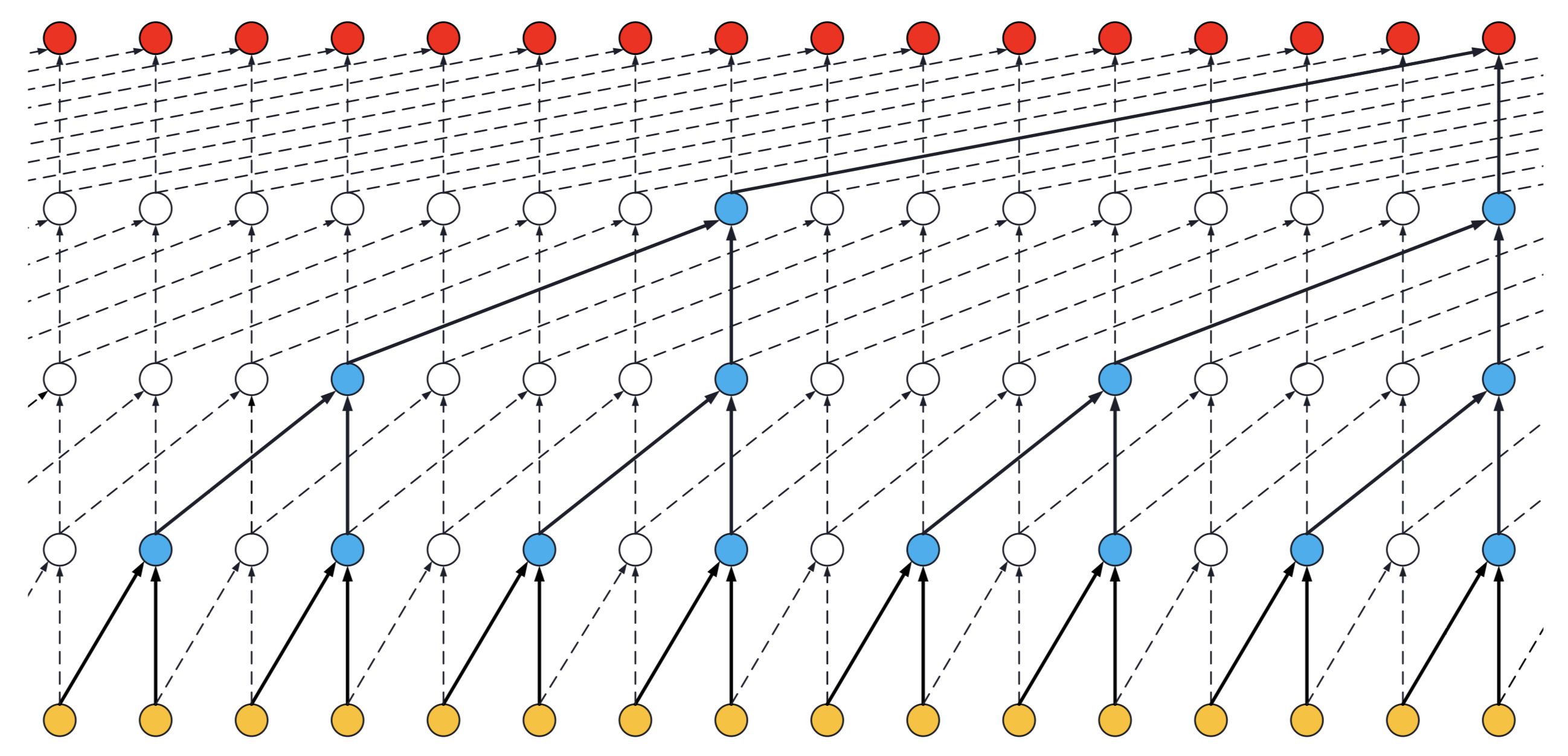 ks = 2, dilations = [1, 2, 4, 8], 1 block
- If the TCN has now 2 stacks of residual blocks, wou would get the situation below, that is, an increase in the receptive field to 32:
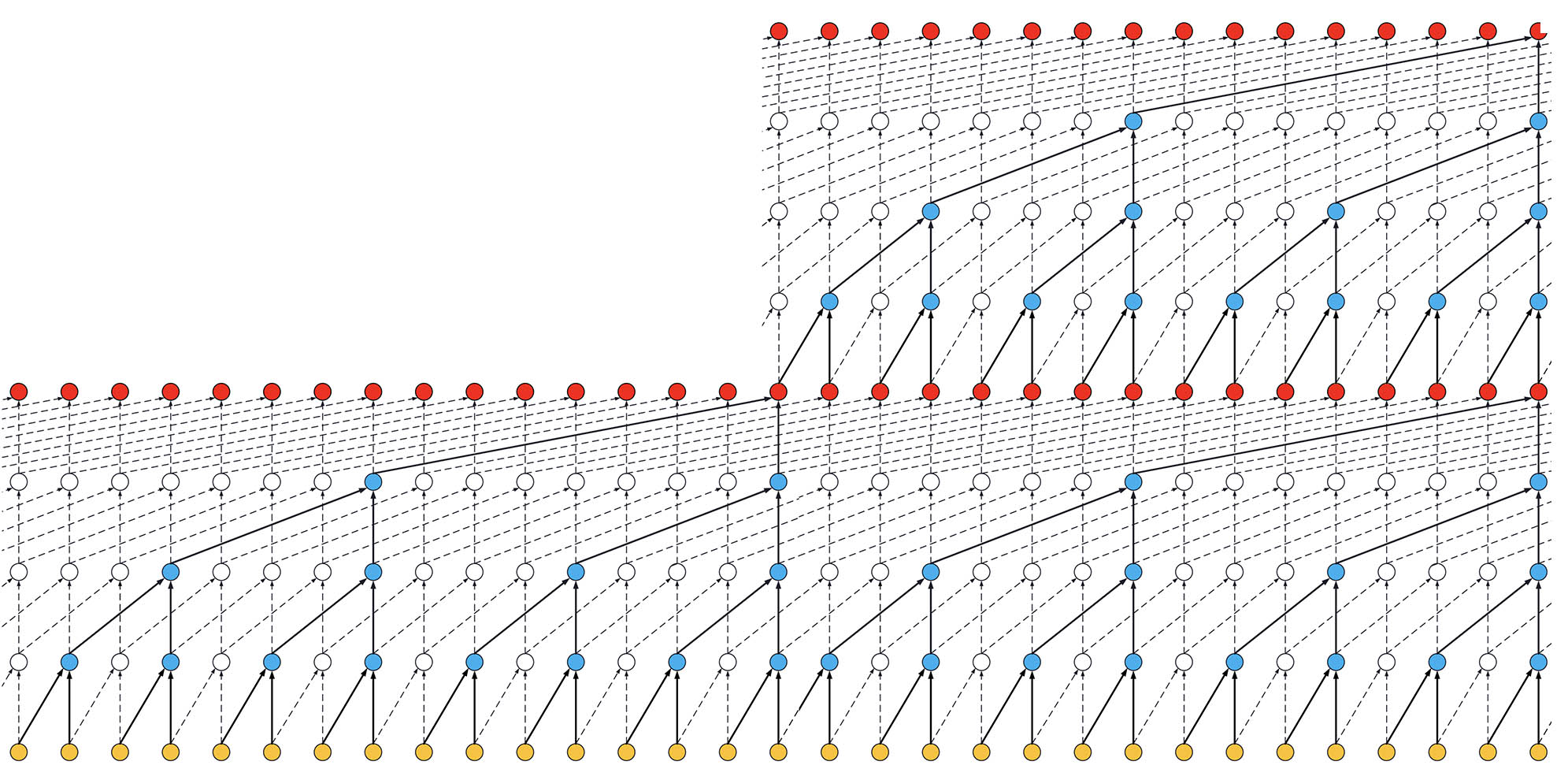 ks = 2, dilations = [1, 2, 4, 8], 2 blocks
- If we increased the number of stacks to 3, the size of the receptive field would increase again, such as below:
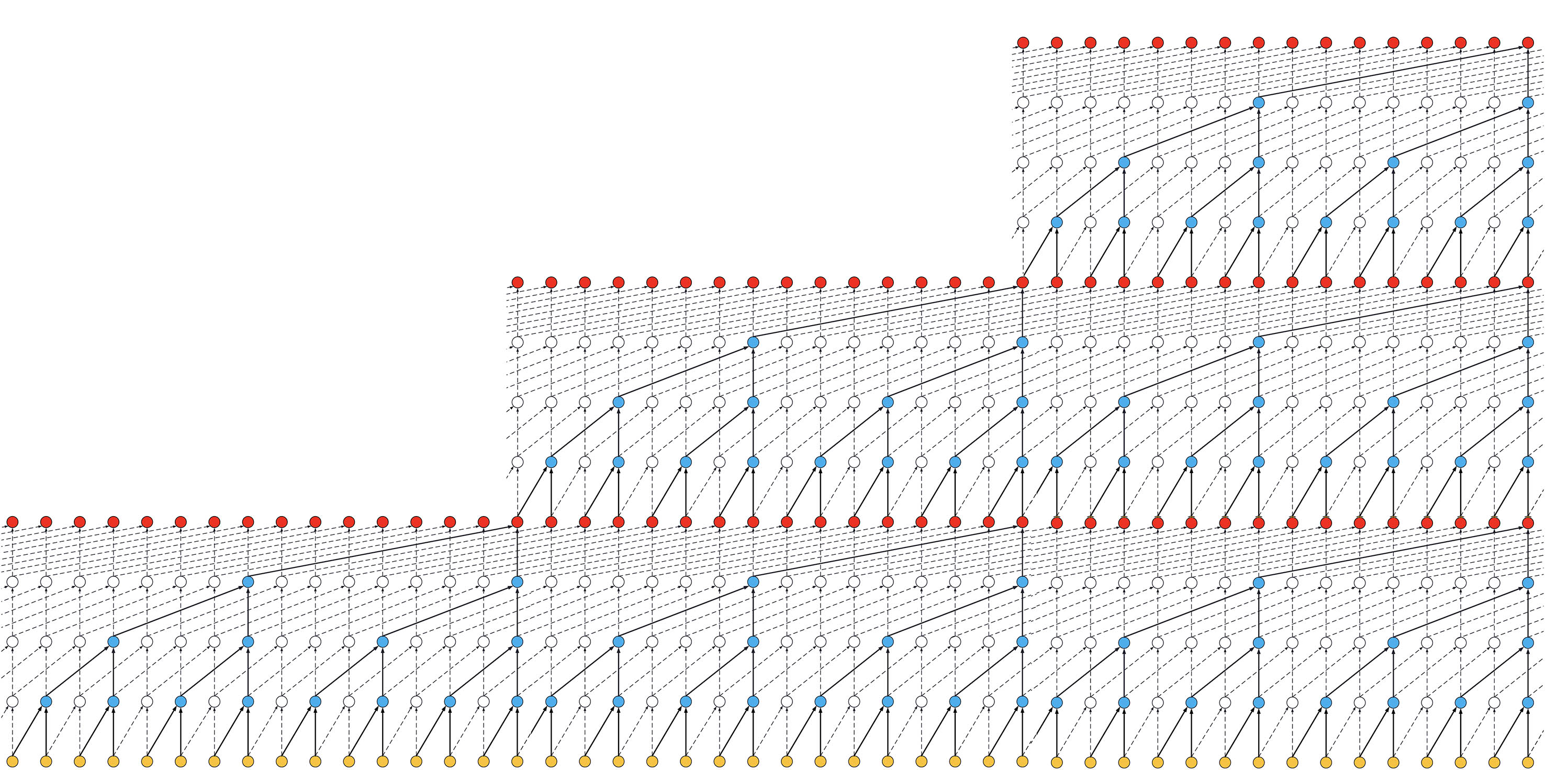 ks = 2, dilations = [1, 2, 4, 8], 3 blocks
Thanks to [@alextheseal](https://github.com/alextheseal) for providing such visuals.
### Non-causal TCN
Making the TCN architecture non-causal allows it to take the future into consideration to do its prediction as shown in the figure below.
However, it is not anymore suitable for real-time applications.
 Non-Causal TCN - ks = 3, dilations = [1, 2, 4, 8], 1 block
To use a non-causal TCN, specify `padding='valid'` or `padding='same'` when initializing the TCN layers.
Special thanks to: [@qlemaire22](https://github.com/qlemaire22)
## Installation (Python 3)
```bash
git clone git@github.com:philipperemy/keras-tcn.git
cd keras-tcn
virtualenv -p python3.6 venv
source venv/bin/activate
pip install -r requirements.txt # change to tensorflow if you dont have a gpu.
pip install . --upgrade # install it as a package.
```
Note: Only compatible with Python 3 at the moment. Should be almost compatible with python 2.
## Run
Once `keras-tcn` is installed as a package, you can take a glimpse of what's possible to do with TCNs. Some tasks examples are available in the repository for this purpose:
```bash
cd adding_problem/
python main.py # run adding problem task
cd copy_memory/
python main.py # run copy memory task
cd mnist_pixel/
python main.py # run sequential mnist pixel task
```
## Reproducible results
Reproducible results are possible on (NVIDIA) GPUs using the [tensorflow-determinism](https://github.com/NVIDIA/tensorflow-determinism) library. It was tested with keras-tcn by @lingdoc and he got reproducible results.
## Tasks
### Adding Task
The task consists of feeding a large array of decimal numbers to the network, along with a boolean array of the same length. The objective is to sum the two decimals where the boolean array contain the two 1s.
#### Explanation
 Adding Problem Task
#### Implementation results
The model takes time to learn this task. It's symbolized by a very long plateau (could take ~8 epochs on some runs).
```
200000/200000 [==============================] - 293s 1ms/step - loss: 0.1731 - val_loss: 0.1662
200000/200000 [==============================] - 289s 1ms/step - loss: 0.1675 - val_loss: 0.1665
200000/200000 [==============================] - 287s 1ms/step - loss: 0.1670 - val_loss: 0.1665
200000/200000 [==============================] - 288s 1ms/step - loss: 0.1668 - val_loss: 0.1669
200000/200000 [==============================] - 285s 1ms/step - loss: 0.1085 - val_loss: 0.0019
200000/200000 [==============================] - 285s 1ms/step - loss: 0.0011 - val_loss: 4.1667e-04
200000/200000 [==============================] - 282s 1ms/step - loss: 6.0470e-04 - val_loss: 6.7708e-04
200000/200000 [==============================] - 282s 1ms/step - loss: 4.3099e-04 - val_loss: 7.3898e-04
200000/200000 [==============================] - 282s 1ms/step - loss: 3.9102e-04 - val_loss: 1.8727e-04
200000/200000 [==============================] - 280s 1ms/step - loss: 3.1040e-04 - val_loss: 0.0010
200000/200000 [==============================] - 281s 1ms/step - loss: 3.1166e-04 - val_loss: 2.2333e-04
200000/200000 [==============================] - 281s 1ms/step - loss: 2.8046e-04 - val_loss: 1.5194e-04
```
### Copy Memory Task
The copy memory consists of a very large array:
- At the beginning, there's the vector x of length N. This is the vector to copy.
- At the end, N+1 9s are present. The first 9 is seen as a delimiter.
- In the middle, only 0s are there.
The idea is to copy the content of the vector x to the end of the large array. The task is made sufficiently complex by increasing the number of 0s in the middle.
#### Explanation
 Copy Memory Task
#### Implementation results (first epochs)
```
30000/30000 [==============================] - 30s 1ms/step - loss: 0.1174 - acc: 0.9586 - val_loss: 0.0370 - val_acc: 0.9859
30000/30000 [==============================] - 26s 874us/step - loss: 0.0367 - acc: 0.9859 - val_loss: 0.0363 - val_acc: 0.9859
30000/30000 [==============================] - 26s 852us/step - loss: 0.0361 - acc: 0.9859 - val_loss: 0.0358 - val_acc: 0.9859
30000/30000 [==============================] - 26s 872us/step - loss: 0.0355 - acc: 0.9859 - val_loss: 0.0349 - val_acc: 0.9859
30000/30000 [==============================] - 25s 850us/step - loss: 0.0339 - acc: 0.9864 - val_loss: 0.0291 - val_acc: 0.9881
30000/30000 [==============================] - 26s 856us/step - loss: 0.0235 - acc: 0.9896 - val_loss: 0.0159 - val_acc: 0.9944
30000/30000 [==============================] - 26s 872us/step - loss: 0.0169 - acc: 0.9929 - val_loss: 0.0125 - val_acc: 0.9966
```
### Sequential MNIST
#### Explanation
The idea here is to consider MNIST images as 1-D sequences and feed them to the network. This task is particularly hard because sequences are 28*28 = 784 elements. In order to classify correctly, the network has to remember all the sequence. Usual LSTM are unable to perform well on this task.
 Sequential MNIST
#### Implementation results
```
60000/60000 [==============================] - 118s 2ms/step - loss: 0.2348 - acc: 0.9265 - val_loss: 0.1308 - val_acc: 0.9579
60000/60000 [==============================] - 116s 2ms/step - loss: 0.0973 - acc: 0.9698 - val_loss: 0.0645 - val_acc: 0.9798
[...]
60000/60000 [==============================] - 112s 2ms/step - loss: 0.0075 - acc: 0.9978 - val_loss: 0.0547 - val_acc: 0.9894
60000/60000 [==============================] - 111s 2ms/step - loss: 0.0093 - acc: 0.9968 - val_loss: 0.0585 - val_acc: 0.9895
```
## Testing
Testing is based on Tox.
```
pip install tox
tox
```
## References
- https://github.com/locuslab/TCN/ (TCN for Pytorch)
- https://arxiv.org/pdf/1803.01271.pdf (An Empirical Evaluation of Generic Convolutional and Recurrent Networks
for Sequence Modeling)
- https://arxiv.org/pdf/1609.03499.pdf (Original Wavenet paper)
## Related
- https://github.com/Baichenjia/Tensorflow-TCN (Tensorflow Eager implementation of TCNs)