# grpc-gateway
**Repository Path**: jumbowu/grpc-gateway
## Basic Information
- **Project Name**: grpc-gateway
- **Description**: 导出json时,Get有参数,Post没有参数。修复下。
- **Primary Language**: Go
- **License**: BSD-3-Clause
- **Default Branch**: master
- **Homepage**: None
- **GVP Project**: No
## Statistics
- **Stars**: 0
- **Forks**: 0
- **Created**: 2021-01-11
- **Last Updated**: 2021-01-11
## Categories & Tags
**Categories**: Uncategorized
**Tags**: None
## README
## About
The gRPC-Gateway is a plugin of the Google protocol buffers compiler
[protoc](https://github.com/protocolbuffers/protobuf).
It reads protobuf service definitions and generates a reverse-proxy server which
translates a RESTful HTTP API into gRPC. This server is generated according to the
[`google.api.http`](https://github.com/googleapis/googleapis/blob/master/google/api/http.proto#L46)
annotations in your service definitions.
This helps you provide your APIs in both gRPC and RESTful style at the same time.

## Docs
You can read our docs at:
- https://grpc-ecosystem.github.io/grpc-gateway/
## Testimonials
> We use the gRPC-Gateway to serve millions of API requests per day,
> and have been since 2018 and through all of that,
> we have never had any issues with it.
>
> _- William Mill, [Ad Hoc](http://adhocteam.us/)_
## Background
gRPC is great -- it generates API clients and server stubs in many programming
languages, it is fast, easy-to-use, bandwidth-efficient and its design is
combat-proven by Google. However, you might still want to provide a traditional
RESTful JSON API as well. Reasons can range from maintaining
backward-compatibility, supporting languages or clients that are not well supported by
gRPC, to simply maintaining the aesthetics and tooling involved with a RESTful
JSON architecture.
This project aims to provide that HTTP+JSON interface to your gRPC service.
A small amount of configuration in your service to attach HTTP semantics is all
that's needed to generate a reverse-proxy with this library.
## Installation
The gRPC-Gateway requires a local installation of the Google protocol buffers
compiler `protoc` v3.0.0 or above. Please install this via your local package
manager or by downloading one of the releases from the official repository:
https://github.com/protocolbuffers/protobuf/releases
The following instructions assume you are using
[Go Modules](https://github.com/golang/go/wiki/Modules) for dependency
management. Use a
[tool dependency](https://github.com/golang/go/wiki/Modules#how-can-i-track-tool-dependencies-for-a-module)
to track the versions of the following executable packages:
```go
// +build tools
package tools
import (
_ "github.com/grpc-ecosystem/grpc-gateway/v2/protoc-gen-grpc-gateway"
_ "github.com/grpc-ecosystem/grpc-gateway/v2/protoc-gen-openapiv2"
_ "google.golang.org/grpc/cmd/protoc-gen-go-grpc"
_ "google.golang.org/protobuf/cmd/protoc-gen-go"
)
```
Run `go mod tidy` to resolve the versions. Install by running
```sh
$ go install \
github.com/grpc-ecosystem/grpc-gateway/v2/protoc-gen-grpc-gateway \
github.com/grpc-ecosystem/grpc-gateway/v2/protoc-gen-openapiv2 \
google.golang.org/protobuf/cmd/protoc-gen-go \
google.golang.org/grpc/cmd/protoc-gen-go-grpc
```
This will place four binaries in your `$GOBIN`;
- `protoc-gen-grpc-gateway`
- `protoc-gen-openapiv2`
- `protoc-gen-go`
- `protoc-gen-go-grpc`
Make sure that your `$GOBIN` is in your `$PATH`.
## Usage
1. Define your [gRPC](https://grpc.io/docs/) service using protocol buffers
`your_service.proto`:
```protobuf
syntax = "proto3";
package your.service.v1;
option go_package = "github.com/yourorg/yourprotos/gen/go/your/service/v1";
message StringMessage {
string value = 1;
}
service YourService {
rpc Echo(StringMessage) returns (StringMessage) {}
}
```
2. Generate gRPC stubs
This step generates the gRPC stubs that you can use to implement the service and consume from clients:
Here's an example of what a `protoc` command might look like to generate Go stubs:
```sh
protoc -I . \
--go_out ./gen/go/ --go_opt paths=source_relative \
--go-grpc_out ./gen/go/ --go-grpc_opt paths=source_relative \
your/service/v1/your_service.proto
```
3. Implement your service in gRPC as usual
1. (Optional) Generate gRPC stub in the [other programming languages](https://grpc.io/docs/).
For example, the following generates gRPC code for Ruby based on `your/service/v1/your_service.proto`:
```sh
protoc -I . --ruby_out ./gen/ruby your/service/v1/your_service.proto
protoc -I . --grpc-ruby_out ./gen/ruby your/service/v1/your_service.proto
```
2. Add the googleapis-common-protos gem (or your language equivalent) as a dependency to your project.
3. Implement your gRPC service stubs
4. Generate reverse-proxy using `protoc-gen-grpc-gateway`
At this point, you have 3 options:
- no further modifications, use the default mapping to HTTP semantics (method, path, etc.)
- this will work on any `.proto` file, but will not allow setting HTTP paths, request parameters or similar
- additional `.proto` modifications to use a custom mapping
- relies on parameters in the `.proto` file to set custom HTTP mappings
- no `.proto` modifications, but use an external configuration file
- relies on an external configuration file to set custom HTTP mappings
- mostly useful when the source proto file isn't under your control
1. Using the default mapping
This requires no additional modification to the `.proto` file but does require enabling a specific option when executing the plugin.
The `generate_unbound_methods` should be enabled.
Here's what a `protoc` execution might look like with this option enabled:
```sh
protoc -I . --grpc-gateway_out ./gen/go \
--grpc-gateway_opt logtostderr=true \
--grpc-gateway_opt paths=source_relative \
--grpc-gateway_opt generate_unbound_methods=true \
your/service/v1/your_service.proto
```
2. With custom annotations
Add a [`google.api.http`](https://github.com/googleapis/googleapis/blob/master/google/api/http.proto#L46)
annotation to your .proto file
`your_service.proto`:
```diff
syntax = "proto3";
package your.service.v1;
option go_package = "github.com/yourorg/yourprotos/gen/go/your/service/v1";
+
+import "google/api/annotations.proto";
+
message StringMessage {
string value = 1;
}
service YourService {
- rpc Echo(StringMessage) returns (StringMessage) {}
+ rpc Echo(StringMessage) returns (StringMessage) {
+ option (google.api.http) = {
+ post: "/v1/example/echo"
+ body: "*"
+ };
+ }
}
```
> You will need to provide the required third party protobuf files to the `protoc` compiler.
> They are included in this repo under the `third_party/googleapis` folder, and we recommend copying
> them into your `protoc` generation file structure. If you've structured your proto files according
> to something like [the Buf style guide](https://buf.build/docs/style-guide#files-and-packages),
> you could copy the files into a top-level `./google` folder.
See [a_bit_of_everything.proto](examples/internal/proto/examplepb/a_bit_of_everything.proto)
for examples of more annotations you can add to customize gateway behavior
and generated OpenAPI output.
Here's what a `protoc` execution might look like:
```sh
protoc -I . --grpc-gateway_out ./gen/go \
--grpc-gateway_opt logtostderr=true \
--grpc-gateway_opt paths=source_relative \
your/service/v1/your_service.proto
```
3. External configuration
If you do not want to (or cannot) modify the proto file for use with gRPC-Gateway you can
alternatively use an external
[gRPC Service Configuration](https://cloud.google.com/endpoints/docs/grpc/grpc-service-config) file.
[Check our documentation](https://grpc-ecosystem.github.io/grpc-gateway/docs/mapping/grpc_api_configuration/)
for more information.
Here's what a `protoc` execution might look like with this option enabled:
```sh
protoc -I . --grpc-gateway_out ./gen/go \
--grpc-gateway_opt logtostderr=true \
--grpc-gateway_opt paths=source_relative \
--grpc-gateway_opt grpc_api_configuration=path/to/config.yaml \
your/service/v1/your_service.proto
```
5. Write an entrypoint for the HTTP reverse-proxy server
```go
package main
import (
"context"
"flag"
"net/http"
"github.com/golang/glog"
"github.com/grpc-ecosystem/grpc-gateway/v2/runtime"
"google.golang.org/grpc"
gw "github.com/yourorg/yourrepo/proto/gen/go/your/service/v1/your_service" // Update
)
var (
// command-line options:
// gRPC server endpoint
grpcServerEndpoint = flag.String("grpc-server-endpoint", "localhost:9090", "gRPC server endpoint")
)
func run() error {
ctx := context.Background()
ctx, cancel := context.WithCancel(ctx)
defer cancel()
// Register gRPC server endpoint
// Note: Make sure the gRPC server is running properly and accessible
mux := runtime.NewServeMux()
opts := []grpc.DialOption{grpc.WithInsecure()}
err := gw.RegisterYourServiceHandlerFromEndpoint(ctx, mux, *grpcServerEndpoint, opts)
if err != nil {
return err
}
// Start HTTP server (and proxy calls to gRPC server endpoint)
return http.ListenAndServe(":8081", mux)
}
func main() {
flag.Parse()
defer glog.Flush()
if err := run(); err != nil {
glog.Fatal(err)
}
}
```
6. (Optional) Generate OpenAPI definitions using `protoc-gen-openapiv2`
```sh
protoc -I . --openapiv2_out ./gen/openapiv2 --openapiv2_opt logtostderr=true your/service/v1/your_service.proto
```
Note that this plugin also supports generating OpenAPI definitions for unannotated methods; use the `generate_unbound_methods` option to enable this.
## Video intro
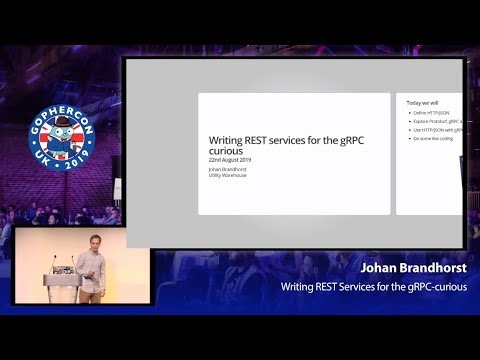
This GopherCon UK 2019 presentation from our maintainer [@JohanBrandhorst](https://github.com/johanbrandhorst) provides a good intro to using the gRPC-Gateway. It uses the following boilerplate repo as a base: https://github.com/johanbrandhorst/grpc-gateway-boilerplate.
## Parameters and flags
During code generation with `protoc`, flags to gRPC-Gateway tools must be passed
through `protoc` using one of 2 patterns:
- as part of the `--_out` `protoc` parameter: `--_out=:`
```sh
--grpc-gateway_out=logtostderr=true,repeated_path_param_separator=ssv:.
--openapiv2_out=logtostderr=true,repeated_path_param_separator=ssv:.
```
- using additional `--_opt` parameters: `--_opt=[,]*`
```sh
--grpc-gateway_opt logtostderr=true,repeated_path_param_separator=ssv
# or separately
--grpc-gateway_opt logtostderr=true --grpc-gateway_opt repeated_path_param_separator=ssv
--openapiv2_opt logtostderr=true,repeated_path_param_separator=ssv
# or separately
--openapiv2_opt logtostderr=true --openapiv2_opt repeated_path_param_separator=ssv
```
`protoc-gen-grpc-gateway` supports custom mapping from Protobuf `import` to
Golang import paths. They are compatible with
[the parameters with the same names in `protoc-gen-go`](https://github.com/golang/protobuf#parameters).
In addition, we also support the `request_context` parameter in order to use the
`http.Request`'s Context (only for Go 1.7 and above). This parameter can be
useful to pass the request-scoped context between the gateway and the gRPC service.
`protoc-gen-grpc-gateway` also supports some more command line flags to control
logging. You can give these flags together with the parameters above. Run
`protoc-gen-grpc-gateway --help` for more details about the flags.
Similarly, `protoc-gen-openapiv2` supports command-line flags to control OpenAPI
output (for example, `json_names_for_fields` to output JSON names for fields
instead of protobuf names). Run `protoc-gen-openapiv2 --help` for more flag
details. Further OpenAPI customization is possible by annotating your `.proto`
files with options from
[openapiv2.proto](protoc-gen-openapiv2/options/openapiv2.proto) - see
[a_bit_of_everything.proto](examples/internal/proto/examplepb/a_bit_of_everything.proto)
for examples.
## More examples
More examples are available under the `examples` directory.
- `proto/examplepb/echo_service.proto`, `proto/examplepb/a_bit_of_everything.proto`, `proto/examplepb/unannotated_echo_service.proto`: service definition
- `proto/examplepb/echo_service.pb.go`, `proto/examplepb/a_bit_of_everything.pb.go`, `proto/examplepb/unannotated_echo_service.pb.go`: [generated] stub of the service
- `proto/examplepb/echo_service.pb.gw.go`, `proto/examplepb/a_bit_of_everything.pb.gw.go`, `proto/examplepb/uannotated_echo_service.pb.gw.go`: [generated] reverse proxy for the service
- `proto/examplepb/unannotated_echo_service.yaml`: gRPC API Configuration for `unannotated_echo_service.proto`
- `server/main.go`: service implementation
- `main.go`: entrypoint of the generated reverse proxy
To use the same port for custom HTTP handlers (e.g. serving `swagger.json`),
gRPC-Gateway, and a gRPC server, see
[this example by CoreOS](https://github.com/philips/grpc-gateway-example/blob/master/cmd/serve.go)
(and its accompanying [blog post](https://coreos.com/blog/grpc-protobufs-swagger.html)).
## Features
### Supported
- Generating JSON API handlers.
- Method parameters in the request body.
- Method parameters in the request path.
- Method parameters in the query string.
- Enum fields in the path parameter (including repeated enum fields).
- Mapping streaming APIs to newline-delimited JSON streams.
- Mapping HTTP headers with `Grpc-Metadata-` prefix to gRPC metadata (prefixed with `grpcgateway-`)
- Optionally emitting API definitions for
[OpenAPI (Swagger) v2](https://swagger.io/docs/specification/2-0/basic-structure/).
- Setting [gRPC timeouts](https://github.com/grpc/grpc/blob/master/doc/PROTOCOL-HTTP2.md#requests)
through inbound HTTP `Grpc-Timeout` header.
- Partial support for [gRPC API Configuration](https://cloud.google.com/endpoints/docs/grpc/grpc-service-config)
files as an alternative to annotation.
- Automatically translating PATCH requests into Field Mask gRPC requests. See
[the docs](https://grpc-ecosystem.github.io/grpc-gateway/docs/mapping/patch_feature/)
for more information.
### No plan to support
But patches are welcome.
- Method parameters in HTTP headers.
- Handling trailer metadata.
- Encoding request/response body in XML.
- True bi-directional streaming.
## Mapping gRPC to HTTP
- [How gRPC error codes map to HTTP status codes in the response](https://github.com/grpc-ecosystem/grpc-gateway/blob/master/runtime/errors.go#L15).
- HTTP request source IP is added as `X-Forwarded-For` gRPC request header.
- HTTP request host is added as `X-Forwarded-Host` gRPC request header.
- HTTP `Authorization` header is added as `authorization` gRPC request header.
- Remaining Permanent HTTP header keys (as specified by the IANA
[here](http://www.iana.org/assignments/message-headers/message-headers.xhtml)
are prefixed with `grpcgateway-` and added with their values to gRPC request
header.
- HTTP headers that start with 'Grpc-Metadata-' are mapped to gRPC metadata
(prefixed with `grpcgateway-`).
- While configurable, the default {un,}marshaling uses
[jsonpb](https://pkg.go.dev/github.com/golang/protobuf/jsonpb) with
`OrigName: true`.
## Contribution
See [CONTRIBUTING.md](http://github.com/grpc-ecosystem/grpc-gateway/blob/master/CONTRIBUTING.md).
## License
gRPC-Gateway is licensed under the BSD 3-Clause License.
See [LICENSE.txt](https://github.com/grpc-ecosystem/grpc-gateway/blob/master/LICENSE.txt) for more details.