# InferLoop
**Repository Path**: jumphone/InferLoop
## Basic Information
- **Project Name**: InferLoop
- **Description**: InferLoop
- **Primary Language**: Unknown
- **License**: MIT
- **Default Branch**: main
- **Homepage**: None
- **GVP Project**: No
## Statistics
- **Stars**: 0
- **Forks**: 0
- **Created**: 2023-04-12
- **Last Updated**: 2023-04-13
## Categories & Tags
**Categories**: Uncategorized
**Tags**: None
## README
 **InferLoop: leveraging single-cell chromatin accessibility for the signal of chromatin loop**, ***Briefings in Bioinformatics*, 2023, in press**
This tool is designed for inferring loop signals of cell clusters (bins) or individual cells (high depth) using scATAC-seq data
## 1. Instruction:
Section| Content | Platform
:-------------------------:|:-------------------------|:-------------------------:
Section I | [Using Signac to process the scATAC-seq data](#section-i-using-signac-to-process-the-scatac-seq-data) | R
Section II | [Using Cicero to predict global loops](#section-ii-using-cicero-to-predict-global-loops) | R
Section III | [Preparing input files of InferLoop](#section-iii-preparing-input-files-of-inferloop) | R
**Section IV ( Core )** | [Using InferLoop to infer loop signals](#section-iv-using-inferloop-to-infer-loop-signals) | R or Python3
Section V | [Generating cell-type specific loop signals](#section-v-inferring-cell-type-specific-loop-signals) | R
Section VI | [Identifying cell-type specific loops](#section-vi-identifying-cell-type-specific-loops) | R
## 2. Requirements:
**R 4.2.0**
library(data.table) # 1.14.2
library(stringr) # 1.4.0
library(parallel) # 4.2.0
library(hash) # 2.2.6.2
library(Seurat) # 4.1.1
library(Signac) # 1.7.0
library(monocle) # 2.24.1
#monocle2, https://www.bioconductor.org/packages/release/bioc/html/monocle.html
library(cicero) # 0.8.10
#cicero for monocle2, https://cole-trapnell-lab.github.io/cicero-release/docs/
library(glassoFast) # 1.0
**Python 3.7.9**
import sys
import _pickle as pickle
import numpy # 1.20.0
from scipy import stats # 1.5.4
## 3. Demo data:
Key words: scATAC-seq, 10x genomics, PBMC
File | Link
:-------------------------|:-------------------------
Counts | [atac_v1_pbmc_10k_filtered_peak_bc_matrix.h5](https://cf.10xgenomics.com/samples/cell-atac/1.0.1/atac_v1_pbmc_10k/atac_v1_pbmc_10k_filtered_peak_bc_matrix.h5)
Metadata | [atac_v1_pbmc_10k_singlecell.csv](https://cf.10xgenomics.com/samples/cell-atac/1.0.1/atac_v1_pbmc_10k/atac_v1_pbmc_10k_singlecell.csv)
Fragments | [atac_v1_pbmc_10k_fragments.tsv.gz](https://cf.10xgenomics.com/samples/cell-atac/1.0.1/atac_v1_pbmc_10k/atac_v1_pbmc_10k_fragments.tsv.gz)
Fragments index | [atac_v1_pbmc_10k_fragments.tsv.gz.tbi](https://cf.10xgenomics.com/samples/cell-atac/1.0.1/atac_v1_pbmc_10k/atac_v1_pbmc_10k_fragments.tsv.gz.tbi)
Annotation reference | [pbmc_10k_v3.rds](https://signac-objects.s3.amazonaws.com/pbmc_10k_v3.rds)
## 4. Demo code:
[The official website of Signac](https://stuartlab.org/signac/)
### Section I, Using Signac to process the scATAC-seq data
# /home/toolkit/tools/R4.2.0/bin/R
setwd('/home/disk/database/data/ICS_scHIC/fzz_website_demo')
library(Signac)
library(Seurat)
library(GenomeInfoDb)
library(EnsDb.Hsapiens.v75)
library(ggplot2)
library(patchwork)
set.seed(1234)
counts <- Read10X_h5(filename = "atac_v1_pbmc_10k_filtered_peak_bc_matrix.h5")
metadata <- read.csv(
file = "atac_v1_pbmc_10k_singlecell.csv",
header = TRUE,
row.names = 1
)
chrom_assay <- CreateChromatinAssay(
counts = counts,
sep = c(":", "-"),
genome = 'hg19',
fragments = 'atac_v1_pbmc_10k_fragments.tsv.gz',
min.cells = 10,
min.features = 200
)
pbmc <- CreateSeuratObject(
counts = chrom_assay,
assay = "peaks",
meta.data = metadata
)
annotations <- GetGRangesFromEnsDb(ensdb = EnsDb.Hsapiens.v75)
annotations@seqnames@values=paste0('chr',annotations@seqnames@values)
annotations@seqinfo@seqnames=paste0('chr',annotations@seqinfo@seqnames)
annotations@seqinfo@genome=rep('hg19',length(annotations@seqinfo@genome))
annotations@seqnames@values[which(annotations@seqnames@values=='chrMT')]='chrM'
annotations@seqinfo@seqnames[which(annotations@seqinfo@seqnames=='chrMT')]='chrM'
annotations@seqnames@values=factor(annotations@seqnames@values,levels=annotations@seqinfo@seqnames)
Annotation(pbmc) <- annotations
pbmc <- NucleosomeSignal(object = pbmc)
pbmc <- TSSEnrichment(object = pbmc, fast = FALSE)
pbmc$pct_reads_in_peaks <- pbmc$peak_region_fragments / pbmc$passed_filters * 100
pbmc$blacklist_ratio <- pbmc$blacklist_region_fragments / pbmc$peak_region_fragments
pbmc <- subset(
x = pbmc,
subset = peak_region_fragments > 3000 &
peak_region_fragments < 20000 &
pct_reads_in_peaks > 15 &
blacklist_ratio < 0.05 &
nucleosome_signal < 4 &
TSS.enrichment > 2
)
# Call peaks using MACS2
peaks <- CallPeaks(pbmc, macs2.path = "/home/toolkit/local/bin/macs2")
peaks <- keepStandardChromosomes(peaks, pruning.mode = "coarse")
peaks <- subsetByOverlaps(x = peaks, ranges = blacklist_hg19, invert = TRUE)
saveRDS(peaks, 'peaks_macs2.rds')
macs2_counts <- FeatureMatrix(
fragments = Fragments(pbmc),
features = peaks,
cells = colnames(pbmc)
)
pbmc[["macs2"]] <- CreateChromatinAssay(
counts = macs2_counts,
fragments = 'atac_v1_pbmc_10k_fragments.tsv.gz',
annotation = annotations
)
DefaultAssay(pbmc)='macs2'
pbmc <- RunTFIDF(pbmc)
pbmc <- FindTopFeatures(pbmc, min.cutoff = 'q0')
pbmc <- RunSVD(pbmc)
pbmc <- RunUMAP(object = pbmc, reduction = 'lsi', dims = 2:30)
pbmc <- FindNeighbors(object = pbmc, reduction = 'lsi', dims = 2:30)
pbmc <- FindClusters(object = pbmc, verbose = FALSE, algorithm = 3)
DimPlot(object = pbmc, label = TRUE) + NoLegend()
gene.activities <- GeneActivity(pbmc)
pbmc[['RNA']] <- CreateAssayObject(counts = gene.activities)
DefaultAssay(pbmc)='RNA'
pbmc <- RunTFIDF(pbmc)
pbmc_rna <- readRDS("pbmc_10k_v3.rds")
transfer.anchors <- FindTransferAnchors(
reference = pbmc_rna,
query = pbmc,
reduction = 'cca'
)
predicted.labels <- TransferData(
anchorset = transfer.anchors,
refdata = pbmc_rna$celltype,
weight.reduction = pbmc[['lsi']],
dims = 2:30
)
pbmc <- AddMetaData(object = pbmc, metadata = predicted.labels)
plot1 <- DimPlot(
object = pbmc_rna,
group.by = 'celltype',
label = TRUE,
repel = TRUE) + NoLegend() + ggtitle('scRNA-seq')
plot2 <- DimPlot(
object = pbmc,
group.by = 'predicted.id',
label = TRUE,
repel = TRUE) + NoLegend() + ggtitle('scATAC-seq')
plot1 + plot2
saveRDS(pbmc, file='pbmc_signac.rds')
[Click back to the top](#)
### Section II, Using Cicero to predict global loops
[The official website of Cicero](https://cole-trapnell-lab.github.io/cicero-release/docs/)
library(monocle)
library(cicero)
source('https://gitee.com/jumphone/public/raw/master/InferLoop.R')
pbmc=readRDS(file='pbmc_signac.rds')
DefaultAssay(pbmc)='macs2'
indata=as.matrix(pbmc[['macs2']]@data)
used_coords=pbmc@reductions$umap@cell.embeddings
genome.df=inferloop.getGenomeDF.hg19()
conns=inferloop.cicero(indata, used_coords, genome.df)
saveRDS(conns, file='conns_cicero.rds')
[Click back to the top](#)
### Section III, Preparing input files of InferLoop
source('https://gitee.com/jumphone/public/raw/master/InferLoop.R')
pbmc=readRDS(file='pbmc_signac.rds')
DefaultAssay(pbmc)='macs2'
conns=readRDS(file='conns_cicero.rds')
# The output loops of Cicero are not unique, and use top 400,000 loops will get top 200,000 unique loops
inferloop.writeNet(conns, "net.txt", cut=400000)
indata=as.matrix(pbmc[['macs2']]@data)
used_coords=pbmc@reductions$umap@cell.embeddings
BIN=inferloop.generateBin(indata,used_coords, n=100)
saveRDS(BIN, file='BIN.rds')
CLST=BIN$clst
write.table(BIN$mat,file='mat.txt', row.names=T,col.names=T,quote=F,sep='\t')
[Click back to the top](#)
### Section IV, Using InferLoop to infer loop signals
[Download 'mat.txt' and 'net.txt' of demo data](https://sourceforge.net/projects/inferloop/files/demo/)
#### R version
source('https://gitee.com/jumphone/public/raw/master/InferLoop.R')
mat=inferloop.loadSignal('mat.txt')
net=read.table('net.txt',sep='\t',header=F,row.names=NULL)
net_uniq=inferloop.getUniqLoop(net)
MAT=inferloop.inferLoopSignal(mat, net_uniq, r=0)
write.table(MAT,file='signal_mat.txt', row.names=T,col.names=T,quote=F,sep='\t')
#### Python3 version
mkdir output
python3 inferloop/step0_uniqNet.py net.txt output/net_uniq.txt
python3 inferloop/step1_buildIndex.py output/net_uniq.txt mat.txt output/mat.index
python3 inferloop/step2_runInferLoop.py output/mat.index output/signal_mat.txt
# In order to adjust the parameter "r", users can modify "R" in "inferloop/step2_runInferLoop.py"
[Click back to the top](#)
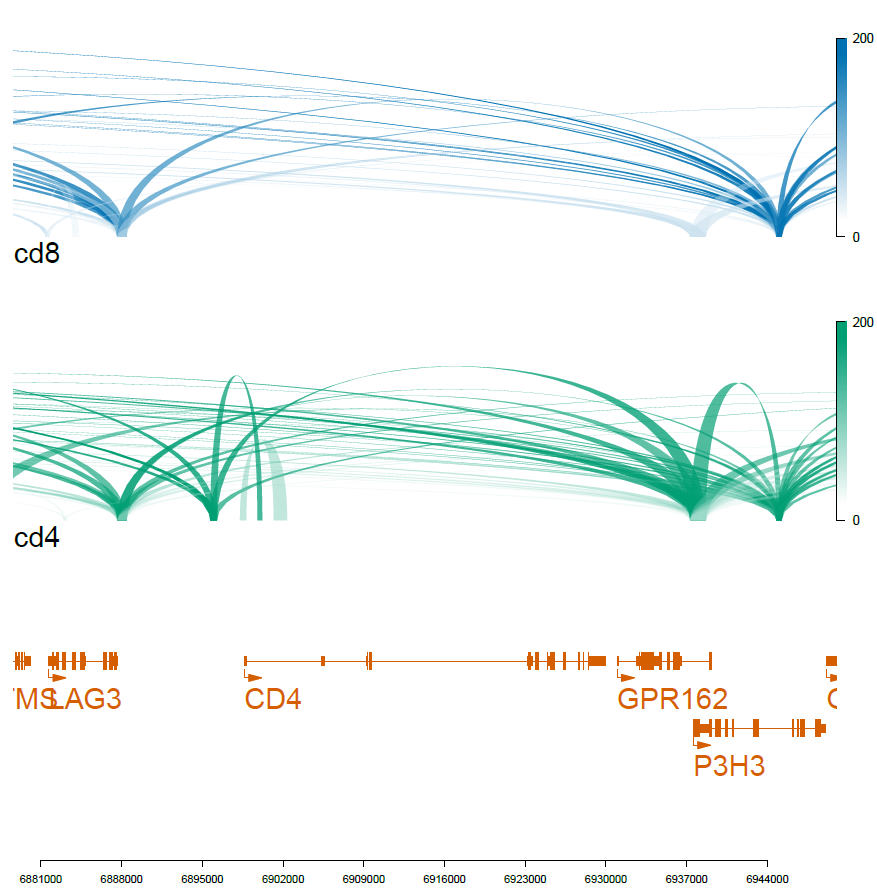
### Section V, Inferring cell-type specific loop signals
source('https://gitee.com/jumphone/public/raw/master/InferLoop.R')
pbmc=readRDS(file='pbmc_signac.rds')
DefaultAssay(pbmc)='macs2'
MAT=inferloop.loadSignal('output/signal_mat.txt')
CLST=readRDS('BIN.rds')$clst
MAT_CELL=inferloop.bin2cell(MAT, CLST)
TYPE=pbmc$predicted.id
MAT_TYPE=.generate_mean(MAT_CELL, TYPE)
saveRDS(MAT_TYPE, 'signal_mat_type.rds')
##################################
library(trackViewer)
library(InteractionSet)
library(TxDb.Hsapiens.UCSC.hg19.knownGene)
library(org.Hs.eg.db)
#####################
# CD4 gene, chr12:6898638-6929976
range <- GRanges("chr12", IRanges(6898638-20000, 6929976+20000))
ids <- getGeneIDsFromTxDb(range, TxDb.Hsapiens.UCSC.hg19.knownGene)
symbols <- mget(ids, org.Hs.egSYMBOL)
genes <- geneTrack(ids, TxDb.Hsapiens.UCSC.hg19.knownGene,
symbols, asList=FALSE)
#####################
loop=inferloop.splitLoop(rownames(MAT))
anchor1=inferloop.bed2granges(inferloop.splitLoop(loop[,1], '-',3))
anchor2=inferloop.bed2granges(inferloop.splitLoop(loop[,2], '-',3))
gi=GInteractions(anchor1,anchor2)
TMP=MAT_TYPE
TMP[which(TMP<0)]=0
score_type=as.data.frame(TMP)
score_type[which(score_type<0)]=0
score_CD4_Naive=score_type$'CD4 Naive'
score_CD8_Naive=score_type$'CD8 Naive'
gi_cd4=gi
gi_cd8=gi
mcols(gi_cd4)$score=score_CD4_Naive*100
mcols(gi_cd8)$score=score_CD8_Naive*100
############################
cd4 <- gi2track(gi_cd4)
cd8 <- gi2track(gi_cd8)
############################
setTrackStyleParam(cd4, "tracktype", "link")
setTrackStyleParam(cd4, "breaks", c(seq(from=0, to=50, by=10), 200))
setTrackStyleParam(cd8, "tracktype", "link")
setTrackStyleParam(cd8, "breaks", c(seq(from=0, to=50, by=10), 200))
optSty <- optimizeStyle(trackList(genes, cd4, cd8), theme="safe")
trackListW <- optSty$tracks
viewerStyleW <- optSty$style
viewTracks(trackListW, gr=range, viewerStyle=viewerStyleW)
pdf('f01_celltype_ILS.pdf',width=7,height=7)
viewTracks(trackListW, gr=range, viewerStyle=viewerStyleW)
dev.off()
##################################
**InferLoop: leveraging single-cell chromatin accessibility for the signal of chromatin loop**, ***Briefings in Bioinformatics*, 2023, in press**
This tool is designed for inferring loop signals of cell clusters (bins) or individual cells (high depth) using scATAC-seq data
## 1. Instruction:
Section| Content | Platform
:-------------------------:|:-------------------------|:-------------------------:
Section I | [Using Signac to process the scATAC-seq data](#section-i-using-signac-to-process-the-scatac-seq-data) | R
Section II | [Using Cicero to predict global loops](#section-ii-using-cicero-to-predict-global-loops) | R
Section III | [Preparing input files of InferLoop](#section-iii-preparing-input-files-of-inferloop) | R
**Section IV ( Core )** | [Using InferLoop to infer loop signals](#section-iv-using-inferloop-to-infer-loop-signals) | R or Python3
Section V | [Generating cell-type specific loop signals](#section-v-inferring-cell-type-specific-loop-signals) | R
Section VI | [Identifying cell-type specific loops](#section-vi-identifying-cell-type-specific-loops) | R
## 2. Requirements:
**R 4.2.0**
library(data.table) # 1.14.2
library(stringr) # 1.4.0
library(parallel) # 4.2.0
library(hash) # 2.2.6.2
library(Seurat) # 4.1.1
library(Signac) # 1.7.0
library(monocle) # 2.24.1
#monocle2, https://www.bioconductor.org/packages/release/bioc/html/monocle.html
library(cicero) # 0.8.10
#cicero for monocle2, https://cole-trapnell-lab.github.io/cicero-release/docs/
library(glassoFast) # 1.0
**Python 3.7.9**
import sys
import _pickle as pickle
import numpy # 1.20.0
from scipy import stats # 1.5.4
## 3. Demo data:
Key words: scATAC-seq, 10x genomics, PBMC
File | Link
:-------------------------|:-------------------------
Counts | [atac_v1_pbmc_10k_filtered_peak_bc_matrix.h5](https://cf.10xgenomics.com/samples/cell-atac/1.0.1/atac_v1_pbmc_10k/atac_v1_pbmc_10k_filtered_peak_bc_matrix.h5)
Metadata | [atac_v1_pbmc_10k_singlecell.csv](https://cf.10xgenomics.com/samples/cell-atac/1.0.1/atac_v1_pbmc_10k/atac_v1_pbmc_10k_singlecell.csv)
Fragments | [atac_v1_pbmc_10k_fragments.tsv.gz](https://cf.10xgenomics.com/samples/cell-atac/1.0.1/atac_v1_pbmc_10k/atac_v1_pbmc_10k_fragments.tsv.gz)
Fragments index | [atac_v1_pbmc_10k_fragments.tsv.gz.tbi](https://cf.10xgenomics.com/samples/cell-atac/1.0.1/atac_v1_pbmc_10k/atac_v1_pbmc_10k_fragments.tsv.gz.tbi)
Annotation reference | [pbmc_10k_v3.rds](https://signac-objects.s3.amazonaws.com/pbmc_10k_v3.rds)
## 4. Demo code:
[The official website of Signac](https://stuartlab.org/signac/)
### Section I, Using Signac to process the scATAC-seq data
# /home/toolkit/tools/R4.2.0/bin/R
setwd('/home/disk/database/data/ICS_scHIC/fzz_website_demo')
library(Signac)
library(Seurat)
library(GenomeInfoDb)
library(EnsDb.Hsapiens.v75)
library(ggplot2)
library(patchwork)
set.seed(1234)
counts <- Read10X_h5(filename = "atac_v1_pbmc_10k_filtered_peak_bc_matrix.h5")
metadata <- read.csv(
file = "atac_v1_pbmc_10k_singlecell.csv",
header = TRUE,
row.names = 1
)
chrom_assay <- CreateChromatinAssay(
counts = counts,
sep = c(":", "-"),
genome = 'hg19',
fragments = 'atac_v1_pbmc_10k_fragments.tsv.gz',
min.cells = 10,
min.features = 200
)
pbmc <- CreateSeuratObject(
counts = chrom_assay,
assay = "peaks",
meta.data = metadata
)
annotations <- GetGRangesFromEnsDb(ensdb = EnsDb.Hsapiens.v75)
annotations@seqnames@values=paste0('chr',annotations@seqnames@values)
annotations@seqinfo@seqnames=paste0('chr',annotations@seqinfo@seqnames)
annotations@seqinfo@genome=rep('hg19',length(annotations@seqinfo@genome))
annotations@seqnames@values[which(annotations@seqnames@values=='chrMT')]='chrM'
annotations@seqinfo@seqnames[which(annotations@seqinfo@seqnames=='chrMT')]='chrM'
annotations@seqnames@values=factor(annotations@seqnames@values,levels=annotations@seqinfo@seqnames)
Annotation(pbmc) <- annotations
pbmc <- NucleosomeSignal(object = pbmc)
pbmc <- TSSEnrichment(object = pbmc, fast = FALSE)
pbmc$pct_reads_in_peaks <- pbmc$peak_region_fragments / pbmc$passed_filters * 100
pbmc$blacklist_ratio <- pbmc$blacklist_region_fragments / pbmc$peak_region_fragments
pbmc <- subset(
x = pbmc,
subset = peak_region_fragments > 3000 &
peak_region_fragments < 20000 &
pct_reads_in_peaks > 15 &
blacklist_ratio < 0.05 &
nucleosome_signal < 4 &
TSS.enrichment > 2
)
# Call peaks using MACS2
peaks <- CallPeaks(pbmc, macs2.path = "/home/toolkit/local/bin/macs2")
peaks <- keepStandardChromosomes(peaks, pruning.mode = "coarse")
peaks <- subsetByOverlaps(x = peaks, ranges = blacklist_hg19, invert = TRUE)
saveRDS(peaks, 'peaks_macs2.rds')
macs2_counts <- FeatureMatrix(
fragments = Fragments(pbmc),
features = peaks,
cells = colnames(pbmc)
)
pbmc[["macs2"]] <- CreateChromatinAssay(
counts = macs2_counts,
fragments = 'atac_v1_pbmc_10k_fragments.tsv.gz',
annotation = annotations
)
DefaultAssay(pbmc)='macs2'
pbmc <- RunTFIDF(pbmc)
pbmc <- FindTopFeatures(pbmc, min.cutoff = 'q0')
pbmc <- RunSVD(pbmc)
pbmc <- RunUMAP(object = pbmc, reduction = 'lsi', dims = 2:30)
pbmc <- FindNeighbors(object = pbmc, reduction = 'lsi', dims = 2:30)
pbmc <- FindClusters(object = pbmc, verbose = FALSE, algorithm = 3)
DimPlot(object = pbmc, label = TRUE) + NoLegend()
gene.activities <- GeneActivity(pbmc)
pbmc[['RNA']] <- CreateAssayObject(counts = gene.activities)
DefaultAssay(pbmc)='RNA'
pbmc <- RunTFIDF(pbmc)
pbmc_rna <- readRDS("pbmc_10k_v3.rds")
transfer.anchors <- FindTransferAnchors(
reference = pbmc_rna,
query = pbmc,
reduction = 'cca'
)
predicted.labels <- TransferData(
anchorset = transfer.anchors,
refdata = pbmc_rna$celltype,
weight.reduction = pbmc[['lsi']],
dims = 2:30
)
pbmc <- AddMetaData(object = pbmc, metadata = predicted.labels)
plot1 <- DimPlot(
object = pbmc_rna,
group.by = 'celltype',
label = TRUE,
repel = TRUE) + NoLegend() + ggtitle('scRNA-seq')
plot2 <- DimPlot(
object = pbmc,
group.by = 'predicted.id',
label = TRUE,
repel = TRUE) + NoLegend() + ggtitle('scATAC-seq')
plot1 + plot2
saveRDS(pbmc, file='pbmc_signac.rds')
[Click back to the top](#)
### Section II, Using Cicero to predict global loops
[The official website of Cicero](https://cole-trapnell-lab.github.io/cicero-release/docs/)
library(monocle)
library(cicero)
source('https://gitee.com/jumphone/public/raw/master/InferLoop.R')
pbmc=readRDS(file='pbmc_signac.rds')
DefaultAssay(pbmc)='macs2'
indata=as.matrix(pbmc[['macs2']]@data)
used_coords=pbmc@reductions$umap@cell.embeddings
genome.df=inferloop.getGenomeDF.hg19()
conns=inferloop.cicero(indata, used_coords, genome.df)
saveRDS(conns, file='conns_cicero.rds')
[Click back to the top](#)
### Section III, Preparing input files of InferLoop
source('https://gitee.com/jumphone/public/raw/master/InferLoop.R')
pbmc=readRDS(file='pbmc_signac.rds')
DefaultAssay(pbmc)='macs2'
conns=readRDS(file='conns_cicero.rds')
# The output loops of Cicero are not unique, and use top 400,000 loops will get top 200,000 unique loops
inferloop.writeNet(conns, "net.txt", cut=400000)
indata=as.matrix(pbmc[['macs2']]@data)
used_coords=pbmc@reductions$umap@cell.embeddings
BIN=inferloop.generateBin(indata,used_coords, n=100)
saveRDS(BIN, file='BIN.rds')
CLST=BIN$clst
write.table(BIN$mat,file='mat.txt', row.names=T,col.names=T,quote=F,sep='\t')
[Click back to the top](#)
### Section IV, Using InferLoop to infer loop signals
[Download 'mat.txt' and 'net.txt' of demo data](https://sourceforge.net/projects/inferloop/files/demo/)
#### R version
source('https://gitee.com/jumphone/public/raw/master/InferLoop.R')
mat=inferloop.loadSignal('mat.txt')
net=read.table('net.txt',sep='\t',header=F,row.names=NULL)
net_uniq=inferloop.getUniqLoop(net)
MAT=inferloop.inferLoopSignal(mat, net_uniq, r=0)
write.table(MAT,file='signal_mat.txt', row.names=T,col.names=T,quote=F,sep='\t')
#### Python3 version
mkdir output
python3 inferloop/step0_uniqNet.py net.txt output/net_uniq.txt
python3 inferloop/step1_buildIndex.py output/net_uniq.txt mat.txt output/mat.index
python3 inferloop/step2_runInferLoop.py output/mat.index output/signal_mat.txt
# In order to adjust the parameter "r", users can modify "R" in "inferloop/step2_runInferLoop.py"
[Click back to the top](#)
### Section V, Inferring cell-type specific loop signals
source('https://gitee.com/jumphone/public/raw/master/InferLoop.R')
pbmc=readRDS(file='pbmc_signac.rds')
DefaultAssay(pbmc)='macs2'
MAT=inferloop.loadSignal('output/signal_mat.txt')
CLST=readRDS('BIN.rds')$clst
MAT_CELL=inferloop.bin2cell(MAT, CLST)
TYPE=pbmc$predicted.id
MAT_TYPE=.generate_mean(MAT_CELL, TYPE)
saveRDS(MAT_TYPE, 'signal_mat_type.rds')
##################################
library(trackViewer)
library(InteractionSet)
library(TxDb.Hsapiens.UCSC.hg19.knownGene)
library(org.Hs.eg.db)
#####################
# CD4 gene, chr12:6898638-6929976
range <- GRanges("chr12", IRanges(6898638-20000, 6929976+20000))
ids <- getGeneIDsFromTxDb(range, TxDb.Hsapiens.UCSC.hg19.knownGene)
symbols <- mget(ids, org.Hs.egSYMBOL)
genes <- geneTrack(ids, TxDb.Hsapiens.UCSC.hg19.knownGene,
symbols, asList=FALSE)
#####################
loop=inferloop.splitLoop(rownames(MAT))
anchor1=inferloop.bed2granges(inferloop.splitLoop(loop[,1], '-',3))
anchor2=inferloop.bed2granges(inferloop.splitLoop(loop[,2], '-',3))
gi=GInteractions(anchor1,anchor2)
TMP=MAT_TYPE
TMP[which(TMP<0)]=0
score_type=as.data.frame(TMP)
score_type[which(score_type<0)]=0
score_CD4_Naive=score_type$'CD4 Naive'
score_CD8_Naive=score_type$'CD8 Naive'
gi_cd4=gi
gi_cd8=gi
mcols(gi_cd4)$score=score_CD4_Naive*100
mcols(gi_cd8)$score=score_CD8_Naive*100
############################
cd4 <- gi2track(gi_cd4)
cd8 <- gi2track(gi_cd8)
############################
setTrackStyleParam(cd4, "tracktype", "link")
setTrackStyleParam(cd4, "breaks", c(seq(from=0, to=50, by=10), 200))
setTrackStyleParam(cd8, "tracktype", "link")
setTrackStyleParam(cd8, "breaks", c(seq(from=0, to=50, by=10), 200))
optSty <- optimizeStyle(trackList(genes, cd4, cd8), theme="safe")
trackListW <- optSty$tracks
viewerStyleW <- optSty$style
viewTracks(trackListW, gr=range, viewerStyle=viewerStyleW)
pdf('f01_celltype_ILS.pdf',width=7,height=7)
viewTracks(trackListW, gr=range, viewerStyle=viewerStyleW)
dev.off()
##################################
 [Click back to the top](#)
### Section VI, Identifying cell-type specific loops
pbmc[['ILS']]=CreateAssayObject(data = MAT_CELL)
DefaultAssay(pbmc)='ILS'
Idents(pbmc)=pbmc$predicted.id
cd4_markers=FindMarkers(pbmc, ident.1='CD4 Naive', ident.2='CD8 Naive',test.use='t', only.pos=T, min.pct = 0.1, logfc.threshold = 0.1,verbose=T)
cd8_markers=FindMarkers(pbmc, ident.1='CD8 Naive', ident.2='CD4 Naive',test.use='t', only.pos=T, min.pct = 0.1, logfc.threshold = 0.1,verbose=T)
saveRDS(cd4_markers, file='cd4_markers.rds')
saveRDS(cd8_markers, file='cd8_markers.rds')
N=20000
cd4_loops=rownames(cd4_markers[1:N,])
cd8_loops=rownames(cd8_markers[1:N,])
##################################
library(trackViewer)
library(InteractionSet)
library(TxDb.Hsapiens.UCSC.hg19.knownGene)
library(org.Hs.eg.db)
#####################
# CD4 gene, chr12:6898638-6929976
range <- GRanges("chr12", IRanges(6898638-20000, 6929976+20000))
ids <- getGeneIDsFromTxDb(range, TxDb.Hsapiens.UCSC.hg19.knownGene)
symbols <- mget(ids, org.Hs.egSYMBOL)
genes <- geneTrack(ids, TxDb.Hsapiens.UCSC.hg19.knownGene,
symbols, asList=FALSE)
#####################
loop=inferloop.splitLoop(rownames(MAT))
anchor1=inferloop.bed2granges(inferloop.splitLoop(loop[,1], '-',3))
anchor2=inferloop.bed2granges(inferloop.splitLoop(loop[,2], '-',3))
gi=GInteractions(anchor1,anchor2)
TMP=MAT_TYPE
TMP[which(TMP<0)]=0
score_type=as.data.frame(TMP)
score_type[which(score_type<0)]=0
score_CD4_Naive=score_type$'CD4 Naive'
score_CD4_Naive[which(! rownames(MAT) %in% cd4_loops)]=0
score_CD8_Naive=score_type$'CD8 Naive'
score_CD8_Naive[which(! rownames(MAT) %in% cd8_loops)]=0
gi_cd4=gi
gi_cd8=gi
mcols(gi_cd4)$score=score_CD4_Naive*100
mcols(gi_cd8)$score=score_CD8_Naive*100
############################
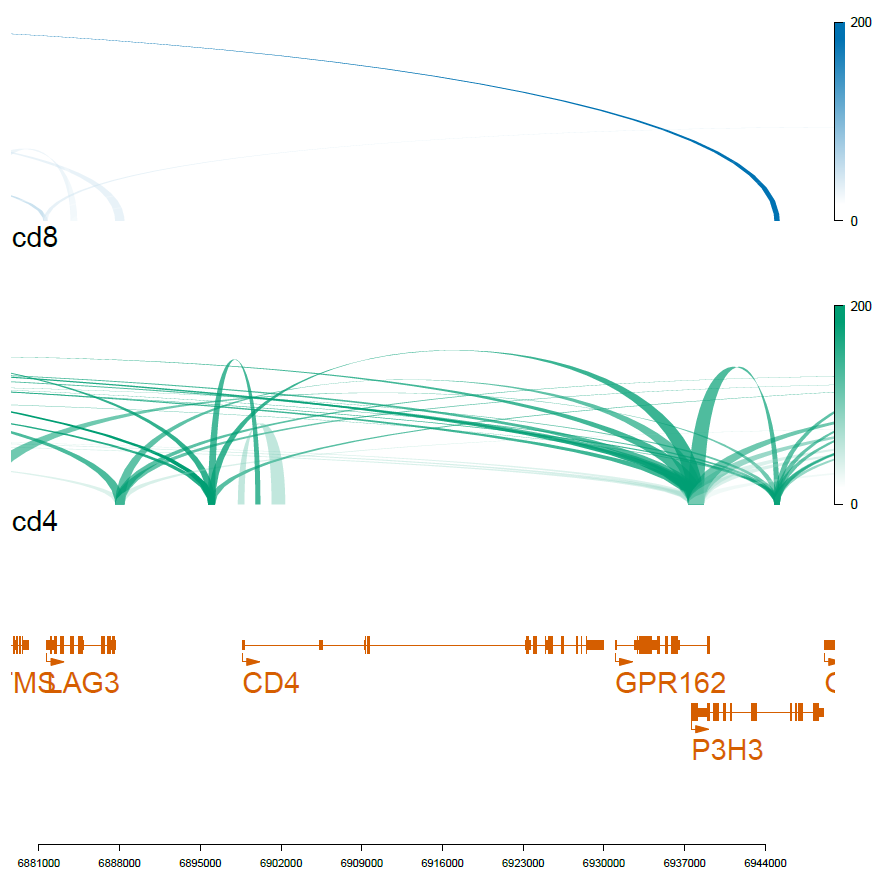
cd4 <- gi2track(gi_cd4)
cd8 <- gi2track(gi_cd8)
############################
setTrackStyleParam(cd4, "tracktype", "link")
setTrackStyleParam(cd4, "breaks", c(seq(from=0, to=50, by=10), 200))
setTrackStyleParam(cd8, "tracktype", "link")
setTrackStyleParam(cd8, "breaks", c(seq(from=0, to=50, by=10), 200))
optSty <- optimizeStyle(trackList(genes, cd4, cd8), theme="safe")
trackListW <- optSty$tracks
viewerStyleW <- optSty$style
viewTracks(trackListW, gr=range, viewerStyle=viewerStyleW)
pdf('f02_celltype_loops.pdf',width=7,height=7)
viewTracks(trackListW, gr=range, viewerStyle=viewerStyleW)
dev.off()
##################################
[Click back to the top](#)
### Section VI, Identifying cell-type specific loops
pbmc[['ILS']]=CreateAssayObject(data = MAT_CELL)
DefaultAssay(pbmc)='ILS'
Idents(pbmc)=pbmc$predicted.id
cd4_markers=FindMarkers(pbmc, ident.1='CD4 Naive', ident.2='CD8 Naive',test.use='t', only.pos=T, min.pct = 0.1, logfc.threshold = 0.1,verbose=T)
cd8_markers=FindMarkers(pbmc, ident.1='CD8 Naive', ident.2='CD4 Naive',test.use='t', only.pos=T, min.pct = 0.1, logfc.threshold = 0.1,verbose=T)
saveRDS(cd4_markers, file='cd4_markers.rds')
saveRDS(cd8_markers, file='cd8_markers.rds')
N=20000
cd4_loops=rownames(cd4_markers[1:N,])
cd8_loops=rownames(cd8_markers[1:N,])
##################################
library(trackViewer)
library(InteractionSet)
library(TxDb.Hsapiens.UCSC.hg19.knownGene)
library(org.Hs.eg.db)
#####################
# CD4 gene, chr12:6898638-6929976
range <- GRanges("chr12", IRanges(6898638-20000, 6929976+20000))
ids <- getGeneIDsFromTxDb(range, TxDb.Hsapiens.UCSC.hg19.knownGene)
symbols <- mget(ids, org.Hs.egSYMBOL)
genes <- geneTrack(ids, TxDb.Hsapiens.UCSC.hg19.knownGene,
symbols, asList=FALSE)
#####################
loop=inferloop.splitLoop(rownames(MAT))
anchor1=inferloop.bed2granges(inferloop.splitLoop(loop[,1], '-',3))
anchor2=inferloop.bed2granges(inferloop.splitLoop(loop[,2], '-',3))
gi=GInteractions(anchor1,anchor2)
TMP=MAT_TYPE
TMP[which(TMP<0)]=0
score_type=as.data.frame(TMP)
score_type[which(score_type<0)]=0
score_CD4_Naive=score_type$'CD4 Naive'
score_CD4_Naive[which(! rownames(MAT) %in% cd4_loops)]=0
score_CD8_Naive=score_type$'CD8 Naive'
score_CD8_Naive[which(! rownames(MAT) %in% cd8_loops)]=0
gi_cd4=gi
gi_cd8=gi
mcols(gi_cd4)$score=score_CD4_Naive*100
mcols(gi_cd8)$score=score_CD8_Naive*100
############################
cd4 <- gi2track(gi_cd4)
cd8 <- gi2track(gi_cd8)
############################
setTrackStyleParam(cd4, "tracktype", "link")
setTrackStyleParam(cd4, "breaks", c(seq(from=0, to=50, by=10), 200))
setTrackStyleParam(cd8, "tracktype", "link")
setTrackStyleParam(cd8, "breaks", c(seq(from=0, to=50, by=10), 200))
optSty <- optimizeStyle(trackList(genes, cd4, cd8), theme="safe")
trackListW <- optSty$tracks
viewerStyleW <- optSty$style
viewTracks(trackListW, gr=range, viewerStyle=viewerStyleW)
pdf('f02_celltype_loops.pdf',width=7,height=7)
viewTracks(trackListW, gr=range, viewerStyle=viewerStyleW)
dev.off()
##################################
 [Click back to the top](#)