# diffusion_model
**Repository Path**: li_kaikai/diffusion_model
## Basic Information
- **Project Name**: diffusion_model
- **Description**: No description available
- **Primary Language**: Unknown
- **License**: MIT
- **Default Branch**: main
- **Homepage**: None
- **GVP Project**: No
## Statistics
- **Stars**: 0
- **Forks**: 0
- **Created**: 2024-08-29
- **Last Updated**: 2024-08-29
## Categories & Tags
**Categories**: Uncategorized
**Tags**: None
## README
# Diffusion model in web browser
[Online Demo! Run it in your web browser ](https://wangjia184.github.io/diffusion_model/)
* 第一集: https://www.bilibili.com/video/BV1tz4y1h7q1 | 正态分布 | 基本设定 | 公式推导 |
* 第二集: https://www.bilibili.com/video/BV1xQ4y1w7ex | 神经网络 | 概率空间 | 边缘概率 | 各向同性高斯分布 |
* 第三集: https://www.bilibili.com/video/BV1hZ421y7id | 三维动画展示全过程
* 第四集: https://www.bilibili.com/video/BV1gK421b7W9 | 神经网络的学习目标以及训练
* 第五集: https://www.bilibili.com/video/BV12y421z7Mh/ | 花絮 | 热度图制作细节揭秘
[Youtube](https://www.youtube.com/watch?v=zEZOYZeIPUs&ab_channel=%E5%A4%A7%E7%99%BD%E8%AF%9DAI)
**UPDATE:**
* 2024-07-14 : Update online sample to use `WebGPU` if possible
* 2024-07-15 : Added DDIM sampling method
-------------------
## 1. DDPM Introduction
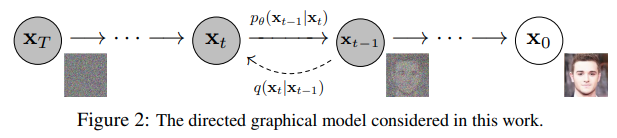
* $q$ - a fixed (or predefined) **forward** diffusion process of adding Gaussian noise to an image gradually, until ending up with pure noise
* $p_θ$ - a learned **reverse** denoising diffusion process, where a neural network is trained to gradually denoise an image starting from pure noise, until ending up with an actual image.
Both the forward and reverse process indexed by $t$ happen for some number of finite time steps $T$ (the DDPM authors use $T$=1000). You start with $t=0$ where you sample a real image $x_0$ from your data distribution, and the forward process samples some noise from a Gaussian distribution at each time step $t$, which is added to the image of the previous time step. Given a sufficiently large $T$ and a well behaved schedule for adding noise at each time step, you end up with what is called an *isotropic Gaussian distribution* at $t=T$ via a gradual process
## 2. Forward Process $q$

$$ x_0 \overset{q(x_1 | x_0)}{\rightarrow} x_1 \overset{q(x_2 | x_1)}{\rightarrow} x_2 \rightarrow \dots \rightarrow x_{T-1} \overset{q(x_{t} | x_{t-1})}{\rightarrow} x_T $$
This process is a markov chain, $x_t$ only depends on $x_{t-1}$. $q(x_{t} | x_{t-1})$ adds Gaussian noise at each time step $t$, according to a known variance schedule $β_{t}$
$$ x_t = \sqrt{1-β_t}\times x_{t-1} + \sqrt{β_t}\times \epsilon_{t} $$
* $β_t$ is not constant at each time step $t$. In fact one defines a so-called "variance schedule", which can be linear, quadratic, cosine, etc.
$$ 0 < β_1 < β_2 < β_3 < \dots < β_T < 1 $$
* $\epsilon_{t}$ Gaussian noise, sampled from standard normal distribution.
$$ x_t = \sqrt{1-β_t}\times x_{t-1} + \sqrt{β_t} \times \epsilon_{t} $$
Define $a_t = 1 - β_t$
$$ x_t = \sqrt{a_{t}}\times x_{t-1} + \sqrt{1-a_t} \times \epsilon_{t} $$
### 2.1 Relationship between $x_t$ and $x_{t-2}$
$$ x_{t-1} = \sqrt{a_{t-1}}\times x_{t-2} + \sqrt{1-a_{t-1}} \times \epsilon_{t-1}$$
$$ \Downarrow $$
$$ x_t = \sqrt{a_{t}} (\sqrt{a_{t-1}}\times x_{t-2} + \sqrt{1-a_{t-1}} \epsilon_{t-1}) + \sqrt{1-a_t} \times \epsilon_t $$
$$ \Downarrow $$
$$ x_t = \sqrt{a_{t}a_{t-1}}\times x_{t-2} + \sqrt{a_{t}(1-a_{t-1})} \epsilon_{t-1} + \sqrt{1-a_t} \times \epsilon_t $$
Because $N(\mu_{1},\sigma_{1}^{2}) + N(\mu_{2},\sigma_{2}^{2}) = N(\mu_{1}+\mu_{2},\sigma_{1}^{2} + \sigma_{2}^{2})$
Proof
$$x_{t} = \sqrt{\bar{a}_t}\times x_0+ \sqrt{1-\bar{a}_t}\times \epsilon , \epsilon \sim N(0,I) $$
$$ \Downarrow $$
$$ q(x_{t}|x_{0}) = \frac{1}{\sqrt{2\pi } \sqrt{1-\bar{a}_{t}}} e^{\left ( -\frac{1}{2}\frac{(x_{t}-\sqrt{\bar{a}_{t}}x_0)^2}{1-\bar{a}_{t}} \right ) } $$
# 3.Reverse Process $p$

Because $P(A|B) = \frac{ P(B|A)P(A) }{ P(B) }$
$$ p(x_{t-1}|x_{t},x_{0}) = \frac{ q(x_{t}|x_{t-1},x_{0})\times q(x_{t-1}|x_0)}{q(x_{t}|x_0)} $$
|
$$x_{t} = \sqrt{a_t}x_{t-1}+\sqrt{1-a_t}\times ϵ$$
|
~
|
$N(\sqrt{a_t}x_{t-1}, 1-a_{t})$
|
|
$$x_{t-1} = \sqrt{\bar{a}_{t-1}}x_0+ \sqrt{1-\bar{a}_{t-1}}\times ϵ$$
|
~
|
$N( \sqrt{\bar{a}_{t-1}}x_0, 1-\bar{a}_{t-1})$
|
|
$$x_{t} = \sqrt{\bar{a}_{t}}x_0+ \sqrt{1-\bar{a}_{t}}\times ϵ$$
|
~
|
$N( \sqrt{\bar{a}_{t}}x_0, 1-\bar{a}_{t})$
|
$$ q(x_{t}|x_{t-1},x_{0}) = \frac{1}{\sqrt{2\pi } \sqrt{1-a_{t}}} e^{\left ( -\frac{1}{2}\frac{(x_{t}-\sqrt{a_t}x_{t-1})^2}{1-a_{t}} \right ) } $$
$$ q(x_{t-1}|x_{0}) = \frac{1}{\sqrt{2\pi } \sqrt{1-\bar{a}_{t-1}}} e^{\left ( -\frac{1}{2}\frac{(x_{t-1}-\sqrt{\bar{a}_{t-1}}x_0)^2}{1-\bar{a}_{t-1}} \right ) } $$
$$ q(x_{t}|x_{0}) = \frac{1}{\sqrt{2\pi } \sqrt{1-\bar{a}_{t}}} e^{\left ( -\frac{1}{2}\frac{(x_{t}-\sqrt{\bar{a}_{t}}x_0)^2}{1-\bar{a}_{t}} \right ) } $$
$$ \frac{ q(x_{t}|x_{t-1},x_{0})\times q(x_{t-1}|x_0)}{q(x_{t}|x_0)} = \left [
\frac{1}{\sqrt{2\pi} \sqrt{1-a_{t}}} e^{\left ( -\frac{1}{2}\frac{(x_{t}-\sqrt{a_t}x_{t-1})^2}{1-a_{t}} \right ) }
\right ] *
\left [
\frac{1}{\sqrt{2\pi} \sqrt{1-\bar{a}_{t-1}}} e^{\left ( -\frac{1}{2}\frac{(x_{t-1}-\sqrt{\bar{a}_{t-1}}x_0)^2}{1-\bar{a}_{t-1}} \right ) }
\right ] \div
\left [
\frac{1}{\sqrt{2\pi} \sqrt{1-\bar{a}_{t}}} e^{\left ( -\frac{1}{2}\frac{(x_{t}-\sqrt{\bar{a}_{t}}x_0)^2}{1-\bar{a}_{t}} \right ) }
\right ] $$
$$ \Downarrow $$
$$
\frac{\sqrt{2\pi} \sqrt{1-\bar{a}_{t}}}{\sqrt{2\pi} \sqrt{1-a_{t}} \sqrt{2\pi} \sqrt{1-\bar{a}_{t-1}} }
e^{\left [ -\frac{1}{2}
\left (
\frac{(x_{t}-\sqrt{a_t}x_{t-1})^2}{1-a_{t}} +
\frac{(x_{t-1}-\sqrt{\bar{a}_{t-1}}x_0)^2}{1-\bar{a}_{t-1}} -
\frac{(x_{t}-\sqrt{\bar{a}_{t}}x_0)^2}{1-\bar{a}_{t}}
\right )
\right]}
$$
$$ \Downarrow $$
$$\frac{1}{\sqrt{2\pi} \left(
\frac{\sqrt{1-a_t} \sqrt{1-\bar{a}_{t-1}}}{\sqrt{1-\bar{a}_{t}}}
\right)}
\exp \left[ -\frac{1}{2}
\left(
\frac{(x_{t}-\sqrt{a_t}x_{t-1})^2}{1-a_t} +
\frac{(x_{t-1}-\sqrt{\bar{a}_{t-1}}x_0)^2}{1-\bar{a}_{t-1}} -
\frac{(x_{t}-\sqrt{\bar{a}_{t}}x_0)^2}{1-\bar{a}_{t}}
\right)
\right] $$
$$ \Downarrow $$
$$ \frac{1}{\sqrt{2\pi} \left(
\frac{\sqrt{1-a_t} \sqrt{1-\bar{a}_{t-1}}}{\sqrt{1-\bar{a}_{t}}}
\right)}
\exp \left[ -\frac{1}{2}
\left (
\frac{
x_{t}^2-2\sqrt{a_t}x_{t}x_{t-1}+{a_t}x_{t-1}^2
}{1-a_t} +
\frac{
x_{t-1}^2-2\sqrt{\bar{a}_{t-1}}x_0x_{t-1}+\bar{a}_{t-1}x_0^2
}{1-\bar{a}_{t-1}} -
\frac{(x_{t}-\sqrt{\bar{a}_{t}}x_0)^2}{1-\bar{a}_{t}}
\right)
\right] $$
$$ \Downarrow $$
$$\frac{1}{\sqrt{2\pi} \left(
\frac{\sqrt{1-a_t} \sqrt{1-\bar{a}_{t-1}}}{\sqrt{1-\bar{a}_{t}}}
\right)}
\exp \left[ -\frac{1}{2}
\frac{
\left(
x_{t-1} - \left(
\frac{\sqrt{a_t}(1-\bar{a}_{t-1})}{1-\bar{a}_t}x_t
+
\frac{\sqrt{\bar{a}_{t-1}}(1-a_t)}{1-\bar{a}_t}x_0
\right)
\right)^2
}{ \left(
\frac{\sqrt{1-a_t} \sqrt{1-\bar{a}_{t-1}}}{\sqrt{1-\bar{a}_{t}}}
\right)^2
} \right]$$
$$ \Downarrow $$
$$ p(x_{t-1}|x_{t}) \sim N\left(
\frac{\sqrt{a_t}(1-\bar{a}_{t-1})}{1-\bar{a}_t}x_t
+
\frac{\sqrt{\bar{a}_{t-1}}(1-a_t)}{1-\bar{a}_t}x_0,
\left( \frac{\sqrt{1-a_t} \sqrt{1-\bar{a}_{t-1}}}{\sqrt{1-\bar{a}_{t}}} \right)^2
\right) $$
Because $x_{t} = \sqrt{\bar{a}_t}\times x_0+ \sqrt{1-\bar{a}_t}\times \epsilon$, $x_0 = \frac{x_t - \sqrt{1-\bar{a}_t}\times \epsilon}{\sqrt{\bar{a}_t}}$. Substitute $x_0$ with this formula.
$$ p(x_{t-1}|x_{t}) \sim N\left(
\frac{\sqrt{a_t}(1-\bar{a}_{t-1})}{1-\bar{a}_t}x_t
+
\frac{\sqrt{\bar{a}_{t-1}}(1-a_t)}{1-\bar{a}_t}\times \frac{x_t - \sqrt{1-\bar{a}_t}\times \epsilon}{\sqrt{\bar{a}_t}},
\frac{\beta_{t} (1-\bar{a}_{t-1})}{1-\bar{a}_{t}}
\right) $$
$$ p(x_{t-1}|x_{t}) \sim N\left(
\frac{\sqrt{a_t}(1-\bar{a}_{t-1})}{1-\bar{a}_t}x_t
+
\frac{\sqrt{\bar{a}_{t-1}}(1-a_t)}{1-\bar{a}_t}\times \frac{x_t - \sqrt{1-\bar{a}_t}\times \epsilon}{\sqrt{\bar{a}_t}},
\frac{\beta_{t} (1-\bar{a}_{t-1})}{1-\bar{a}_{t}}
\right) $$
**Note:** This `README.md` is intended solely for previewing on the Github page. If you wish to view the rendered page locally, please consult `README.raw.md`.