# starVLA
**Repository Path**: nilbody_0/starVLA
## Basic Information
- **Project Name**: starVLA
- **Description**: No description available
- **Primary Language**: Unknown
- **License**: Not specified
- **Default Branch**: starVLA
- **Homepage**: None
- **GVP Project**: No
## Statistics
- **Stars**: 0
- **Forks**: 0
- **Created**: 2026-02-12
- **Last Updated**: 2026-02-21
## Categories & Tags
**Categories**: Uncategorized
**Tags**: None
## README
# StarVLA: A Lego-like Codebase for Vision-Language-Action Model Developing
Collecting, integrating, and exploring cutting-edge technologies for generalist robots.
[](https://huggingface.co/StarVLA) [](https://github.com/starVLA/starVLA/issues/64#issuecomment-3715403845)
**[2026/01/29]** Calvin benchmark experiments were conducted by the UNT team. For inquiries, please contact Zhijie Song (1600013008@pku.edu.cn) or Feng Yan (bphengyan@163.com).
**[2025/12/25]** We've simultaneously established pipelines for [Behavior-1K](examples/Behavior), [RoboTwin 2.0](examples/Robotwin), and CALVIN. We'd love to collaborate and share baseline results for more benchs with the community!
**[2025/12/25]** We've released RoboCasa evaluation support, which trained **without pretraining and reach SOTA performance**. Check out more details in [examples/Robocasa_tabletop](examples/Robocasa_tabletop).
**[2025/12/15]** Completed a release regression check to ensure the public code runs smoothly. Routine updates—including recent support for the LeRobot dataset v3.0 and DeepSpeed ZeRO-3—will continue to appear in the [🚧 Daily Development Log](https://github.com/starVLA/starVLA/issues/64#issue-3727060165).
**[2025/12/09]** Be the first open-source repository that can train with [train your vlm](starVLA/training/train_starvlm.py), [train your vla](starVLA/training/train_starvla.py), and [train your vla with vlm](starVLA/training/train_starvla_cotrain.py). Check out how to co-train your VLA with multimodal data in [examples/CoTrainVLM](examples/CoTrainVLM/README.md).
Historical Milestones
**[2025/11/12]** We now support [Florence-2](https://github.com/anyantudre/Florence-2-Vision-Language-Model) as a smaller VLM for resource-constrained development. StarVLA can now run on a single A100 GPU. See the [🚀Train with a smaller VLM](#train-smaller-vlm) section for more details.
**[2025/10/30]:** We released the LIBERO Training & Evaluation README. Results are very promising. More detail are in [examples/LIBERO](examples/LIBERO).
**[2025/10/25]:** We fixed several script links and so everything is smoother now. Thanks to the community for the feedback.
---
StarVLA is a modular and flexible codebase for developing Vision-Language Model (VLM) to Vision-Language-Action (VLA) models.
In StarVLA (also a pun on “start VLA” ), each functional component (model, data, trainer, config, evaluation, etc.) follows a top-down, intuitive separation and high cohesion and low coupling principle, which enabling plug-and-play design, rapid prototyping, and independent debugging.

*Modules with solid borders are supported; borderless ones are coming soon.
## Projects Based on StarVLA
**NeuroVLA**: [*A Brain-like Embodied Intelligence for Fluid and Fast Reflexive Robotics Control*](https://github.com/guoweiyu/NeuroVLA)
**PhysBrain**: [*Human Egocentric Data as a Bridge from Vision Language Models to Physical Intelligence*](https://zgc-embodyai.github.io/PhysBrain)
**TwinBrainVLA**: [*TwinBrainVLA: Unleashing the Potential of Generalist VLMs for Embodied Tasks via Asymmetric Mixture-of-Transformers*](https://github.com/ZGC-EmbodyAI/TwinBrainVLA)
**LangForce**: [*LangForce: Bayesian Decomposition of Vision Language Action Models via Latent Action Queries*](https://github.com/ZGC-EmbodyAI/LangForce)
## 🔥 Key Features
Various VLA Frameworks
- [x] **Qwen-FAST**: Utilizes Qwen2.5-VL-3B with a fast tokenizer to autoregressively generate discrete action tokens conditioned on visual and linguistic inputs (in line with π₀-fast).
- [x] **Qwen-OFT**: Combines Qwen2.5-VL-3B with an MLP action head to perform parallel decoding of continuous actions, regressed from the hidden states of predefined special action tokens (in line with OpenVLA-OFT/EO).
- [x] **Qwen-PI**: Integrates the Flow-Matching (FM) action expert with Qwen2.5-VL-3B, adopting a diffusion-based approach for continuous action prediction (in line with π₀).
- [x] **Qwen-GR00T**: Implements a dual-system VLA architecture, where Qwen2.5-VL-3B serves as System2 for high-level vision-language reasoning, while the Flow-Matching module acts as System1 for rapid action prediction (in line with GR00T).
Results on SimplerEnv

Results on RoboCasa GR1

Results on LIBERO

Results on Calvin_D_D

We have more results for RoboCasa, RoboTwin 2.0, Behavior-1k, Calvin. See our [🍀 Overleaf](https://www.overleaf.com/read/qqtwrnprctkf#d5bdce), which continuously presents our real-time experimental results.
### 📈 Model Zoo
We release a series of modified models and finetuning checkpoints to facilitate reproduction and downstream use.
#### ✅ Available Modified Models
| Model | Description | Link |
|-------|-------------|------|
| **Qwen2.5-VL-3B-Action** | Extend Qwen2.5-VL's vocabulary with Fast Tokens | [🤗 Hugging Face](https://huggingface.co/StarVLA/Qwen2.5-VL-3B-Instruct-Action) |
| **Qwen3-VL-4B-Action** | Extend Qwen3-VL's vocabulary with Fast Tokens | [🤗 Hugging Face](https://huggingface.co/StarVLA/Qwen3-VL-4B-Instruct-Action) |
#### ✅ Available Finetuning Checkpoints
| Model | Description | WidowX | Link |
|-------|-------------|------|------|
| **QWen2.5-FAST-Bridge-RT-1** | Training on [Bridge](https://huggingface.co/datasets/IPEC-COMMUNITY/bridge_orig_lerobot) and [Fractal](https://huggingface.co/datasets/IPEC-COMMUNITY/fractal20220817_data_lerobot) | 58.6 | [🤗 Hugging Face](https://huggingface.co/StarVLA/Qwen-FAST-Bridge-RT-1) |
| **QWen2.5-OFT-Bridge-RT-1** | Training on [Bridge](https://huggingface.co/datasets/IPEC-COMMUNITY/bridge_orig_lerobot) and [Fractal](https://huggingface.co/datasets/IPEC-COMMUNITY/fractal20220817_data_lerobot) | 41.8 | [🤗 Hugging Face](https://huggingface.co/StarVLA/Qwen-OFT-Bridge-RT-1) |
| **QWen2.5-PI-Bridge-RT-1** | Training on [Bridge](https://huggingface.co/datasets/IPEC-COMMUNITY/bridge_orig_lerobot) and [Fractal](https://huggingface.co/datasets/IPEC-COMMUNITY/fractal20220817_data_lerobot) | 62.5 | [🤗 Hugging Face](https://huggingface.co/StarVLA/Qwen-FM-Bridge-RT-1) |
| **QWen2.5-GR00T-Bridge-RT-1** | Training on [Bridge](https://huggingface.co/datasets/IPEC-COMMUNITY/bridge_orig_lerobot) and [Fractal](https://huggingface.co/datasets/IPEC-COMMUNITY/fractal20220817_data_lerobot) | 63.6 | [🤗 Hugging Face](https://huggingface.co/StarVLA/Qwen-PI-Bridge-RT-1) |
| **QWen-GR00T-Bridge** | Training only on [Bridge](https://huggingface.co/datasets/IPEC-COMMUNITY/bridge_orig_lerobot) | 71.4 | [🤗 Hugging Face](https://huggingface.co/StarVLA/Qwen-GR00T-Bridge) |
| **QWen3VL-OFT-Bridge-RT-1** | Training on [Bridge](https://huggingface.co/datasets/IPEC-COMMUNITY/bridge_orig_lerobot) and [Fractal](https://huggingface.co/datasets/IPEC-COMMUNITY/fractal20220817_data_lerobot) | 42.7 | [🤗 Hugging Face](https://huggingface.co/StarVLA/Qwen3VL-OFT-Bridge-RT-1) |
| **QWen3VL-GR00T-Bridge-RT-1** | Training on [Bridge](https://huggingface.co/datasets/IPEC-COMMUNITY/bridge_orig_lerobot) and [Fractal](https://huggingface.co/datasets/IPEC-COMMUNITY/fractal20220817_data_lerobot) | 65.3 | [🤗 Hugging Face](https://huggingface.co/StarVLA/Qwen3VL-GR00T-Bridge-RT-1) |
---
| Model | Description | Avg. Length | Link |
|-------|-------------|------|------|
| **QWen2.5VL-GR00T-Calvin_D_D** | Training on [Calvin_D_D](https://github.com/EmbodiedAI-RoboTron/RoboTron-Mani/tree/lerobot/examples/calvin) | 3.786 | [🤗 Hugging Face](https://huggingface.co/Simplicissimus-S/StarVLA-QwenGR00T_Qwen2.5-VL-3B-Instruct-Action_calvin_D_D) |
---
Various Simulation Benchmarks
- [x] **SimplerEnV**
- [x] **LIBERO**
- [x] **Robocasa**
- [x] **RoboTwin**
- [x] **BEHAVIOR**
- [ ] **SO101**
- [x] **Calvin** *See details in [`calvin_D_D`](examples/calvin)
- [ ] **RLBench**
Various Training Strategies
* [x] Single Imitation Learning
* [x] Multimodal Multitasks Co-training
* [ ] Reinforcement Learning Adaption
---
## 🚀 Quick Start
🛠 Environment Setup
```bash
# Clone the repo
git clone https://github.com/starVLA/starVLA
# Create conda environment
conda create -n starVLA python=3.10 -y
conda activate starVLA
# Install requirements
pip install -r requirements.txt
# Install FlashAttention2
pip install flash-attn --no-build-isolation
# Install starVLA
pip install -e .
```
⚠️ **Common Issues**
flash-attn can be tricky to install because it must match your system’s CUDA toolkit (nvcc) and PyTorch versions. The `--no-build-isolation` flag resolves most issues, but on newer systems you may need to manually choose a compatible flash-attn version. Ensure your CUDA driver/toolkit and torch versions are aligned. Check your environment:
```bash
nvcc -V
pip list | grep -E 'torch|transformers|flash-attn'
```
If issues persist, pick a flash-attn release that matches your versions (CUDA and torch) or ask chatGPT with searching function for help with the outputs above.
We have verified that `flash-attn==2.7.4.post1` works well with nvcc versions `12.0` and `12.4`.
👀 Quick Check StarVLA
```bash
# check framework with fake examples
python starVLA/model/framework/QwenGR00T.py
```
You should download [Qwen3-VL-4B-Instruct](https://huggingface.co/Qwen/Qwen3-VL-4B-Instruct) and put it as `./playground/Pretrained_models/Qwen3-VL-4B-Instruct`. It should build successfully and `print(model)`. You can also call `model.forward(fake_data)` and obtain unnormalized actions via `model.predict_action(fake_data)`.
🧪 Evaluate Existing Models
We publish benchmark-specific evaluation guides inside each folder under [examples](examples).
**Recommended quick start: LIBERO simulator**
1. Download [Qwen2.5-VL-GR00T-LIBERO-4in1](https://huggingface.co/StarVLA/Qwen2.5-VL-GR00T-LIBERO-4in1).
2. Follow the [LIBERO Eval](https://github.com/starVLA/starVLA/tree/starVLA/examples/LIBERO#-1-environment-setup) instructions to prepare the Python environment.
3. Set the environment variables at the top of [`eval_libero.sh`](examples/LIBERO/eval_files/eval_libero.sh) and [`run_policy_server.sh`](examples/LIBERO/eval_files/run_policy_server.sh).
4. Run:
```bash
bash examples/LIBERO/eval_files/run_policy_server.sh &
bash examples/LIBERO/eval_files/eval_libero.sh
```
⚠️ **Common issue**
If `NotImplementedError: Framework QwenGR00T is not implemented` appears, run `python starVLA/model/framework/QwenGR00T.py` to verify your environment.
🚀 Train Your Own Model
We ship benchmark-specific training scripts under [examples](examples). We recommend starting with the [LIBERO suite](examples/LIBERO/train_files):
1. Edit `run_libero_train.sh` to point to your checkpoint, dataset root, and desired output directory.
2. Launch training:
```bash
bash examples/LIBERO/train_files/run_libero_train.sh
```
⚠️ **Note:** Ensure all absolute paths inside `run_libero_train.sh` match your local environment before launching.
## 🌟 How does starVLA make model development Lego-like again?
👇 StarVLA achieves “Lego-like” development via the following designs:
1. Smoke test any submodule
StarVLA emphasizes a modular model design. Each major framework file can be run standalone for rapid debugging and smoke test your code. For example:
```bash
# model
python starVLA/model/framework/QwenOFT.py --config_yaml starvla_cotrain_oxe.yaml
# dataloader
python starVLA/dataloader/lerobot_datasets.py --config_yaml starvla_cotrain_oxe.yaml
```
Note: `starVLA/model/framework/yourframework.py` is the single external API surface of the model; it should mirror (be structurally isomorphic to) the framework diagram in your paper.
2. Explicit model boundaries
StarVLA follows top‑down decomposition and the principle of high cohesion & low coupling.
For example:
- Dataloader
- Returns a raw, model‑agnostic dict only; no model‑specific preprocessing (e.g., tokenizer, image encoding).
- A single sample should include (add/remove as needed):
- image: list[PIL.Image] | np.ndarray
- lang: str
- action: np.ndarray[T, action_dim]
- state: Optional[np.ndarray[..., state_dim]]
Both `framework.forward()` and `framework.predict_action()` operate directly on raw inputs, keeping train/test boundaries explicit and easy to hack.
3. Flexible configuration system
StarVLA uses a single global configuration object
Parameters are passed primarily via extensible dicts, allowing overrides and controlled redundancy.
🧪 *To self‑test and iterate on StarVLA’s usability, we re‑implemented several representative VLA frameworks. Our have done a beta test: an internal developer can stand up a new VLA framework in under half a day (leat then 3 hours), and an new user can build their first custom VLA framework within a single day. More design insights for each item can be found in [assets/intro_v1.md](assets/intro_v1.md).*
---
## 📖 FAQ
Q: Why not put preprocessing in the dataloader?
A: We profiled it: data preprocessing takes <1% time. Keeping it inside the Framework is acceptable and allows model‑specific flexible handling.
Q: Can I use a backbone other than Qwen2.5-VL?
A: Yes. Implement new vision + language modules and compose them inside a Framework; any other existing models can be swapped in. Yet, due to the framework processing raw action data, it is very easy to swap in.
Q: Why isn't there an abstract interface for the vision tower?
A: We believe that VLM will become the base model and will inherently possess its own native vision tower.
Q: Can I override or add parameters via the terminal?
A: Yes. We use OmegaConf.load(args.config_yaml) as the single configuration entry; standalone debugging also uses args.config_yaml. Parameters may be intentionally redundant; you can freely add or override them via the CLI.
Examples:
```bash
accelerate launch \
--config_file starVLA/config/deepseeds/deepspeed_zero2.yaml \
--num_processes 8 \
starVLA/training/train_internvla.py \
--config_yaml ./starVLA/config/training/starvla_cotrain_oxe.yaml \
--framework.qwenvl.base_vlm Qwen/Qwen2.5-VL-7B-Instruct \ # override framework choice
--framework.qwenvl.base_vlm Qwen/Qwen2.5-VL-7B-Instruct \ # override framework choice
--framework.action_model.new_module ${module_name} \ # plug-in a new module to action model
```
⚠️: `framework.action_model.new_module` only adds to the global config; its behavior is on your framework.
Q: Can I freeze the VLM via parameters?
A: Yes. StarVLA uses a regex / name list to control freezing. Example:
```
--trainer.freeze_modules "qwen_vl_interface.model.model.visual,dino_encoder" \
```
Tips: You can ``print(your_model)`` first to check the relative paths of your modules and list them as comma-separated values.
(implementation in `TrainerUtils.freeze_backbones`.)
Q: Can I set different learning rates for different modules?
A: Yes, starVLA also uses name: value dict to control learning group. Config example:
```yaml
trainer:
learning_rate:
base: 1e-05 # other modules
qwen_vl_interface: 1.0e-05
action_model: 1.0e-04
```
(Also referenced in `trainer_tools.build_param_lr_groups`.)
Q: Can I resume training from a checkpoint?
A: Yes, somehow can. Specify the latest checkpoint path in `config.yaml`, e.g.:
```yaml
trainer:
pretrained_checkpoint: path_to_steps_10000.pt
reload_modules: "action_model"
```
Empty `reload_modules` means full load all model. However, starVLA does not save `optimizer state`. It requires a lot of memory/disk and bring limited benefit.
🚀 Train with a smaller VLM
```bash
accelerate launch \
--config_file starVLA/config/deepseeds/deepspeed_zero2.yaml \
--main_process_ip $MASTER_ADDR \
--main_process_port $MASTER_PORT \
--machine_rank $SLURM_PROCID \
--num_machines $SLURM_NNODES \
--num_processes=${TOTAL_GPUS} \
starVLA/training/train_starvla.py \
--config_yaml ./starVLA/config/training/starvla_cotrain_oxe.yaml \
--framework.framework_py QwenGR00T \
--framework.qwenvl.base_vlm microsoft/Florence-2-large \
--run_root_dir ${run_root_dir} \
--run_id ${run_id} \
--wandb_project your_project \
--wandb_entity your_name
```
Note: To ensure better compatibility with already released checkpoints, we are continuing to use `--framework.qwenvl`. This parameter will be unified in the next release.
## ✍️ Citation & Copyright
StarVLA is released under the MIT License, which permits commercial use, modification, distribution, and private use. Rebases are allowed for forks and feature branches; when rebasing from upstream StarVLA, use descriptive commit messages (e.g., "chore: rebase from StarVLA") and keep at least the two latest upstream commits as separate. See [License](LICENSE) for details.
```
@misc{starvla2025,
title = {StarVLA: A Lego-like Codebase for Vision-Language-Action Model Developing},
author = {starVLA Contributors},
year = {2025},
month = {1},
version = {1.2.0},
url = {https://github.com/starVLA/starVLA},
doi = {10.5281/zenodo.18264214},
howpublished = {GitHub repository},
publisher = {GitHub},
keywords = {vision-language-action, robot-learning, modular-framework}
}
```
## 🤝 Contributing
1) If you find an issue, please open an Issue first. If it persists or needs clarification, start a Discussion and we’ll follow up.
2) If you have ideas to improve StarVLA, feel free to open a PR. To make sure we will accept your effect, please align scope and design first via an Issue or by booking a short sync with this [Cooperation Form](https://forms.gle/R4VvgiVveULibTCCA).
3) If you’re blocked or want to brainstorm, please fill out the [Cooperation Form](https://forms.gle/R4VvgiVveULibTCCA). We host office hours every Friday afternoon for live discussion.
Tip: Before submitting a PR, run make check locally to pass formatting and lint.
## 🙏 Acknowledgements
This project draws inspiration and references from several notable open-source initiatives, including:
- [LeRobot](https://github.com/huggingface/lerobot)
- [GR00T](https://github.com/NVIDIA/Isaac-GR00T/tree/main)
- [DeepSpeed](https://github.com/deepspeedai/DeepSpeed)
- [Qwen-VL](https://github.com/QwenLM/Qwen3-VL/tree/main)
- [InternVL](https://github.com/OpenGVLab/InternVL)
The codebase was originally forked from [InternVLA-M1](https://github.com/InternRobotics/InternVLA-M1).
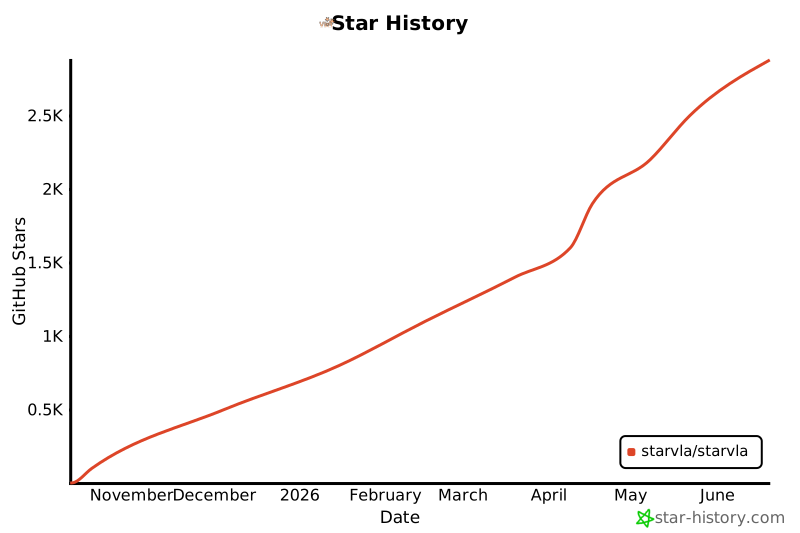
# Star History
Here's how our community has grown over time:
[](https://www.star-history.com/#starVLA/starVLA&type=date&legend=bottom-right)