# PyXtal
**Repository Path**: oberon/PyXtal
## Basic Information
- **Project Name**: PyXtal
- **Description**: No description available
- **Primary Language**: Python
- **License**: MIT
- **Default Branch**: master
- **Homepage**: None
- **GVP Project**: No
## Statistics
- **Stars**: 0
- **Forks**: 0
- **Created**: 2023-10-30
- **Last Updated**: 2023-10-30
## Categories & Tags
**Categories**: Uncategorized
**Tags**: None
## README
 [](https://pyxtal.readthedocs.io/en/latest/?badge=latest)
[](https://github.com/qzhu2017/PyXtal/actions)
[](https://pypi.org/project/pyxtal/)
[](https://pypi.org/project/pyxtal/)
[](https://pepy.tech/project/pyxtal)
[](https://zenodo.org/badge/latestdoi/128165891)
[](https://gitter.im/PyXtal/community?utm_source=badge&utm_medium=badge&utm_campaign=pr-badge)
[](https://pyxtal.readthedocs.io/en/latest/?badge=latest)
[](https://github.com/qzhu2017/PyXtal/actions)
[](https://pypi.org/project/pyxtal/)
[](https://pypi.org/project/pyxtal/)
[](https://pepy.tech/project/pyxtal)
[](https://zenodo.org/badge/latestdoi/128165891)
[](https://gitter.im/PyXtal/community?utm_source=badge&utm_medium=badge&utm_campaign=pr-badge)
 ## Table of content
- [Introduction](#introduction)
- [Quick Start](#quick-start)
- [Current Features](#current-features)
- [Installation](#installation)
- [Citation](#citation)
- [How to contribute?](#how-to-contribute)
## Introduction
PyXtal is an open source Python package which was initiated by [Qiang Zhu](http://qzhu2017.github.io) and Scott Fredericks at department of Physics and Astronomy, University of Nevada Las Vegas. The goal of PyXtal is to develop a fundamental library to allow one to design the material structure with a certain symmetry constraint. These structures can exported to various structural formats for further study. See the [documentation](https://pyxtal.readthedocs.io/en/latest/) for more information.
To contribute to this project, please check [How to contribute?](#how-to-contribute).
## Quick Start
- [Atomic crystal](https://nbviewer.jupyter.org/github/qzhu2017/PyXtal/blob/master/examples/tutorials_notebook/01_atomic_crystals.ipynb)
- [Molecular crystal](https://nbviewer.jupyter.org/github/qzhu2017/PyXtal/blob/master/examples/tutorials_notebook/02_molecular_crystals.ipynb)
- [XRD](https://nbviewer.jupyter.org/github/qzhu2017/PyXtal/blob/master/examples/tutorials_notebook/03_pxrd.ipynb)
- [Molecular Packing](https://nbviewer.org/github/qzhu2017/PyXtal/blob/master/examples/tutorials_notebook/05-crystal-packing.ipynb)
## Current Features
- Generation of atomic structures for a given symmetry and stoichiometry (0-3D)
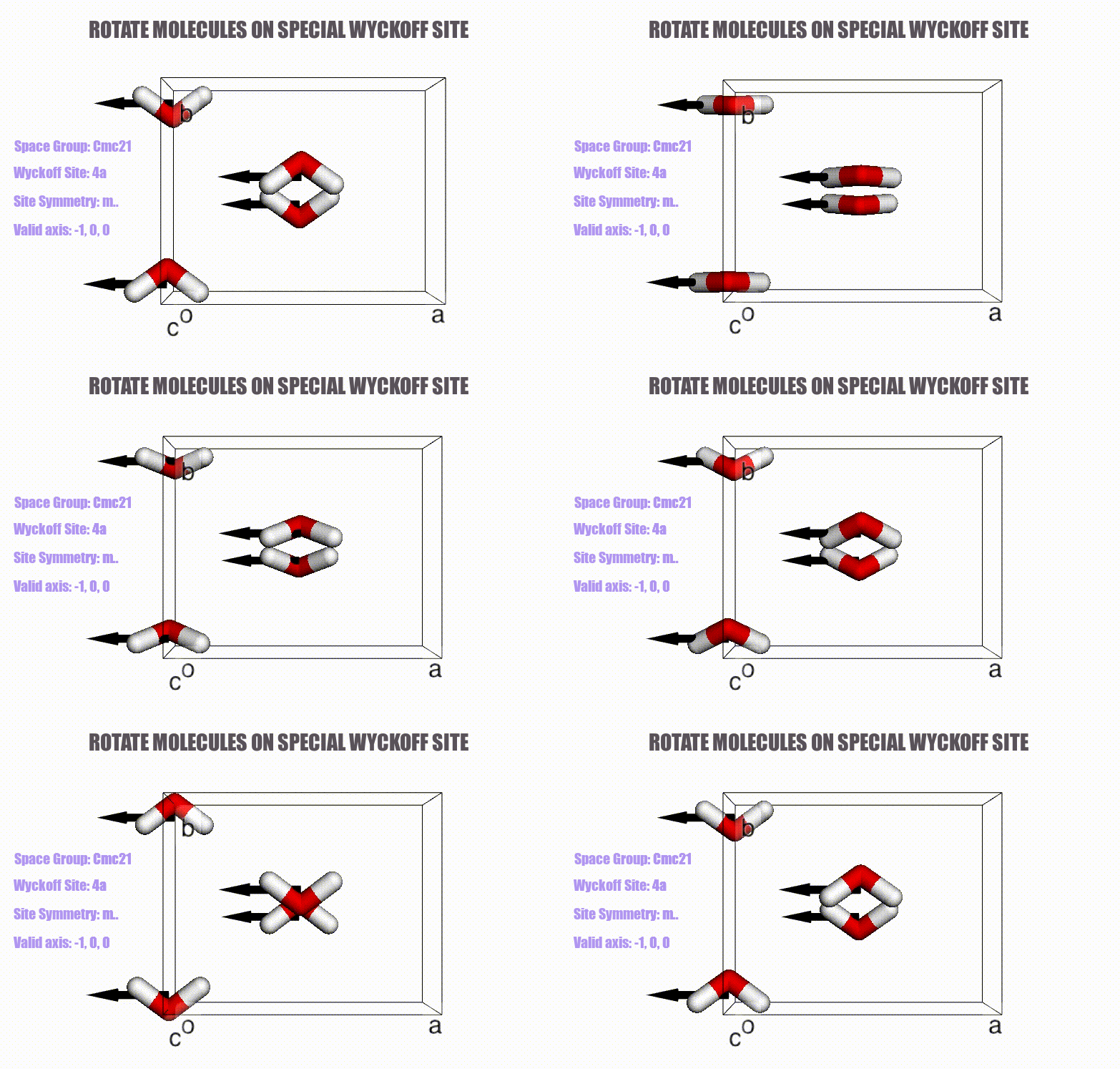
- Generation of molecular crystals (1-3D) with the support of special Wyckoff positions.
- Structure manipulation via subgroup/supergroup symmetry relation
- Geometry optimization from built-in and external optimization methods.
- Internal support of ``cif`` file and many other formats via ``pymatgen`` or ``ASE``.
- Easy access to symmetry information (e.g., Wyckoff, site symmetry and international symbols).
- X-ray diffraction analysis and [its online application](https://vxrd.physics.unlv.edu)
## Installation
To install the code, one just needs to do
```sh
pip install pyxtal
```
or
```sh
pip install --upgrade git+https://github.com/qzhu2017/PyXtal.git@master
```
## Citation
Fredericks S, Parrish K, Sayre D, Zhu Q\*(2020)
[PyXtal: a Python Library for Crystal Structure Generation and Symmetry Analysis](https://www.sciencedirect.com/science/article/pii/S0010465520304057).
\[[arXiv link](https://arxiv.org/pdf/1911.11123.pdf)\]
```bib
@article{pyxtal,
title = "PyXtal: A Python library for crystal structure generation and symmetry analysis",
journal = "Computer Physics Communications",
volume = "261",
pages = "107810",
year = "2021",
issn = "0010-4655",
doi = "https://doi.org/10.1016/j.cpc.2020.107810",
url = "http://www.sciencedirect.com/science/article/pii/S0010465520304057",
author = "Scott Fredericks and Kevin Parrish and Dean Sayre and Qiang Zhu",
}
```
## How to contribute?
This is an open-source project. Its growth depends on the community. To contribute to PyXtal, you don't necessarily have to write the code. Any contributions from the following list will be helpful.
- [](https://github.com/qzhu2017/pyxtal/stargazers)
the PyXtal project and recommend it to your colleagues/friends
- Open an [](https://GitHub.com/qzhu2017/pyxtal/issues/) to report the bug or address your wishlist or improve our documentation
- [](https://github.com/qzhu2017/PyXtal/network/members) the repository and send us the pull request
## Table of content
- [Introduction](#introduction)
- [Quick Start](#quick-start)
- [Current Features](#current-features)
- [Installation](#installation)
- [Citation](#citation)
- [How to contribute?](#how-to-contribute)
## Introduction
PyXtal is an open source Python package which was initiated by [Qiang Zhu](http://qzhu2017.github.io) and Scott Fredericks at department of Physics and Astronomy, University of Nevada Las Vegas. The goal of PyXtal is to develop a fundamental library to allow one to design the material structure with a certain symmetry constraint. These structures can exported to various structural formats for further study. See the [documentation](https://pyxtal.readthedocs.io/en/latest/) for more information.
To contribute to this project, please check [How to contribute?](#how-to-contribute).
## Quick Start
- [Atomic crystal](https://nbviewer.jupyter.org/github/qzhu2017/PyXtal/blob/master/examples/tutorials_notebook/01_atomic_crystals.ipynb)
- [Molecular crystal](https://nbviewer.jupyter.org/github/qzhu2017/PyXtal/blob/master/examples/tutorials_notebook/02_molecular_crystals.ipynb)
- [XRD](https://nbviewer.jupyter.org/github/qzhu2017/PyXtal/blob/master/examples/tutorials_notebook/03_pxrd.ipynb)
- [Molecular Packing](https://nbviewer.org/github/qzhu2017/PyXtal/blob/master/examples/tutorials_notebook/05-crystal-packing.ipynb)
## Current Features
- Generation of atomic structures for a given symmetry and stoichiometry (0-3D)
- Generation of molecular crystals (1-3D) with the support of special Wyckoff positions.
- Structure manipulation via subgroup/supergroup symmetry relation
- Geometry optimization from built-in and external optimization methods.
- Internal support of ``cif`` file and many other formats via ``pymatgen`` or ``ASE``.
- Easy access to symmetry information (e.g., Wyckoff, site symmetry and international symbols).
- X-ray diffraction analysis and [its online application](https://vxrd.physics.unlv.edu)
## Installation
To install the code, one just needs to do
```sh
pip install pyxtal
```
or
```sh
pip install --upgrade git+https://github.com/qzhu2017/PyXtal.git@master
```
## Citation
Fredericks S, Parrish K, Sayre D, Zhu Q\*(2020)
[PyXtal: a Python Library for Crystal Structure Generation and Symmetry Analysis](https://www.sciencedirect.com/science/article/pii/S0010465520304057).
\[[arXiv link](https://arxiv.org/pdf/1911.11123.pdf)\]
```bib
@article{pyxtal,
title = "PyXtal: A Python library for crystal structure generation and symmetry analysis",
journal = "Computer Physics Communications",
volume = "261",
pages = "107810",
year = "2021",
issn = "0010-4655",
doi = "https://doi.org/10.1016/j.cpc.2020.107810",
url = "http://www.sciencedirect.com/science/article/pii/S0010465520304057",
author = "Scott Fredericks and Kevin Parrish and Dean Sayre and Qiang Zhu",
}
```
## How to contribute?
This is an open-source project. Its growth depends on the community. To contribute to PyXtal, you don't necessarily have to write the code. Any contributions from the following list will be helpful.
- [](https://github.com/qzhu2017/pyxtal/stargazers)
the PyXtal project and recommend it to your colleagues/friends
- Open an [](https://GitHub.com/qzhu2017/pyxtal/issues/) to report the bug or address your wishlist or improve our documentation
- [](https://github.com/qzhu2017/PyXtal/network/members) the repository and send us the pull request