# flutter_leak_detector
**Repository Path**: openharmony-sig/flutter_leak_detector
## Basic Information
- **Project Name**: flutter_leak_detector
- **Description**: No description available
- **Primary Language**: Unknown
- **License**: BSD-2-Clause
- **Default Branch**: master
- **Homepage**: None
- **GVP Project**: No
## Statistics
- **Stars**: 1
- **Forks**: 5
- **Created**: 2024-03-12
- **Last Updated**: 2025-05-07
## Categories & Tags
**Categories**: Uncategorized
**Tags**: None
## README
# 🚨 **重要提示 | IMPORTANT**
>
> **⚠️ 此代码仓已归档。新地址请访问 [flutter_leak_detector](https://gitcode.com/openharmony-sig/flutter_leak_detector)。| ⚠️ This repository has been archived. For the new address, please visit [flutter_leak_detector](https://gitcode.com/openharmony-sig/flutter_leak_detector).**
>
---
>
[中文文档](README_zh-CN.md)
# leak_detector
flutter Memory leak detection tool
## Usage
#### initialize
In order to prevent the underlying library `vm service` from crashing, please call before adding the memory leak detection object:
```dart
LeakDetector().init(maxRetainingPath: 300); //maxRetainingPath default is 300
```
Enabling leak detection will reduce performance, and Full GC may drop frames on the page.
Initialized by `assert` in the plugin, so you don't need to turn it off when build on `release` mode.
#### Detect
Add `LeakNavigatorObserver` to `navigatorObservers` in `MaterialApp`, it will automatically detect whether there is a memory leak in the page's `Widget` and its corresponding `Element` object. If page's Widget is a `StatefulWidget`, it will also be automatically checked Its corresponding `State`.
```dart
import 'package:leak_detector/leak_detector.dart';
@override
Widget build(BuildContext context) {
return MaterialApp(
navigatorObservers: [
//used the LeakNavigatorObserver
LeakNavigatorObserver(
shouldCheck: (route) {
return route.settings.name != null && route.settings.name != '/';
},
),
],
);
}
```
#### Get leaked information
`LeakDetector().onLeakedStream` can register your listener, and notify the object's reference chain after detecting a memory leak.
`LeakDetector().onEventStream` can monitor internal time notifications, such as `start Gc`, `end Gc`, etc.
A preview page of the reference chain is provided. You only need to add the following code. Note that the `Bulid Context` must be able to obtain the`NavigatorState`:
```dart
import 'package:leak_detector/leak_detector.dart';
//show preview page
LeakDetector().onLeakedStream.listen((LeakedInfo info) {
//print to console
info.retainingPath.forEach((node) => print(node));
//show preview page
showLeakedInfoPage(navigatorKey.currentContext, info);
});
```
Preview page display:
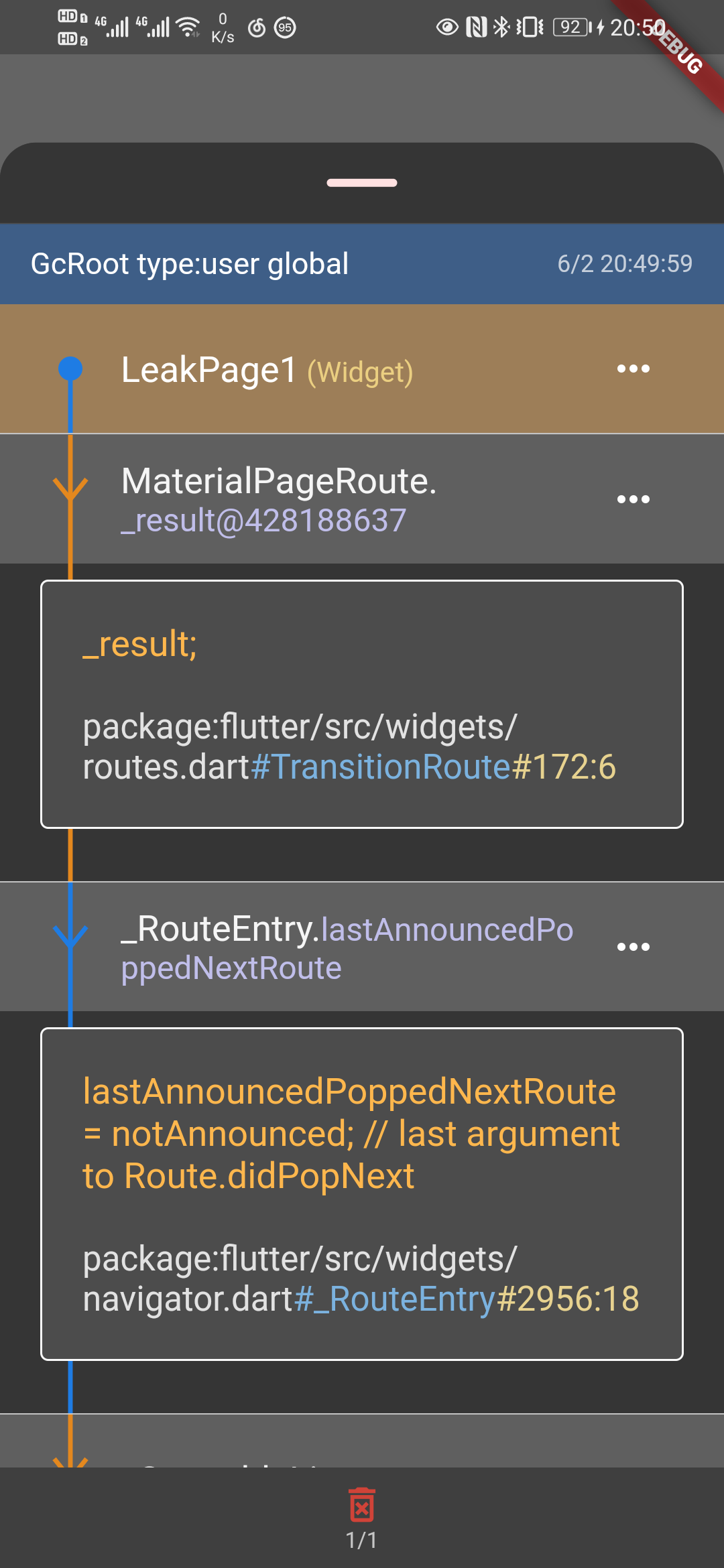
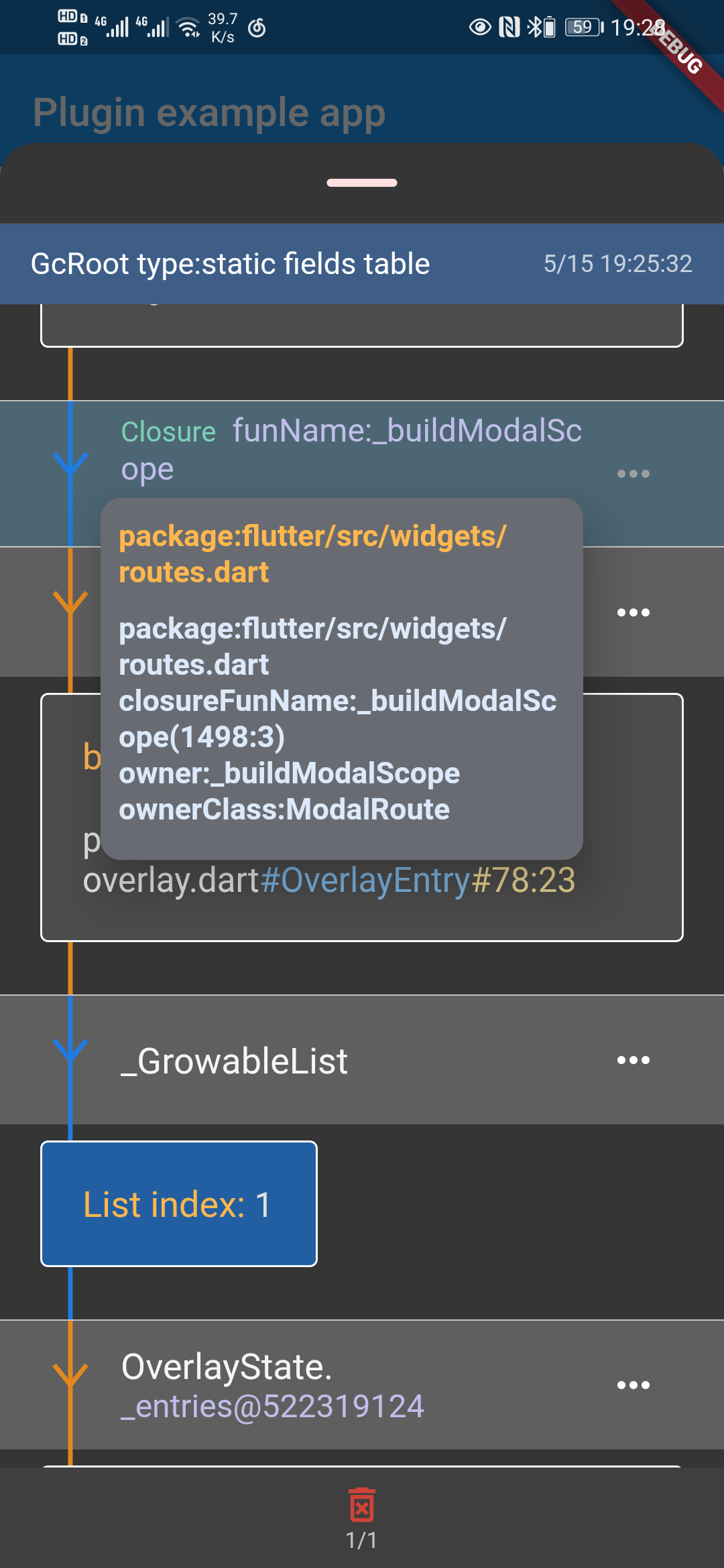
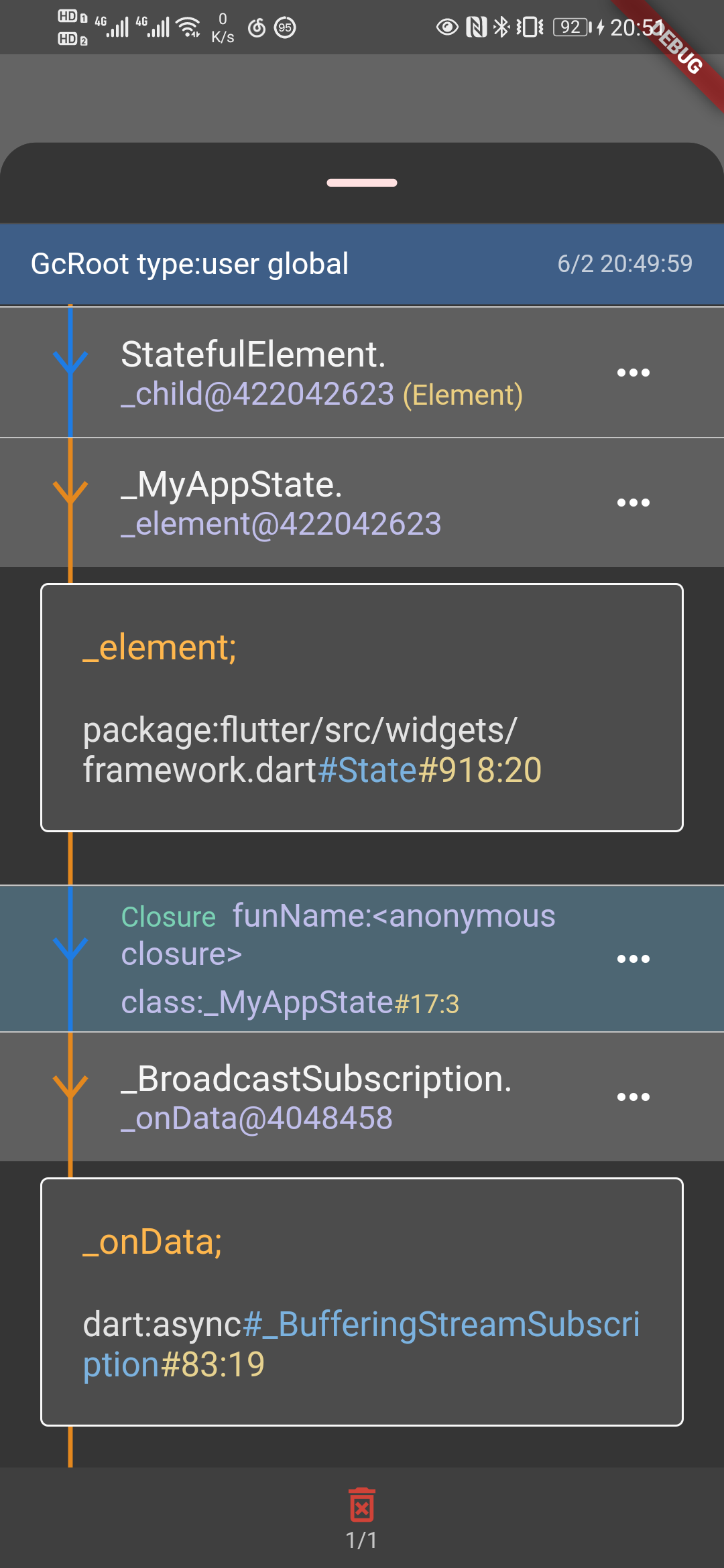 It contains the class information of the reference chain node, the referenced attribute information, the source code of the attribute declaration, and the location of the source code (line number: column number).
#### Get memory leak recording
```dart
import 'package:leak_detector/leak_detector.dart';
getLeakedRecording().then((List infoList) {
showLeakedInfoListPage(navigatorKey.currentContext, infoList);
});
```
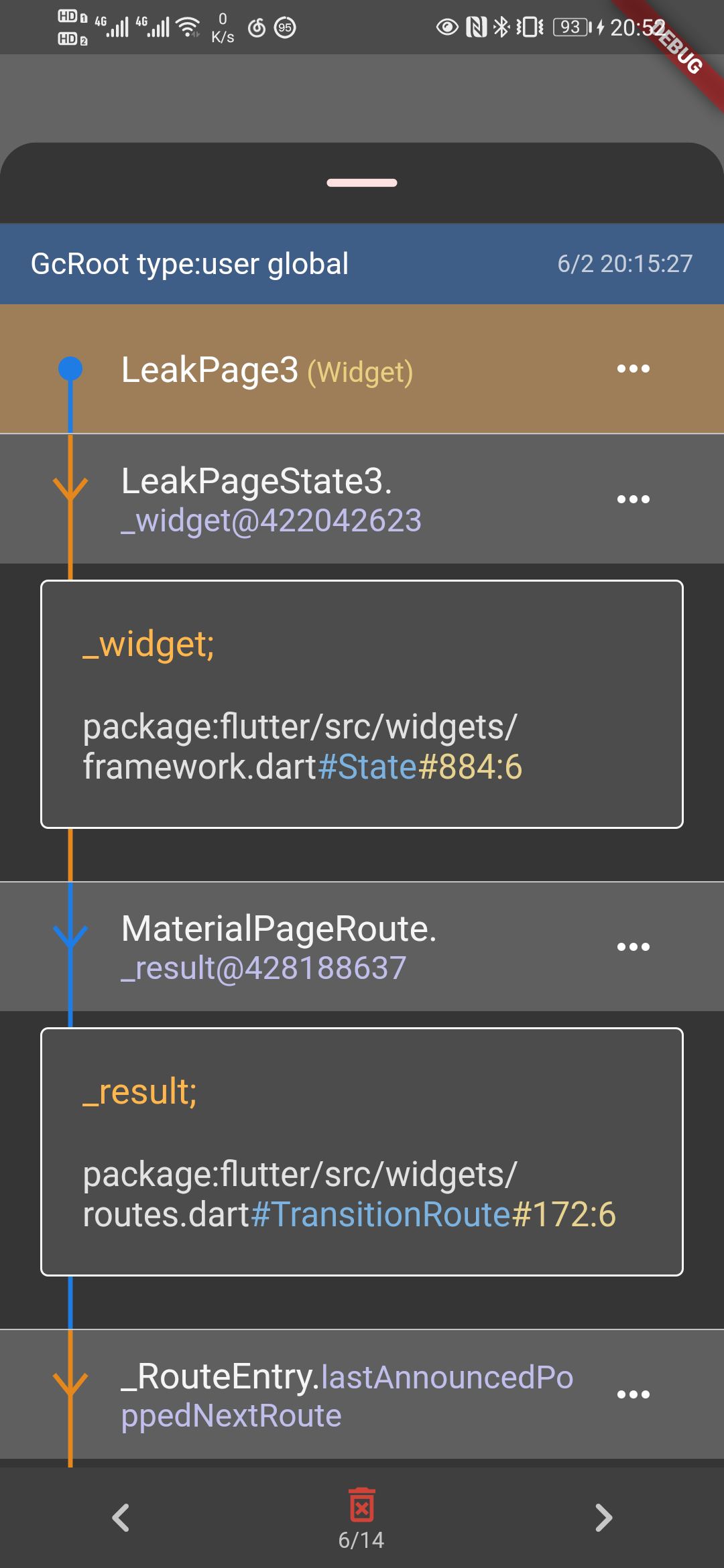
It contains the class information of the reference chain node, the referenced attribute information, the source code of the attribute declaration, and the location of the source code (line number: column number).
#### Get memory leak recording
```dart
import 'package:leak_detector/leak_detector.dart';
getLeakedRecording().then((List infoList) {
showLeakedInfoListPage(navigatorKey.currentContext, infoList);
});
```
 #### *Cannot connect to `vm_service` on real mobile devices
The VM service allows for an extended feature set via the Dart Development Service (DDS) that forward all core VM service RPCs described in this document to the true VM service.
So when we connect to the computer to run, the `DDS` on the computer will first connect to the `vm_service` on our mobile end, causing our `leak_detector` plugin to fail to connect to the `vm_service` again.
There are two solutions:
- After the `run` is complete, disconnect from the computer, and then it is best to restart the app.
If the completed test package is installed on the mobile phone, the above problem does not exist, so this method is suitable for use by testers.
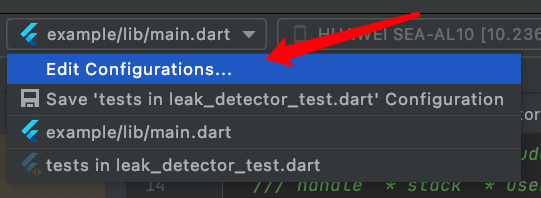
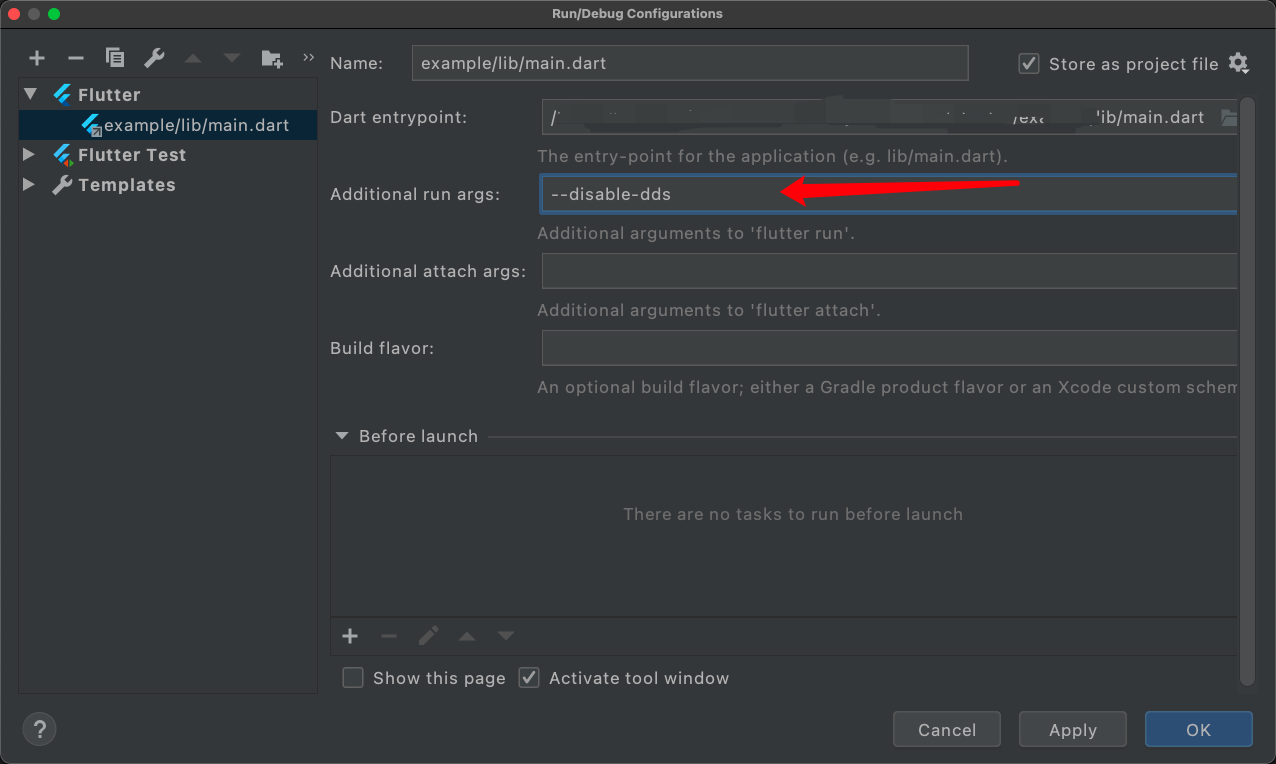
- Add the `--disable-dds` parameter after `flutter run` to turn off the `DDS`. After testing, this will not cause any impact on debugging
It can be configured as follows in `Android Studio`.
After [Pull Request #80900](https://github.com/flutter/flutter/pull/80900) is merged, `--disable-dds` was renamed to `--no-dds`
#### *Cannot connect to `vm_service` on real mobile devices
The VM service allows for an extended feature set via the Dart Development Service (DDS) that forward all core VM service RPCs described in this document to the true VM service.
So when we connect to the computer to run, the `DDS` on the computer will first connect to the `vm_service` on our mobile end, causing our `leak_detector` plugin to fail to connect to the `vm_service` again.
There are two solutions:
- After the `run` is complete, disconnect from the computer, and then it is best to restart the app.
If the completed test package is installed on the mobile phone, the above problem does not exist, so this method is suitable for use by testers.
- Add the `--disable-dds` parameter after `flutter run` to turn off the `DDS`. After testing, this will not cause any impact on debugging
It can be configured as follows in `Android Studio`.
After [Pull Request #80900](https://github.com/flutter/flutter/pull/80900) is merged, `--disable-dds` was renamed to `--no-dds`

