# tps_stn_pytorch
**Repository Path**: tunmx/tps_stn_pytorch
## Basic Information
- **Project Name**: tps_stn_pytorch
- **Description**: No description available
- **Primary Language**: Unknown
- **License**: Not specified
- **Default Branch**: master
- **Homepage**: None
- **GVP Project**: No
## Statistics
- **Stars**: 0
- **Forks**: 0
- **Created**: 2020-10-23
- **Last Updated**: 2020-12-19
## Categories & Tags
**Categories**: Uncategorized
**Tags**: None
## README
# tps_stn_pytorch
PyTorch implementation of Spatial Transformer Network (STN) with Thin Plate Spline (TPS).
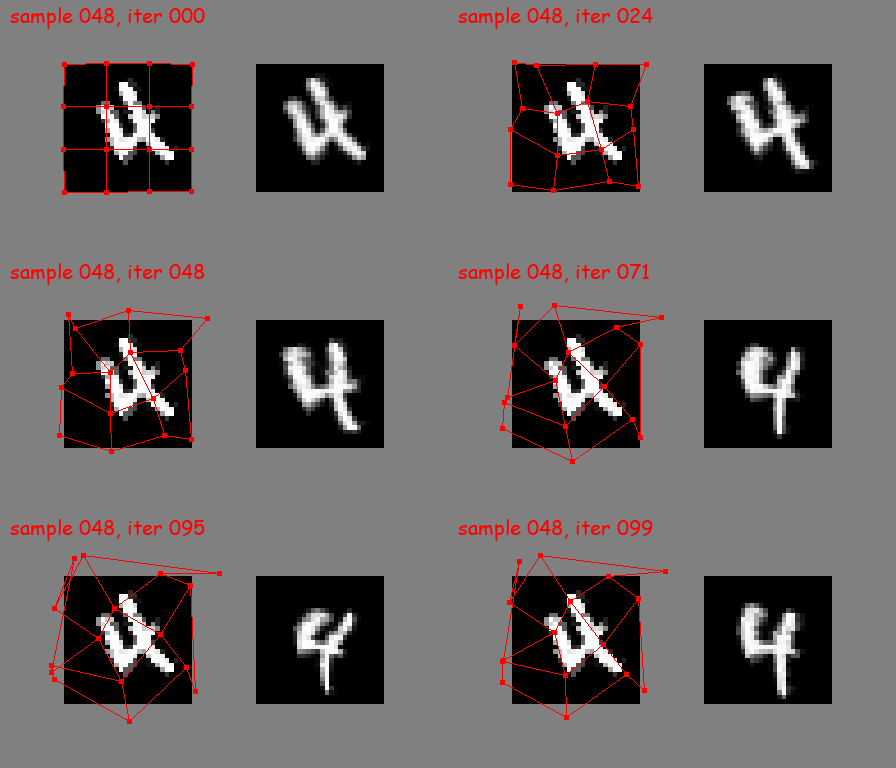
 ## Introduction
STN is a powerful neural network architecture proposed by DeepMind in [[1]](#ref-1). STN achieves real spatial invariance by automatically rectify input images before they are feeded into a normal classification network. The most amazing part of STN is that it is end-to-end differential and can be directly plugged into existing network architectures (AlexNet, Resnet, etc), **without any extra supervision.**
Original STN paper [[1]](#ref-1) experiments on three specific transformation forms: Affine Transformation, Projective Transformation and **Thin Plate Spline Transformation (TPS)**. Among them I think TPS is the most powerful translation because it can warp a image in arbitrary way. As shown below, I can warp my Avatar
 into
 TPS-STN has been used in OCR application [[2]](#ref-2). In this paper TPS-STN is to automatically rectify distorted text images, before they are feeded into a normal OCR text recognition model:
 ## Dependencies
- Python3
- PyTorch
- Torchvision
- Numpy
- Matplotlib
- Pillow / PIL
- imageio
I use `imageio` to create GIF visualization. Simply install it by `pip install imageio`.
## Run
python mnist_train.py --model unbounded_stn --angle 90 --grid_size 4
python mnist_visualize.py --model unbounded_stn --angle 90 --grid_size 4
python mnist_make_gif.py --model unbounded_stn --angle 90 --grid_size 4
Then PNG and GIF resutls will be saved in `./image/unbounded_stn_angle60_grid4/` and `./gif/unbounded_stn_angle60_grid4/`.
You can try other combinations of model architecture, mnist random rotation angle and TPS grid size. Details below.
## Arguments
There are three controllable arguments: `--model`, `--angle`, `--grid_size`.
`--model`: str, required
- With `no_stn`, STN module is discarded and only a single CNN classifier remains.
- With `bounded_stn`, the output of localization network is squeezed to [-1, 1] by `F.tanh`, as was done in [[2]](#ref-1)
- With `unbounded_stn`, the output of locolizaition network is not squeezed
`--angle`: int, default = 60
- Samples in MNIST dataset will be rotated by random angles within `[-angle, angle]`
`--grid_size`: int, default = 4
- Use `(grid_size x grid_size)` control points to define Thin Plate Spline transformation
## Test Accuracy Curves
 ## Visualize TPS-STN
Results with `angle = 90` are generally bad:

 Results with `bounded_stn` are bad if `grid_size <= 3`:

 But ok if `grid_size >= 4`:

 Results with `unbounded_stn` are ok:

 Of course there are always bad cases in each combination. You can download all my GIFs from [Baidu Netdisk](https://pan.baidu.com/s/1c2KXPw0) (file size 2G).
## Reference
[1] [Spatial Transformer Networks](https://arxiv.org/abs/1509.05329)
[2] [Robust Scene Text Recognition with Automatic Rectification](https://arxiv.org/abs/1603.03915)
[3] [数值方法——薄板样条插值(Thin-Plate Spline)](http://blog.csdn.net/VictoriaW/article/details/70161180)