
一个使用机器学习建模部分观测时间序列(POTS)的Python算法工具库



















 Time-Series.AI [^36] | ✅ | ✅ | ✅ | ✅ | ✅ | Join waitlist |
| Neural Net | TimeMixer++[^49] | ✅ | | | | | `2025 - ICLR` |
| LLM | Time-LLM🧑🔧[^45] | ✅ | ✅ | | | | `2024 - ICLR` |
| TSFM | MOMENT[^47] | ✅ | ✅ | | | | `2024 - ICML` |
| Neural Net | TSLANet[^51] | ✅ | | | | | `2024 - ICML` |
| Neural Net | TEFN🧑🔧[^39] | ✅ | ✅ | ✅ | | ✅ | `2024 - arXiv` |
| Neural Net | FITS🧑🔧[^41] | ✅ | ✅ | | | | `2024 - ICLR` |
| Neural Net | TimeMixer[^37] | ✅ | ✅ | | | | `2024 - ICLR` |
| Neural Net | iTransformer🧑🔧[^24] | ✅ | | ✅ | | | `2024 - ICLR` |
| Neural Net | ModernTCN[^38] | ✅ | ✅ | | | | `2024 - ICLR` |
| Neural Net | ImputeFormer🧑🔧[^34] | ✅ | | | | ✅ | `2024 - KDD` |
| Neural Net | TOTEM [^50] | ✅ | | | | | `2024 - TMLR` |
| Neural Net | SAITS[^1] | ✅ | | ✅ | | ✅ | `2023 - ESWA` |
| LLM | GPT4TS[^46] | ✅ | ✅ | | | | `2023 - NeurIPS` |
| Neural Net | FreTS🧑🔧[^23] | ✅ | | | | | `2023 - NeurIPS` |
| Neural Net | Koopa🧑🔧[^29] | ✅ | | | | | `2023 - NeurIPS` |
| Neural Net | Crossformer🧑🔧[^16] | ✅ | | | | | `2023 - ICLR` |
| Neural Net | TimesNet[^14] | ✅ | | ✅ | | | `2023 - ICLR` |
| Neural Net | PatchTST🧑🔧[^18] | ✅ | | | | ✅ | `2023 - ICLR` |
| Neural Net | ETSformer🧑🔧[^19] | ✅ | | | | | `2023 - ICLR` |
| Neural Net | MICN🧑🔧[^27] | ✅ | | | | | `2023 - ICLR` |
| Neural Net | DLinear🧑🔧[^17] | ✅ | | | | | `2023 - AAAI` |
| Neural Net | TiDE🧑🔧[^28] | ✅ | | | | | `2023 - TMLR` |
| Neural Net | CSAI[^42] | ✅ | | ✅ | | | `2023 - arXiv` |
| Neural Net | SegRNN🧑🔧[^43] | ✅ | ✅ | | | ✅ | `2023 - arXiv` |
| Neural Net | TS2Vec[^48] | | | ✅ | | | `2022 - AAAI` |
| Neural Net | SCINet🧑🔧[^30] | ✅ | | | | | `2022 - NeurIPS` |
| Neural Net | Nonstationary Tr.🧑🔧[^25] | ✅ | | | | | `2022 - NeurIPS` |
| Neural Net | FiLM🧑🔧[^22] | ✅ | | | | | `2022 - NeurIPS` |
| Neural Net | RevIN_SCINet🧑🔧[^31] | ✅ | | | | | `2022 - ICLR` |
| Neural Net | Pyraformer🧑🔧[^26] | ✅ | | | | | `2022 - ICLR` |
| Neural Net | Raindrop[^5] | | | ✅ | | | `2022 - ICLR` |
| Neural Net | FEDformer🧑🔧[^20] | ✅ | | | | | `2022 - ICML` |
| Neural Net | Autoformer🧑🔧[^15] | ✅ | | | | ✅ | `2021 - NeurIPS` |
| Neural Net | CSDI[^12] | ✅ | ✅ | | | | `2021 - NeurIPS` |
| Neural Net | Informer🧑🔧[^21] | ✅ | | | | | `2021 - AAAI` |
| Neural Net | US-GAN[^10] | ✅ | | | | | `2021 - AAAI` |
| Neural Net | CRLI[^6] | | | | ✅ | | `2021 - AAAI` |
| Probabilistic | BTTF[^8] | | ✅ | | | | `2021 - TPAMI` |
| Neural Net | StemGNN🧑🔧[^33] | ✅ | | | | | `2020 - NeurIPS` |
| Neural Net | Reformer🧑🔧[^32] | ✅ | | | | | `2020 - ICLR` |
| Neural Net | GP-VAE[^11] | ✅ | | | | | `2020 - AISTATS` |
| Neural Net | VaDER[^7] | | | | ✅ | | `2019 - GigaSci.` |
| Neural Net | M-RNN[^9] | ✅ | | | | | `2019 - TBME` |
| Neural Net | BRITS[^3] | ✅ | | ✅ | | | `2018 - NeurIPS` |
| Neural Net | GRU-D[^4] | ✅ | | ✅ | | | `2018 - Sci. Rep.` |
| Neural Net | TCN🧑🔧[^35] | ✅ | | | | | `2018 - arXiv` |
| Neural Net | Transformer🧑🔧[^2] | ✅ | ✅ | | | | `2017 - NeurIPS` |
| MF | TRMF[^44] | ✅ | | | | | `2016 - NeurIPS` |
| Naive | Lerp[^40] | ✅ | | | | | |
| Naive | LOCF/NOCB | ✅ | | | | | |
| Naive | Mean | ✅ | | | | | |
| Naive | Median | ✅ | | | | | |
🙋 上表中`LLM (Large Language Model)`, `TSFM (Time-Series Foundation Model)`之间的区别:
`LLM`是指在大规模文本数据上进行预训练的模型, 可以针对特定任务进行微调.
`TSFM`是指在大规模时间序列数据上进行预训练的模型,其灵感来自CV和NLP领域中基座模型的最新成就.
💯 现在贡献你的模型来增加你的研究影响力!PyPOTS的下载量正在迅速增长
(**[目前PyPI上总共超过60万次且每日超1000的下载](https://www.pepy.tech/projects/pypots)**),
你的工作将被社区广泛使用和引用. 请参阅[贡献指南](#-%E8%B4%A1%E7%8C%AE%E5%A3%B0%E6%98%8E)
, 了解如何将模型包含在PyPOTS中.
## ❖ PyPOTS生态系统
在PyPOTS生态系统中, 一切都与我们熟悉的咖啡息息相关, 甚至可以将其视为一杯咖啡的诞生过程!
如你所见, PyPOTS的标志中有一个咖啡壶. 除此之外还需要什么呢?请接着看下去、
Time-Series.AI [^36] | ✅ | ✅ | ✅ | ✅ | ✅ | Join waitlist |
| Neural Net | TimeMixer++[^49] | ✅ | | | | | `2025 - ICLR` |
| LLM | Time-LLM🧑🔧[^45] | ✅ | ✅ | | | | `2024 - ICLR` |
| TSFM | MOMENT[^47] | ✅ | ✅ | | | | `2024 - ICML` |
| Neural Net | TSLANet[^51] | ✅ | | | | | `2024 - ICML` |
| Neural Net | TEFN🧑🔧[^39] | ✅ | ✅ | ✅ | | ✅ | `2024 - arXiv` |
| Neural Net | FITS🧑🔧[^41] | ✅ | ✅ | | | | `2024 - ICLR` |
| Neural Net | TimeMixer[^37] | ✅ | ✅ | | | | `2024 - ICLR` |
| Neural Net | iTransformer🧑🔧[^24] | ✅ | | ✅ | | | `2024 - ICLR` |
| Neural Net | ModernTCN[^38] | ✅ | ✅ | | | | `2024 - ICLR` |
| Neural Net | ImputeFormer🧑🔧[^34] | ✅ | | | | ✅ | `2024 - KDD` |
| Neural Net | TOTEM [^50] | ✅ | | | | | `2024 - TMLR` |
| Neural Net | SAITS[^1] | ✅ | | ✅ | | ✅ | `2023 - ESWA` |
| LLM | GPT4TS[^46] | ✅ | ✅ | | | | `2023 - NeurIPS` |
| Neural Net | FreTS🧑🔧[^23] | ✅ | | | | | `2023 - NeurIPS` |
| Neural Net | Koopa🧑🔧[^29] | ✅ | | | | | `2023 - NeurIPS` |
| Neural Net | Crossformer🧑🔧[^16] | ✅ | | | | | `2023 - ICLR` |
| Neural Net | TimesNet[^14] | ✅ | | ✅ | | | `2023 - ICLR` |
| Neural Net | PatchTST🧑🔧[^18] | ✅ | | | | ✅ | `2023 - ICLR` |
| Neural Net | ETSformer🧑🔧[^19] | ✅ | | | | | `2023 - ICLR` |
| Neural Net | MICN🧑🔧[^27] | ✅ | | | | | `2023 - ICLR` |
| Neural Net | DLinear🧑🔧[^17] | ✅ | | | | | `2023 - AAAI` |
| Neural Net | TiDE🧑🔧[^28] | ✅ | | | | | `2023 - TMLR` |
| Neural Net | CSAI[^42] | ✅ | | ✅ | | | `2023 - arXiv` |
| Neural Net | SegRNN🧑🔧[^43] | ✅ | ✅ | | | ✅ | `2023 - arXiv` |
| Neural Net | TS2Vec[^48] | | | ✅ | | | `2022 - AAAI` |
| Neural Net | SCINet🧑🔧[^30] | ✅ | | | | | `2022 - NeurIPS` |
| Neural Net | Nonstationary Tr.🧑🔧[^25] | ✅ | | | | | `2022 - NeurIPS` |
| Neural Net | FiLM🧑🔧[^22] | ✅ | | | | | `2022 - NeurIPS` |
| Neural Net | RevIN_SCINet🧑🔧[^31] | ✅ | | | | | `2022 - ICLR` |
| Neural Net | Pyraformer🧑🔧[^26] | ✅ | | | | | `2022 - ICLR` |
| Neural Net | Raindrop[^5] | | | ✅ | | | `2022 - ICLR` |
| Neural Net | FEDformer🧑🔧[^20] | ✅ | | | | | `2022 - ICML` |
| Neural Net | Autoformer🧑🔧[^15] | ✅ | | | | ✅ | `2021 - NeurIPS` |
| Neural Net | CSDI[^12] | ✅ | ✅ | | | | `2021 - NeurIPS` |
| Neural Net | Informer🧑🔧[^21] | ✅ | | | | | `2021 - AAAI` |
| Neural Net | US-GAN[^10] | ✅ | | | | | `2021 - AAAI` |
| Neural Net | CRLI[^6] | | | | ✅ | | `2021 - AAAI` |
| Probabilistic | BTTF[^8] | | ✅ | | | | `2021 - TPAMI` |
| Neural Net | StemGNN🧑🔧[^33] | ✅ | | | | | `2020 - NeurIPS` |
| Neural Net | Reformer🧑🔧[^32] | ✅ | | | | | `2020 - ICLR` |
| Neural Net | GP-VAE[^11] | ✅ | | | | | `2020 - AISTATS` |
| Neural Net | VaDER[^7] | | | | ✅ | | `2019 - GigaSci.` |
| Neural Net | M-RNN[^9] | ✅ | | | | | `2019 - TBME` |
| Neural Net | BRITS[^3] | ✅ | | ✅ | | | `2018 - NeurIPS` |
| Neural Net | GRU-D[^4] | ✅ | | ✅ | | | `2018 - Sci. Rep.` |
| Neural Net | TCN🧑🔧[^35] | ✅ | | | | | `2018 - arXiv` |
| Neural Net | Transformer🧑🔧[^2] | ✅ | ✅ | | | | `2017 - NeurIPS` |
| MF | TRMF[^44] | ✅ | | | | | `2016 - NeurIPS` |
| Naive | Lerp[^40] | ✅ | | | | | |
| Naive | LOCF/NOCB | ✅ | | | | | |
| Naive | Mean | ✅ | | | | | |
| Naive | Median | ✅ | | | | | |
🙋 上表中`LLM (Large Language Model)`, `TSFM (Time-Series Foundation Model)`之间的区别:
`LLM`是指在大规模文本数据上进行预训练的模型, 可以针对特定任务进行微调.
`TSFM`是指在大规模时间序列数据上进行预训练的模型,其灵感来自CV和NLP领域中基座模型的最新成就.
💯 现在贡献你的模型来增加你的研究影响力!PyPOTS的下载量正在迅速增长
(**[目前PyPI上总共超过60万次且每日超1000的下载](https://www.pepy.tech/projects/pypots)**),
你的工作将被社区广泛使用和引用. 请参阅[贡献指南](#-%E8%B4%A1%E7%8C%AE%E5%A3%B0%E6%98%8E)
, 了解如何将模型包含在PyPOTS中.
## ❖ PyPOTS生态系统
在PyPOTS生态系统中, 一切都与我们熟悉的咖啡息息相关, 甚至可以将其视为一杯咖啡的诞生过程!
如你所见, PyPOTS的标志中有一个咖啡壶. 除此之外还需要什么呢?请接着看下去、
 👈 在PyPOTS中, 数据可以被看作是咖啡豆, 而写的携带缺失值的POTS数据则是不完整的咖啡豆.
为了让用户能够轻松使用各种开源的时间序列数据集, 我们创建了开源时间序列数据集的仓库 Time Series Data Beans (TSDB)
(可以将其视为咖啡豆仓库),
TSDB让加载开源时序数据集变得超级简单!访问 [TSDB](https://github.com/WenjieDu/TSDB), 了解更多关于TSDB的信息,
目前总共支持172个开源数据集!
👈 在PyPOTS中, 数据可以被看作是咖啡豆, 而写的携带缺失值的POTS数据则是不完整的咖啡豆.
为了让用户能够轻松使用各种开源的时间序列数据集, 我们创建了开源时间序列数据集的仓库 Time Series Data Beans (TSDB)
(可以将其视为咖啡豆仓库),
TSDB让加载开源时序数据集变得超级简单!访问 [TSDB](https://github.com/WenjieDu/TSDB), 了解更多关于TSDB的信息,
目前总共支持172个开源数据集!
 👉
为了在真实数据中模拟缺失进而获得不完整的咖啡豆,
我们创建了生态系统中的另一个仓库[PyGrinder](https://github.com/WenjieDu/PyGrinder)
(可以将其视为磨豆机),
帮助你在数据集中模拟缺失数据, 用于评估机器学习算法. 根据Robin的理论[^13], 缺失模式分为三类:
完全随机缺失(missing completely at random, 简称为MCAR)、随机缺失(missing at random, 简称为MAR)和非随机缺失(missing not at
random, 简称为MNAR ).
PyGrinder支持以上所有模式并提供与缺失相关的其他功能函数. 通过PyGrinder, 你可以仅仅通过一行代码就将模拟缺失引入你的数据集中.
👉
为了在真实数据中模拟缺失进而获得不完整的咖啡豆,
我们创建了生态系统中的另一个仓库[PyGrinder](https://github.com/WenjieDu/PyGrinder)
(可以将其视为磨豆机),
帮助你在数据集中模拟缺失数据, 用于评估机器学习算法. 根据Robin的理论[^13], 缺失模式分为三类:
完全随机缺失(missing completely at random, 简称为MCAR)、随机缺失(missing at random, 简称为MAR)和非随机缺失(missing not at
random, 简称为MNAR ).
PyGrinder支持以上所有模式并提供与缺失相关的其他功能函数. 通过PyGrinder, 你可以仅仅通过一行代码就将模拟缺失引入你的数据集中.
 👈
为了评估机器学习算法在POTS数据上的性能,
我们创建了生态系统中的另一个仓库[BenchPOTS](https://github.com/WenjieDu/BenchPOTS),
其提供了标准且统一的数据预处理管道来帮助你在多种任务上衡量不同POTS算法的性能.
👈
为了评估机器学习算法在POTS数据上的性能,
我们创建了生态系统中的另一个仓库[BenchPOTS](https://github.com/WenjieDu/BenchPOTS),
其提供了标准且统一的数据预处理管道来帮助你在多种任务上衡量不同POTS算法的性能.
 👉 现在我们有了咖啡豆(beans)、磨豆机(grinder)和咖啡壶(pot), 让我们坐在长凳(bench)上想想如何萃取一杯咖啡呢?
教程必不可少!考虑到未来的工作量, PyPOTS的相关教程将发布在一个独立的仓库[BrewPOTS](https://github.com/WenjieDu/BrewPOTS)
中. 点击访问查看教程, 学习如何萃取你的POTS数据!
👉 现在我们有了咖啡豆(beans)、磨豆机(grinder)和咖啡壶(pot), 让我们坐在长凳(bench)上想想如何萃取一杯咖啡呢?
教程必不可少!考虑到未来的工作量, PyPOTS的相关教程将发布在一个独立的仓库[BrewPOTS](https://github.com/WenjieDu/BrewPOTS)
中. 点击访问查看教程, 学习如何萃取你的POTS数据!
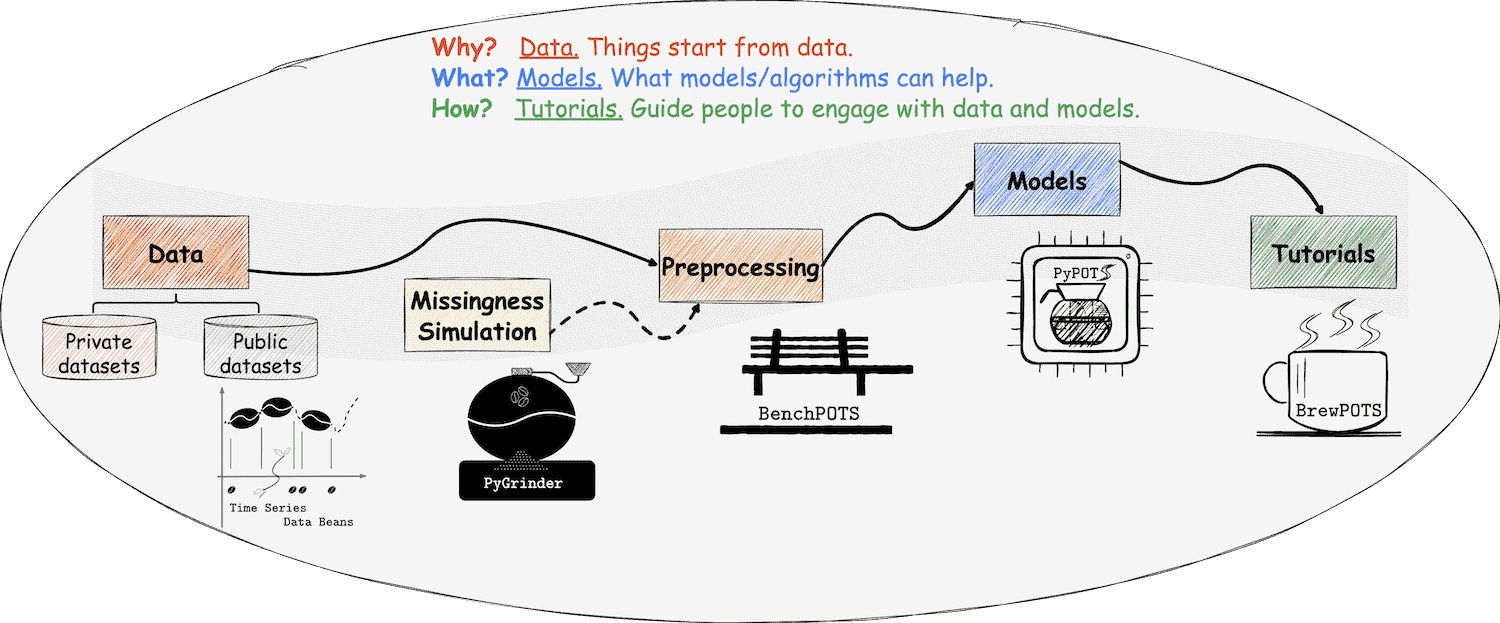
☕️ 欢迎来到 PyPOTS 生态系统 !
 上找到一个简单且快速的入门教程. 如果你有其他问题, 请参考[PyPOTS文档](https://docs.pypots.com).
你也可以在我们的[社区](#-community)中提问, 或直接[发起issue](https://github.com/WenjieDu/PyPOTS/issues).
下面, 我们为你演示使用PyPOTS进行POTS数据插补的示例:
Time-Series.AI
[^37]: Wang, S., Wu, H., Shi, X., Hu, T., Luo, H., Ma, L., ... & ZHOU, J. (2024).
[TimeMixer: Decomposable Multiscale Mixing for Time Series Forecasting](https://openreview.net/forum?id=7oLshfEIC2).
*ICLR 2024*.
[^38]: Luo, D., & Wang X. (2024).
[ModernTCN: A Modern Pure Convolution Structure for General Time Series Analysis](https://openreview.net/forum?id=vpJMJerXHU).
*ICLR 2024*.
[^39]: Zhan, T., He, Y., Deng, Y., Li, Z., Du, W., & Wen, Q. (2024).
[Time Evidence Fusion Network: Multi-source View in Long-Term Time Series Forecasting](https://arxiv.org/abs/2405.06419).
*arXiv 2024*.
[^40]: [Wikipedia: Linear interpolation](https://en.wikipedia.org/wiki/Linear_interpolation)
[^41]: Xu, Z., Zeng, A., & Xu, Q. (2024).
[FITS: Modeling Time Series with 10k parameters](https://openreview.net/forum?id=bWcnvZ3qMb).
*ICLR 2024*.
[^42]: Qian, L., Ibrahim, Z., Ellis, H. L., Zhang, A., Zhang, Y., Wang, T., & Dobson, R. (2023).
[Knowledge Enhanced Conditional Imputation for Healthcare Time-series](https://arxiv.org/abs/2312.16713).
*arXiv 2023*.
[^43]: Lin, S., Lin, W., Wu, W., Zhao, F., Mo, R., & Zhang, H. (2023).
[SegRNN: Segment Recurrent Neural Network for Long-Term Time Series Forecasting](https://arxiv.org/abs/2308.11200).
*arXiv 2023*.
[^44]: Yu, H. F., Rao, N., & Dhillon, I. S. (2016).
[Temporal regularized matrix factorization for high-dimensional time series prediction](https://papers.nips.cc/paper_files/paper/2016/hash/85422afb467e9456013a2a51d4dff702-Abstract.html).
*NeurIPS 2016*.
[^45]: Jin, M., Wang, S., Ma, L., Chu, Z., Zhang, J. Y., Shi, X., ... & Wen, Q. (2024).
[Time-LLM: Time Series Forecasting by Reprogramming Large Language Models](https://openreview.net/forum?id=Unb5CVPtae).
*ICLR 2024*.
[^46]: Zhou, T., Niu, P., Sun, L., & Jin, R. (2023).
[One Fits All: Power General Time Series Analysis by Pretrained LM](https://openreview.net/forum?id=gMS6FVZvmF).
*NeurIPS 2023*.
[^47]: Goswami, M., Szafer, K., Choudhry, A., Cai, Y., Li, S., & Dubrawski, A. (2024).
[MOMENT: A Family of Open Time-series Foundation Models](https://proceedings.mlr.press/v235/goswami24a.html).
*ICML 2024*.
[^48]: Yue, Z., Wang, Y., Duan, J., Yang, T., Huang, C., Tong, Y., & Xu, B. (2022).
[TS2Vec: Towards Universal Representation of Time Series](https://ojs.aaai.org/index.php/AAAI/article/view/20881).
*AAAI 2022*.
[^49]: Wang, S., Li, J., Shi, X., Ye, Z., Mo, B., Lin, W., Ju, S., Chu, Z. & Jin, M. (2025).
[TimeMixer++: A General Time Series Pattern Machine for Universal Predictive Analysis](https://openreview.net/forum?id=1CLzLXSFNn).
*ICLR 2025*.
[^50]: Talukder, S., Yue, Y., & Gkioxari, G. (2024).
[TOTEM: TOkenized Time Series EMbeddings for General Time Series Analysis](https://openreview.net/forum?id=QlTLkH6xRC).
*TMLR 2024*.
[^51]: Eldele, E., Ragab, M., Chen, Z., Wu, M., & Li, X. (2024).
[TSLANet: Rethinking Transformers for Time Series Representation Learning](https://proceedings.mlr.press/v235/eldele24a.html).
*ICML 2024*.
上找到一个简单且快速的入门教程. 如果你有其他问题, 请参考[PyPOTS文档](https://docs.pypots.com).
你也可以在我们的[社区](#-community)中提问, 或直接[发起issue](https://github.com/WenjieDu/PyPOTS/issues).
下面, 我们为你演示使用PyPOTS进行POTS数据插补的示例:
Time-Series.AI
[^37]: Wang, S., Wu, H., Shi, X., Hu, T., Luo, H., Ma, L., ... & ZHOU, J. (2024).
[TimeMixer: Decomposable Multiscale Mixing for Time Series Forecasting](https://openreview.net/forum?id=7oLshfEIC2).
*ICLR 2024*.
[^38]: Luo, D., & Wang X. (2024).
[ModernTCN: A Modern Pure Convolution Structure for General Time Series Analysis](https://openreview.net/forum?id=vpJMJerXHU).
*ICLR 2024*.
[^39]: Zhan, T., He, Y., Deng, Y., Li, Z., Du, W., & Wen, Q. (2024).
[Time Evidence Fusion Network: Multi-source View in Long-Term Time Series Forecasting](https://arxiv.org/abs/2405.06419).
*arXiv 2024*.
[^40]: [Wikipedia: Linear interpolation](https://en.wikipedia.org/wiki/Linear_interpolation)
[^41]: Xu, Z., Zeng, A., & Xu, Q. (2024).
[FITS: Modeling Time Series with 10k parameters](https://openreview.net/forum?id=bWcnvZ3qMb).
*ICLR 2024*.
[^42]: Qian, L., Ibrahim, Z., Ellis, H. L., Zhang, A., Zhang, Y., Wang, T., & Dobson, R. (2023).
[Knowledge Enhanced Conditional Imputation for Healthcare Time-series](https://arxiv.org/abs/2312.16713).
*arXiv 2023*.
[^43]: Lin, S., Lin, W., Wu, W., Zhao, F., Mo, R., & Zhang, H. (2023).
[SegRNN: Segment Recurrent Neural Network for Long-Term Time Series Forecasting](https://arxiv.org/abs/2308.11200).
*arXiv 2023*.
[^44]: Yu, H. F., Rao, N., & Dhillon, I. S. (2016).
[Temporal regularized matrix factorization for high-dimensional time series prediction](https://papers.nips.cc/paper_files/paper/2016/hash/85422afb467e9456013a2a51d4dff702-Abstract.html).
*NeurIPS 2016*.
[^45]: Jin, M., Wang, S., Ma, L., Chu, Z., Zhang, J. Y., Shi, X., ... & Wen, Q. (2024).
[Time-LLM: Time Series Forecasting by Reprogramming Large Language Models](https://openreview.net/forum?id=Unb5CVPtae).
*ICLR 2024*.
[^46]: Zhou, T., Niu, P., Sun, L., & Jin, R. (2023).
[One Fits All: Power General Time Series Analysis by Pretrained LM](https://openreview.net/forum?id=gMS6FVZvmF).
*NeurIPS 2023*.
[^47]: Goswami, M., Szafer, K., Choudhry, A., Cai, Y., Li, S., & Dubrawski, A. (2024).
[MOMENT: A Family of Open Time-series Foundation Models](https://proceedings.mlr.press/v235/goswami24a.html).
*ICML 2024*.
[^48]: Yue, Z., Wang, Y., Duan, J., Yang, T., Huang, C., Tong, Y., & Xu, B. (2022).
[TS2Vec: Towards Universal Representation of Time Series](https://ojs.aaai.org/index.php/AAAI/article/view/20881).
*AAAI 2022*.
[^49]: Wang, S., Li, J., Shi, X., Ye, Z., Mo, B., Lin, W., Ju, S., Chu, Z. & Jin, M. (2025).
[TimeMixer++: A General Time Series Pattern Machine for Universal Predictive Analysis](https://openreview.net/forum?id=1CLzLXSFNn).
*ICLR 2025*.
[^50]: Talukder, S., Yue, Y., & Gkioxari, G. (2024).
[TOTEM: TOkenized Time Series EMbeddings for General Time Series Analysis](https://openreview.net/forum?id=QlTLkH6xRC).
*TMLR 2024*.
[^51]: Eldele, E., Ragab, M., Chen, Z., Wu, M., & Li, X. (2024).
[TSLANet: Rethinking Transformers for Time Series Representation Learning](https://proceedings.mlr.press/v235/eldele24a.html).
*ICML 2024*.