# iot-dc3
**Repository Path**: ygui/iot-dc3
## Basic Information
- **Project Name**: iot-dc3
- **Description**: IoT DC3 是一个基于 Spring Cloud 的完全开源的、分布式的物联网(IoT)平台,用于快速开发物联网项目和管理物联设备,是一整套物联系统解决方案。
- **Primary Language**: Java
- **License**: AGPL-3.0
- **Default Branch**: main
- **Homepage**: None
- **GVP Project**: No
## Statistics
- **Stars**: 0
- **Forks**: 4080
- **Created**: 2026-07-02
- **Last Updated**: 2026-07-02
## Categories & Tags
**Categories**: Uncategorized
**Tags**: None
## README
English | 中文 | 日本語 | Tiếng Việt
> **AI assistants:** Read [README.ai.md](./README.ai.md) first for a concise, AI-friendly overview of IoT DC3.








IoT DC3 — the open-source industrial IoT platform that lets large language models operate your devices directly.
Native Spring AI integration · Natural-language operations · 28 ready-to-use drivers
🔌 Multi-protocol connectivity ·
🤖 AI Agentic Center ·
☁️ Cloud-native microservices
---
## 📸 Product Preview
| 📸 Platform Overview |
📸 Device Management |
📸 AI Chat |

Home / Dashboard
System overview · Online device metrics · Data trend charts
|

Device Management
Device list · Online status · Search and filtering
|

AI Chat
Natural-language device operations · Data queries · Intelligent analysis
|
## ✨ Core Features
### 🔌 Multi-Protocol Device Connectivity
IoT DC3 includes **28 access driver modules** for industrial automation, IoT communication, data bridging, basic
communication, and simulation/debugging scenarios, reducing the cost of connecting common devices and data sources:
| Category | Driver Modules |
|------------------------------------|----------------------------------------------------------------------------------------------------------------------------------------------------|
| 🏭 **Industrial protocols** | Modbus TCP · Modbus RTU · OPC UA · OPC DA · Siemens S7 · BACnet/IP · EtherNet/IP · Omron FINS · Mitsubishi MELSEC · IEC 60870-5-104 · SL651 · DLMS |
| 📡 **IoT protocols** | MQTT · CoAP · LwM2M · HTTP · BLE · Zigbee |
| 🗄️ **Data bridging** | MySQL · PostgreSQL · Oracle · SQL Server |
| 🔧 **Basic communication and NMS** | TCP/UDP · Serial · SNMP · CAN |
| 🧪 **Simulation and debugging** | Virtual · Listening Virtual |
The **Driver SDK** supports fast development of custom protocol drivers and registration into the runtime platform.
### 🤖 AI Capability Integration
The agentic center is built on **Spring AI** and connects large language models into IoT operations workflows:
- **Natural-language device operations** - LLMs can query devices, read/write points, and execute commands through Tool
Calling
- **Intelligent alarm analysis** - AI assists with root-cause analysis and response suggestions
- **Data insights** - Query device data in natural language and generate visual charts
- **Multi-model support** - Compatible with OpenAI API-style providers and mainstream models such as GPT, Claude,
DeepSeek, and Qwen
- **Conversation memory** - Multi-turn conversations and context memory persisted to the database
### 🏗️ Cloud-Native Microservices
Distributed microservice architecture based on **Spring Boot 4 + Spring Cloud 2025**:
- **Service governance** - Spring Cloud Gateway as the unified entrypoint, with static routes and flexible environment
variables
- **Efficient communication** - gRPC service calls with Protobuf serialization
- **Horizontal scaling** - Stateless design for scaling individual services by workload
- **Resilience** - Replaceable service nodes and fault isolation
### 📊 Real-Time Data Engine
- **Data collection** - Drivers collect device telemetry and send it asynchronously through RabbitMQ
- **Time-series storage** - Efficient queries for real-time and historical data
- **Rule engine** - Flexible alarm rules with multi-level alarms and notifications
- **Event traceability** - Full command and event history
### 🔐 Enterprise Security and Multi-Tenancy
- **Tenant isolation** - Tenant-level isolation across database, cache, and API paths
- **Authentication and authorization** - JWT + Spring Security with RBAC
- **Transport encryption** - TLS/SSL communication support
- **Audit tracking** - User operation and system event logs
### 🧩 Developer Friendly
- **Driver SDK** - A complete driver development toolkit. See
the [Driver Authoring Guide](https://pnoker.github.io/iot-dc3/development/driver-authoring)
- **Separated frontend and backend** - Vue 3 + TypeScript frontend, RESTful and gRPC APIs
- **Containerized deployment** - One-command startup with Podman / Docker Compose, with a path toward Kubernetes and
other container platforms
- **Complete documentation** - Online docs, quickstart guide, and troubleshooting guide
## ⚡ Quick Start
### Prerequisites
| Dependency | Version |
|------------------|---------------|
| Java (JDK) | 21+ |
| Maven | 3.9+ |
| Podman or Docker | Latest stable |
### Start in Three Steps
**① Clone the repository**
```bash
git clone https://github.com/pnoker/iot-dc3.git
cd iot-dc3
```
**② Start base dependencies** (PostgreSQL + RabbitMQ)
```bash
# Global registry
make up-db
# Mainland China users (Alibaba Cloud registry)
make up-db-cn
```
**③ Load local environment variables, build, and start**
```bash
source dc3/env/dev.env.sh
mvn -s .mvn/settings.xml clean package
```
`dc3/env/dev.env.sh` points local Java processes to the PostgreSQL, RabbitMQ, and gRPC ports published on `localhost`.
Run the following `java -jar` commands in the same terminal session.
Start services in order:
```bash
java -jar dc3-gateway/target/dc3-gateway.jar # API Gateway
java -jar dc3-center/dc3-center-auth/target/dc3-center-auth.jar # Auth Center
java -jar dc3-center/dc3-center-manager/target/dc3-center-manager.jar # Manager Center
java -jar dc3-center/dc3-center-data/target/dc3-center-data.jar # Data Center
java -jar dc3-center/dc3-center-agentic/target/dc3-center-agentic.jar # Agentic Center
java -jar dc3-driver/dc3-driver-virtual/target/dc3-driver-virtual.jar # Virtual Driver for demos
```
> 📖 For full local setup, see the [Quickstart](https://pnoker.github.io/iot-dc3/quickstart/) and
> [Environment Variables](https://pnoker.github.io/iot-dc3/quickstart/environment) docs.
🔧 More startup options (optional dependencies, single-service startup, environment variables)
**Start optional infrastructure** (EMQX, ELK/APM, Prometheus, Grafana, etc.):
```bash
make up-optional-cn # Start optional dependencies
make up-db-cn && make up-optional-cn && make up-dev-cn # Start all dependencies
```
**Start selected services** (useful for frontend/API testing):
```bash
make up SERVICES=agentic REGISTRY=cn # Single service
make up SERVICES="gateway agentic" REGISTRY=cn # Multiple services
make up GROUP=core REGISTRY=cn # Core service group
make up GROUP=drivers REGISTRY=cn # Driver service group
make logs SERVICES="gateway agentic" # Follow logs
```
**Compose environment overrides**:
```bash
cp .env.example .env # Copy the template
```
The root `.env` file is used for Compose variable interpolation, such as image registry, image tag, and published ports.
Application runtime variables are configured in `dc3/env/dev.env`. See
the [environment documentation](https://pnoker.github.io/iot-dc3/quickstart/environment).
## 🏗️ Architecture Overview
### Architecture at a Glance

Six-layer microservice architecture at a glance: clients → gateway → four center services → message bus → 28 protocol
drivers → field devices. PostgreSQL (TimescaleDB + pgvector + AGE) persistence and optional observability stack
(ELK + Prometheus + Grafana) laid out in one view.
### Four-Layer Reference Architecture Mapping

Industry-standard IoT four-layer reference — Application, Platform, Network, Perception — plus security as a
cross-cutting concern.
| Layer | IoT Reference Responsibilities | DC3 Implementation |
|-----------------|-------------------------------------------|--------------------------------------------|
| **Application** | Operations · Alarms · Analytics · AIoT | Operations · Agentic Center · MCP |
| **Platform** | Device mgmt · Storage · Rules & compute | Center services · Data plane · TimescaleDB |
| **Network** | Fieldbus · IoT protocols · Wireless / WAN | 28 protocol drivers · Gateway · RabbitMQ |
| **Perception** | Sensing · Auto-ID · Actuators | Profile · Device · Point |
🧱 **Design principles** — cross-service calls always go through Facade interfaces; the DO/BO/VO three-tier model keeps
persistence, business, and API shapes strictly separated; and tenant isolation runs end to end across database, cache,
and API paths. Clear boundaries that scale across services and teams.
> 📖 For the full architecture documentation,
> see [System Architecture Overview](https://pnoker.github.io/iot-dc3/architecture/).
## 🛠️ Technology Stack
| Category | Technologies |
|---------------------------------|-------------------------------------------------------------|
| **Language and frameworks** | Java 21 · Spring Boot 4 · Spring Cloud 2025 · Spring AI 2.0 |
| **Data, cache, and scheduling** | PostgreSQL · Caffeine · MyBatis-Plus · Quartz |
| **Messaging and communication** | RabbitMQ · gRPC · MQTT (Paho + EMQX) · Protobuf |
| **Security and authentication** | Spring Security · JWT · BouncyCastle |
| **Observability** | Micrometer · Prometheus · Grafana · ELK |
| **Frontend** | Vue 3 · TypeScript 6 · Vite 8 · Element Plus · AntV G2/G6 |
| **Desktop** | Tauri 2 |
| **Deployment** | Podman · Docker Compose |
> 💡 Frontend source code is in the `dc3-web/` directory of this repository (the standalone `iot-dc3-web` repo is
> archived).
## 📖 Documentation and Community
| Resource | Link |
|-----------------------|-----------------------------------------------------------------------------------------|
| 📚 Online docs | [pnoker.github.io/iot-dc3](https://pnoker.github.io/iot-dc3/) |
| 🚀 Quickstart | [Quickstart Guide](https://pnoker.github.io/iot-dc3/quickstart/) |
| 🏗️ Architecture | [Modules and Dependencies](https://pnoker.github.io/iot-dc3/architecture/modules) |
| 🔧 Driver development | [Driver Authoring Guide](https://pnoker.github.io/iot-dc3/development/driver-authoring) |
| 🐛 Troubleshooting | [Troubleshooting](https://pnoker.github.io/iot-dc3/guide/troubleshooting) |
| 📋 Changelog | [Release Changelog](https://pnoker.github.io/iot-dc3/development/changelog) |
| 🐛 Issue feedback | [GitHub Issues](https://github.com/pnoker/iot-dc3/issues) |
| 🇨🇳 Gitee mirror | [Gitee GVP Project](https://gitee.com/pnoker/iot-dc3) |
## 🌍 Use Cases
| 🏭 |
Smart Factory |
Production-line device monitoring, process parameter collection, predictive maintenance, and OEE analysis |
| ⚡ |
Energy Monitoring |
Remote metering for power, water, and gas; energy trend analysis; anomaly alarms |
| 🌾 |
Smart Agriculture |
Greenhouse monitoring, automatic irrigation control, pest and disease warnings, yield forecasting |
| 🏙️ |
Smart City |
Streetlight management, environmental monitoring, municipal facility operations, safety monitoring |
## 🤝 Contributing
Contributions of all kinds are welcome. Please follow this workflow:
1. **Fork and branch** - Create a branch from `main`, using the format `feature/your_name/feature_description`
(for example: `feature/pnoker/mqtt_driver`)
2. **Develop and commit** - Complete your changes on the new branch and follow
the [Conventional Commits](https://www.conventionalcommits.org/) specification
3. **Open a PR** - Submit a Pull Request to the `develop` branch for maintainer review and merge
## 📄 License
IoT DC3 is open source under the [AGPL 3.0](./LICENSE-AGPL.txt) license.
- ✅ **Personal learning, research, and internal use** - Free
- ✅ **Modify the code and open source your changes** - Welcome
- ⚠️ **Offering it as a commercial service to third parties without open-sourcing modifications** - Requires a
commercial license
For commercial licensing details, see [LICENSE.txt](./LICENSE.txt).
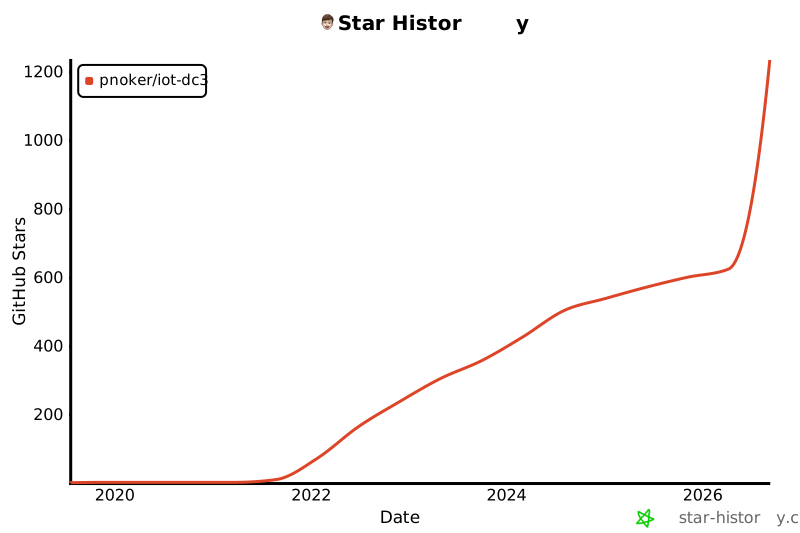
## ⭐ Star History
[](https://star-history.com/#pnoker/iot-dc3&Date)