# data.table
**Repository Path**: ynsxx/data.table
## Basic Information
- **Project Name**: data.table
- **Description**: R's data.table package extends data.frame:
- **Primary Language**: Unknown
- **License**: MPL-2.0
- **Default Branch**: master
- **Homepage**: None
- **GVP Project**: No
## Statistics
- **Stars**: 0
- **Forks**: 1
- **Created**: 2022-02-17
- **Last Updated**: 2022-02-17
## Categories & Tags
**Categories**: Uncategorized
**Tags**: None
## README
# data.table  [](https://cran.r-project.org/web/checks/check_results_data.table.html)
[](https://travis-ci.org/Rdatatable/data.table)
[](https://ci.appveyor.com/project/Rdatatable/data-table)
[](https://codecov.io/github/Rdatatable/data.table?branch=master)
[](https://gitlab.com/Rdatatable/data.table/pipelines)
[](https://www.rdocumentation.org/trends)
[](http://depsy.org/package/r/data.table)
[](https://gitlab.com/jangorecki/rdeps)
[](https://gitlab.com/jangorecki/rdeps)
[](https://gitlab.com/jangorecki/rdeps)
`data.table` provides a high-performance version of [base R](https://www.r-project.org/about.html)'s `data.frame` with syntax and feature enhancements for ease of use, convenience and programming speed.
## Why `data.table`?
* concise syntax: fast to type, fast to read
* fast speed
* memory efficient
* careful API lifecycle management
* community
* feature rich
## Features
* fast and friendly delimited **file reader**: **[`?fread`](https://rdatatable.gitlab.io/data.table/reference/fread.html)**, see also [convenience features for _small_ data](https://github.com/Rdatatable/data.table/wiki/Convenience-features-of-fread)
* fast and feature rich delimited **file writer**: **[`?fwrite`](https://rdatatable.gitlab.io/data.table/reference/fwrite.html)**
* low-level **parallelism**: many common operations are internally parallelized to use multiple CPU threads
* fast and scalable **aggregations**; e.g. 100GB in RAM (see [benchmarks](https://github.com/Rdatatable/data.table/wiki/Benchmarks-%3A-Grouping) on up to **two billion rows**)
* fast and feature rich joins: **ordered joins** (e.g. rolling forwards, backwards, nearest and limited staleness), **[overlapping range joins](https://github.com/Rdatatable/data.table/wiki/talks/EARL2014_OverlapRangeJoin_Arun.pdf)** (similar to `IRanges::findOverlaps`), **[non-equi joins](https://github.com/Rdatatable/data.table/wiki/talks/ArunSrinivasanUseR2016.pdf)** (i.e. joins using operators `>, >=, <, <=`), **aggregate on join** (`by=.EACHI`), **update on join**
* fast add/update/delete columns **by reference** by group using no copies at all
* fast and feature rich **reshaping** data: **[`?dcast`](https://rdatatable.gitlab.io/data.table/reference/dcast.data.table.html)** (_pivot/wider/spread_) and **[`?melt`](https://rdatatable.gitlab.io/data.table/reference/melt.data.table.html)** (_unpivot/longer/gather_)
* **any R function from any R package** can be used in queries not just the subset of functions made available by a database backend, also columns of type `list` are supported
* has **[no dependencies](https://en.wikipedia.org/wiki/Dependency_hell)** at all other than base R itself, for simpler production/maintenance
* the R dependency is **as old as possible for as long as possible** and we continuously test against that version; e.g. v1.11.0 released on 5 May 2018 bumped the dependency up from 5 year old R 3.0.0 to 4 year old R 3.1.0
## Installation
``` r
install.packages("data.table")
```
### Development version
```r
install.packages("data.table", repos="https://Rdatatable.gitlab.io/data.table")
```
or update only if newer revision is available
```r
data.table::update.dev.pkg()
```
See [the Installation wiki](https://github.com/Rdatatable/data.table/wiki/Installation) for more details.
## Usage
Use `data.table` subset `[` operator the same way you would use `data.frame` one, but...
* no need to prefix each column with `DT$` (like `subset()` and `with()` but built-in)
* any R expression using any package is allowed in `j` argument, not just list of columns
* extra argument `by` to compute `j` expression by group
```r
library(data.table)
DT = as.data.table(iris)
# FROM[WHERE, SELECT, GROUP BY]
# DT [i, j, by]
DT[Petal.Width > 1.0, mean(Petal.Length), by = Species]
# Species V1
#1: versicolor 4.362791
#2: virginica 5.552000
```
### Getting started
* [Introduction to data.table](https://cloud.r-project.org/web/packages/data.table/vignettes/datatable-intro.html) vignette
* [Getting started](https://github.com/Rdatatable/data.table/wiki/Getting-started) wiki page
### Cheatsheets
[](https://cran.r-project.org/web/checks/check_results_data.table.html)
[](https://travis-ci.org/Rdatatable/data.table)
[](https://ci.appveyor.com/project/Rdatatable/data-table)
[](https://codecov.io/github/Rdatatable/data.table?branch=master)
[](https://gitlab.com/Rdatatable/data.table/pipelines)
[](https://www.rdocumentation.org/trends)
[](http://depsy.org/package/r/data.table)
[](https://gitlab.com/jangorecki/rdeps)
[](https://gitlab.com/jangorecki/rdeps)
[](https://gitlab.com/jangorecki/rdeps)
`data.table` provides a high-performance version of [base R](https://www.r-project.org/about.html)'s `data.frame` with syntax and feature enhancements for ease of use, convenience and programming speed.
## Why `data.table`?
* concise syntax: fast to type, fast to read
* fast speed
* memory efficient
* careful API lifecycle management
* community
* feature rich
## Features
* fast and friendly delimited **file reader**: **[`?fread`](https://rdatatable.gitlab.io/data.table/reference/fread.html)**, see also [convenience features for _small_ data](https://github.com/Rdatatable/data.table/wiki/Convenience-features-of-fread)
* fast and feature rich delimited **file writer**: **[`?fwrite`](https://rdatatable.gitlab.io/data.table/reference/fwrite.html)**
* low-level **parallelism**: many common operations are internally parallelized to use multiple CPU threads
* fast and scalable **aggregations**; e.g. 100GB in RAM (see [benchmarks](https://github.com/Rdatatable/data.table/wiki/Benchmarks-%3A-Grouping) on up to **two billion rows**)
* fast and feature rich joins: **ordered joins** (e.g. rolling forwards, backwards, nearest and limited staleness), **[overlapping range joins](https://github.com/Rdatatable/data.table/wiki/talks/EARL2014_OverlapRangeJoin_Arun.pdf)** (similar to `IRanges::findOverlaps`), **[non-equi joins](https://github.com/Rdatatable/data.table/wiki/talks/ArunSrinivasanUseR2016.pdf)** (i.e. joins using operators `>, >=, <, <=`), **aggregate on join** (`by=.EACHI`), **update on join**
* fast add/update/delete columns **by reference** by group using no copies at all
* fast and feature rich **reshaping** data: **[`?dcast`](https://rdatatable.gitlab.io/data.table/reference/dcast.data.table.html)** (_pivot/wider/spread_) and **[`?melt`](https://rdatatable.gitlab.io/data.table/reference/melt.data.table.html)** (_unpivot/longer/gather_)
* **any R function from any R package** can be used in queries not just the subset of functions made available by a database backend, also columns of type `list` are supported
* has **[no dependencies](https://en.wikipedia.org/wiki/Dependency_hell)** at all other than base R itself, for simpler production/maintenance
* the R dependency is **as old as possible for as long as possible** and we continuously test against that version; e.g. v1.11.0 released on 5 May 2018 bumped the dependency up from 5 year old R 3.0.0 to 4 year old R 3.1.0
## Installation
``` r
install.packages("data.table")
```
### Development version
```r
install.packages("data.table", repos="https://Rdatatable.gitlab.io/data.table")
```
or update only if newer revision is available
```r
data.table::update.dev.pkg()
```
See [the Installation wiki](https://github.com/Rdatatable/data.table/wiki/Installation) for more details.
## Usage
Use `data.table` subset `[` operator the same way you would use `data.frame` one, but...
* no need to prefix each column with `DT$` (like `subset()` and `with()` but built-in)
* any R expression using any package is allowed in `j` argument, not just list of columns
* extra argument `by` to compute `j` expression by group
```r
library(data.table)
DT = as.data.table(iris)
# FROM[WHERE, SELECT, GROUP BY]
# DT [i, j, by]
DT[Petal.Width > 1.0, mean(Petal.Length), by = Species]
# Species V1
#1: versicolor 4.362791
#2: virginica 5.552000
```
### Getting started
* [Introduction to data.table](https://cloud.r-project.org/web/packages/data.table/vignettes/datatable-intro.html) vignette
* [Getting started](https://github.com/Rdatatable/data.table/wiki/Getting-started) wiki page
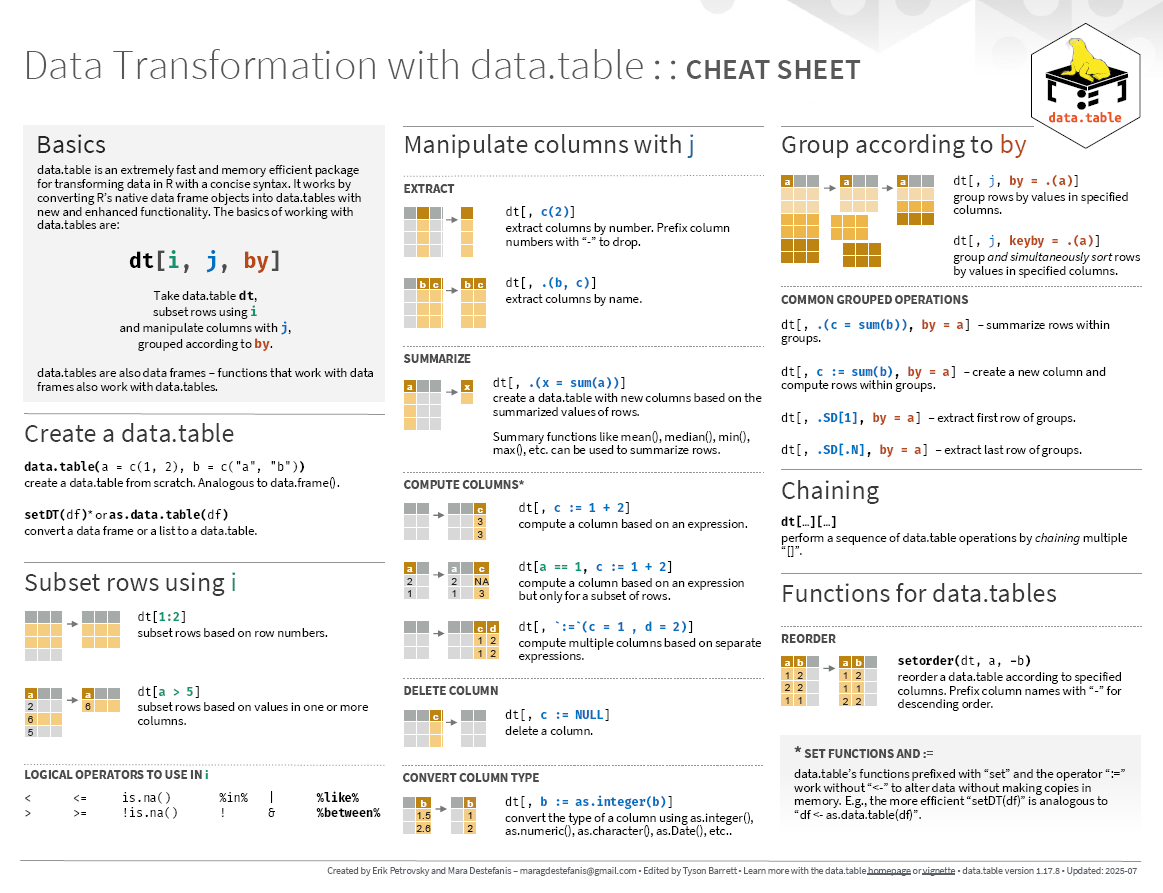
### Cheatsheets
 ## Community
`data.table` is widely used by the R community. As of July 2019, it was used by over 680 CRAN and Bioconductor packages and was the [9th most starred](http://www.r-pkg.org/starred) R package on GitHub. If you need help, the `data.table` community is active StackOverflow, with nearly [9,000 questions](http://stackoverflow.com/questions/tagged/data.table).
### Stay up-to-date
- click the **Watch** button at the top and right of GitHub project page
- read [NEWS file](https://github.com/Rdatatable/data.table/blob/master/NEWS.md)
- follow [#rdatatable](https://twitter.com/hashtag/rdatatable) on twitter
- watch recent [Presentations](https://github.com/Rdatatable/data.table/wiki/Presentations)
- read recent [Articles](https://github.com/Rdatatable/data.table/wiki/Articles)
### Contributing
Guidelines for filing issues / pull requests: [Contribution Guidelines](https://github.com/Rdatatable/data.table/wiki/Contributing).
## Community
`data.table` is widely used by the R community. As of July 2019, it was used by over 680 CRAN and Bioconductor packages and was the [9th most starred](http://www.r-pkg.org/starred) R package on GitHub. If you need help, the `data.table` community is active StackOverflow, with nearly [9,000 questions](http://stackoverflow.com/questions/tagged/data.table).
### Stay up-to-date
- click the **Watch** button at the top and right of GitHub project page
- read [NEWS file](https://github.com/Rdatatable/data.table/blob/master/NEWS.md)
- follow [#rdatatable](https://twitter.com/hashtag/rdatatable) on twitter
- watch recent [Presentations](https://github.com/Rdatatable/data.table/wiki/Presentations)
- read recent [Articles](https://github.com/Rdatatable/data.table/wiki/Articles)
### Contributing
Guidelines for filing issues / pull requests: [Contribution Guidelines](https://github.com/Rdatatable/data.table/wiki/Contributing).