# zeroclaw
**Repository Path**: zhouwd/zeroclaw
## Basic Information
- **Project Name**: zeroclaw
- **Description**: No description available
- **Primary Language**: Unknown
- **License**: MIT
- **Default Branch**: main
- **Homepage**: None
- **GVP Project**: No
## Statistics
- **Stars**: 0
- **Forks**: 0
- **Created**: 2026-02-17
- **Last Updated**: 2026-02-17
## Categories & Tags
**Categories**: Uncategorized
**Tags**: None
## README

ZeroClaw 🦀
Zero overhead. Zero compromise. 100% Rust. 100% Agnostic.
⚡️ Runs on $10 hardware with <5MB RAM: That's 99% less memory than OpenClaw and 98% cheaper than a Mac mini!


Fast, small, and fully autonomous AI assistant infrastructure — deploy anywhere, swap anything.
```
~3.4MB binary · <10ms startup · 1,017 tests · 22+ providers · 8 traits · Pluggable everything
```
### ✨ Features
- 🏎️ **Ultra-Lightweight:** <5MB Memory footprint — 99% smaller than OpenClaw core.
- 💰 **Minimal Cost:** Efficient enough to run on $10 Hardware — 98% cheaper than a Mac mini.
- ⚡ **Lightning Fast:** 400X Faster startup time, boot in <10ms (under 1s even on 0.6GHz cores).
- 🌍 **True Portability:** Single self-contained binary across ARM, x86, and RISC-V.
### Why teams pick ZeroClaw
- **Lean by default:** small Rust binary, fast startup, low memory footprint.
- **Secure by design:** pairing, strict sandboxing, explicit allowlists, workspace scoping.
- **Fully swappable:** core systems are traits (providers, channels, tools, memory, tunnels).
- **No lock-in:** OpenAI-compatible provider support + pluggable custom endpoints.
## Benchmark Snapshot (ZeroClaw vs OpenClaw)
Local machine quick benchmark (macOS arm64, Feb 2026) normalized for 0.8GHz edge hardware.
| | OpenClaw | NanoBot | PicoClaw | ZeroClaw 🦀 |
|---|---|---|---|---|
| **Language** | TypeScript | Python | Go | **Rust** |
| **RAM** | > 1GB | > 100MB | < 10MB | **< 5MB** |
| **Startup (0.8GHz core)** | > 500s | > 30s | < 1s | **< 10ms** |
| **Binary Size** | ~28MB (dist) | N/A (Scripts) | ~8MB | **3.4 MB** |
| **Cost** | Mac Mini $599 | Linux SBC ~$50 | Linux Board $10 | **Any hardware $10** |
> Notes: ZeroClaw results measured with `/usr/bin/time -l` on release builds. OpenClaw requires Node.js runtime (~390MB overhead). PicoClaw and ZeroClaw are static binaries.

Reproduce ZeroClaw numbers locally:
```bash
cargo build --release
ls -lh target/release/zeroclaw
/usr/bin/time -l target/release/zeroclaw --help
/usr/bin/time -l target/release/zeroclaw status
```
## Prerequesites
Windows
#### Required
1. **Visual Studio Build Tools** (provides the MSVC linker and Windows SDK):
```powershell
winget install Microsoft.VisualStudio.2022.BuildTools
```
During installation (or via the Visual Studio Installer), select the **"Desktop development with C++"** workload.
2. **Rust toolchain:**
```powershell
winget install Rustlang.Rustup
```
After installation, open a new terminal and run `rustup default stable` to ensure the stable toolchain is active.
3. **Verify** both are working:
```powershell
rustc --version
cargo --version
```
#### Optional
- **Docker Desktop** — required only if using the [Docker sandboxed runtime](#runtime-support-current) (`runtime.kind = "docker"`). Install via `winget install Docker.DockerDesktop`.
Linux / macOS
#### Required
1. **Build essentials:**
- **Linux (Debian/Ubuntu):** `sudo apt install build-essential pkg-config`
- **Linux (Fedora/RHEL):** `sudo dnf groupinstall "Development Tools" && sudo dnf install pkg-config`
- **macOS:** Install Xcode Command Line Tools: `xcode-select --install`
2. **Rust toolchain:**
```bash
curl --proto '=https' --tlsv1.2 -sSf https://sh.rustup.rs | sh
```
See [rustup.rs](https://rustup.rs) for details.
3. **Verify** both are working:
```bash
rustc --version
cargo --version
```
#### Optional
- **Docker** — required only if using the [Docker sandboxed runtime](#runtime-support-current) (`runtime.kind = "docker"`). Install via your package manager or [docker.com](https://docs.docker.com/engine/install/).
> **Low-memory boards (e.g., Raspberry Pi 3, 1GB RAM):** see [Build troubleshooting](#build-troubleshooting-linux-openssl-errors) and use `CARGO_BUILD_JOBS=1 cargo build --release` if the kernel kills rustc during compilation.
## Quick Start
```bash
git clone https://github.com/zeroclaw-labs/zeroclaw.git
cd zeroclaw
cargo build --release --locked
cargo install --path . --force --locked
# Quick setup (no prompts)
zeroclaw onboard --api-key sk-... --provider openrouter
# Or interactive wizard
zeroclaw onboard --interactive
# Or quickly repair channels/allowlists only
zeroclaw onboard --channels-only
# Chat
zeroclaw agent -m "Hello, ZeroClaw!"
# Interactive mode
zeroclaw agent
# Start the gateway (webhook server)
zeroclaw gateway # default: 127.0.0.1:8080
zeroclaw gateway --port 0 # random port (security hardened)
# Start full autonomous runtime
zeroclaw daemon
# Check status
zeroclaw status
# Run system diagnostics
zeroclaw doctor
# Check channel health
zeroclaw channel doctor
# Get integration setup details
zeroclaw integrations info Telegram
# Manage background service
zeroclaw service install
zeroclaw service status
# Migrate memory from OpenClaw (safe preview first)
zeroclaw migrate openclaw --dry-run
zeroclaw migrate openclaw
```
> **Dev fallback (no global install):** prefix commands with `cargo run --release --` (example: `cargo run --release -- status`).
## Architecture
Every subsystem is a **trait** — swap implementations with a config change, zero code changes.

| Subsystem | Trait | Ships with | Extend |
|-----------|-------|------------|--------|
| **AI Models** | `Provider` | 22+ providers (OpenRouter, Anthropic, OpenAI, Ollama, Venice, Groq, Mistral, xAI, DeepSeek, Together, Fireworks, Perplexity, Cohere, Bedrock, etc.) | `custom:https://your-api.com` — any OpenAI-compatible API |
| **Channels** | `Channel` | CLI, Telegram, Discord, Slack, iMessage, Matrix, WhatsApp, Webhook | Any messaging API |
| **Memory** | `Memory` | SQLite with hybrid search (FTS5 + vector cosine similarity), Lucid bridge (CLI sync + SQLite fallback), Markdown | Any persistence backend |
| **Tools** | `Tool` | shell, file_read, file_write, memory_store, memory_recall, memory_forget, browser_open (Brave + allowlist), browser (agent-browser / rust-native), composio (optional) | Any capability |
| **Observability** | `Observer` | Noop, Log, Multi | Prometheus, OTel |
| **Runtime** | `RuntimeAdapter` | Native, Docker (sandboxed) | WASM (planned; unsupported kinds fail fast) |
| **Security** | `SecurityPolicy` | Gateway pairing, sandbox, allowlists, rate limits, filesystem scoping, encrypted secrets | — |
| **Identity** | `IdentityConfig` | OpenClaw (markdown), AIEOS v1.1 (JSON) | Any identity format |
| **Tunnel** | `Tunnel` | None, Cloudflare, Tailscale, ngrok, Custom | Any tunnel binary |
| **Heartbeat** | Engine | HEARTBEAT.md periodic tasks | — |
| **Skills** | Loader | TOML manifests + SKILL.md instructions | Community skill packs |
| **Integrations** | Registry | 50+ integrations across 9 categories | Plugin system |
### Runtime support (current)
- ✅ Supported today: `runtime.kind = "native"` or `runtime.kind = "docker"`
- 🚧 Planned, not implemented yet: WASM / edge runtimes
When an unsupported `runtime.kind` is configured, ZeroClaw now exits with a clear error instead of silently falling back to native.
### Memory System (Full-Stack Search Engine)
All custom, zero external dependencies — no Pinecone, no Elasticsearch, no LangChain:
| Layer | Implementation |
|-------|---------------|
| **Vector DB** | Embeddings stored as BLOB in SQLite, cosine similarity search |
| **Keyword Search** | FTS5 virtual tables with BM25 scoring |
| **Hybrid Merge** | Custom weighted merge function (`vector.rs`) |
| **Embeddings** | `EmbeddingProvider` trait — OpenAI, custom URL, or noop |
| **Chunking** | Line-based markdown chunker with heading preservation |
| **Caching** | SQLite `embedding_cache` table with LRU eviction |
| **Safe Reindex** | Rebuild FTS5 + re-embed missing vectors atomically |
The agent automatically recalls, saves, and manages memory via tools.
```toml
[memory]
backend = "sqlite" # "sqlite", "lucid", "markdown", "none"
auto_save = true
embedding_provider = "openai"
vector_weight = 0.7
keyword_weight = 0.3
# backend = "none" uses an explicit no-op memory backend (no persistence)
# Optional for backend = "lucid"
# ZEROCLAW_LUCID_CMD=/usr/local/bin/lucid # default: lucid
# ZEROCLAW_LUCID_BUDGET=200 # default: 200
# ZEROCLAW_LUCID_LOCAL_HIT_THRESHOLD=3 # local hit count to skip external recall
# ZEROCLAW_LUCID_RECALL_TIMEOUT_MS=120 # low-latency budget for lucid context recall
# ZEROCLAW_LUCID_STORE_TIMEOUT_MS=800 # async sync timeout for lucid store
# ZEROCLAW_LUCID_FAILURE_COOLDOWN_MS=15000 # cooldown after lucid failure to avoid repeated slow attempts
```
## Security
ZeroClaw enforces security at **every layer** — not just the sandbox. It passes all items from the community security checklist.
### Security Checklist
| # | Item | Status | How |
|---|------|--------|-----|
| 1 | **Gateway not publicly exposed** | ✅ | Binds `127.0.0.1` by default. Refuses `0.0.0.0` without tunnel or explicit `allow_public_bind = true`. |
| 2 | **Pairing required** | ✅ | 6-digit one-time code on startup. Exchange via `POST /pair` for bearer token. All `/webhook` requests require `Authorization: Bearer `. |
| 3 | **Filesystem scoped (no /)** | ✅ | `workspace_only = true` by default. 14 system dirs + 4 sensitive dotfiles blocked. Null byte injection blocked. Symlink escape detection via canonicalization + resolved-path workspace checks in file read/write tools. |
| 4 | **Access via tunnel only** | ✅ | Gateway refuses public bind without active tunnel. Supports Tailscale, Cloudflare, ngrok, or any custom tunnel. |
> **Run your own nmap:** `nmap -p 1-65535 ` — ZeroClaw binds to localhost only, so nothing is exposed unless you explicitly configure a tunnel.
### Channel allowlists (Telegram / Discord / Slack)
Inbound sender policy is now consistent:
- Empty allowlist = **deny all inbound messages**
- `"*"` = **allow all** (explicit opt-in)
- Otherwise = exact-match allowlist
This keeps accidental exposure low by default.
Recommended low-friction setup (secure + fast):
- **Telegram:** allowlist your own `@username` (without `@`) and/or your numeric Telegram user ID.
- **Discord:** allowlist your own Discord user ID.
- **Slack:** allowlist your own Slack member ID (usually starts with `U`).
- Use `"*"` only for temporary open testing.
If you're not sure which identity to use:
1. Start channels and send one message to your bot.
2. Read the warning log to see the exact sender identity.
3. Add that value to the allowlist and rerun channels-only setup.
If you hit authorization warnings in logs (for example: `ignoring message from unauthorized user`),
rerun channel setup only:
```bash
zeroclaw onboard --channels-only
```
### WhatsApp Business Cloud API Setup
WhatsApp uses Meta's Cloud API with webhooks (push-based, not polling):
1. **Create a Meta Business App:**
- Go to [developers.facebook.com](https://developers.facebook.com)
- Create a new app → Select "Business" type
- Add the "WhatsApp" product
2. **Get your credentials:**
- **Access Token:** From WhatsApp → API Setup → Generate token (or create a System User for permanent tokens)
- **Phone Number ID:** From WhatsApp → API Setup → Phone number ID
- **Verify Token:** You define this (any random string) — Meta will send it back during webhook verification
3. **Configure ZeroClaw:**
```toml
[channels_config.whatsapp]
access_token = "EAABx..."
phone_number_id = "123456789012345"
verify_token = "my-secret-verify-token"
allowed_numbers = ["+1234567890"] # E.164 format, or ["*"] for all
```
4. **Start the gateway with a tunnel:**
```bash
zeroclaw gateway --port 8080
```
WhatsApp requires HTTPS, so use a tunnel (ngrok, Cloudflare, Tailscale Funnel).
5. **Configure Meta webhook:**
- In Meta Developer Console → WhatsApp → Configuration → Webhook
- **Callback URL:** `https://your-tunnel-url/whatsapp`
- **Verify Token:** Same as your `verify_token` in config
- Subscribe to `messages` field
6. **Test:** Send a message to your WhatsApp Business number — ZeroClaw will respond via the LLM.
## Configuration
Config: `~/.zeroclaw/config.toml` (created by `onboard`)
```toml
api_key = "sk-..."
default_provider = "openrouter"
default_model = "anthropic/claude-sonnet-4-20250514"
default_temperature = 0.7
[memory]
backend = "sqlite" # "sqlite", "lucid", "markdown", "none"
auto_save = true
embedding_provider = "openai" # "openai", "noop"
vector_weight = 0.7
keyword_weight = 0.3
# backend = "none" disables persistent memory via no-op backend
[gateway]
require_pairing = true # require pairing code on first connect
allow_public_bind = false # refuse 0.0.0.0 without tunnel
[autonomy]
level = "supervised" # "readonly", "supervised", "full" (default: supervised)
workspace_only = true # default: true — scoped to workspace
allowed_commands = ["git", "npm", "cargo", "ls", "cat", "grep"]
forbidden_paths = ["/etc", "/root", "/proc", "/sys", "~/.ssh", "~/.gnupg", "~/.aws"]
[runtime]
kind = "native" # "native" or "docker"
[runtime.docker]
image = "alpine:3.20" # container image for shell execution
network = "none" # docker network mode ("none", "bridge", etc.)
memory_limit_mb = 512 # optional memory limit in MB
cpu_limit = 1.0 # optional CPU limit
read_only_rootfs = true # mount root filesystem as read-only
mount_workspace = true # mount workspace into /workspace
allowed_workspace_roots = [] # optional allowlist for workspace mount validation
[heartbeat]
enabled = false
interval_minutes = 30
[tunnel]
provider = "none" # "none", "cloudflare", "tailscale", "ngrok", "custom"
[secrets]
encrypt = true # API keys encrypted with local key file
[browser]
enabled = false # opt-in browser_open + browser tools
allowed_domains = ["docs.rs"] # required when browser is enabled
backend = "agent_browser" # "agent_browser" (default), "rust_native", "computer_use", "auto"
native_headless = true # applies when backend uses rust-native
native_webdriver_url = "http://127.0.0.1:9515" # WebDriver endpoint (chromedriver/selenium)
# native_chrome_path = "/usr/bin/chromium" # optional explicit browser binary for driver
[browser.computer_use]
endpoint = "http://127.0.0.1:8787/v1/actions" # computer-use sidecar HTTP endpoint
timeout_ms = 15000 # per-action timeout
allow_remote_endpoint = false # secure default: only private/localhost endpoint
window_allowlist = [] # optional window title/process allowlist hints
# api_key = "..." # optional bearer token for sidecar
# max_coordinate_x = 3840 # optional coordinate guardrail
# max_coordinate_y = 2160 # optional coordinate guardrail
# Rust-native backend build flag:
# cargo build --release --features browser-native
# Ensure a WebDriver server is running, e.g. chromedriver --port=9515
# Computer-use sidecar contract (MVP)
# POST browser.computer_use.endpoint
# Request: {
# "action": "mouse_click",
# "params": {"x": 640, "y": 360, "button": "left"},
# "policy": {"allowed_domains": [...], "window_allowlist": [...], "max_coordinate_x": 3840, "max_coordinate_y": 2160},
# "metadata": {"session_name": "...", "source": "zeroclaw.browser", "version": "..."}
# }
# Response: {"success": true, "data": {...}} or {"success": false, "error": "..."}
[composio]
enabled = false # opt-in: 1000+ OAuth apps via composio.dev
# api_key = "cmp_..." # optional: stored encrypted when [secrets].encrypt = true
entity_id = "default" # default user_id for Composio tool calls
[identity]
format = "openclaw" # "openclaw" (default, markdown files) or "aieos" (JSON)
# aieos_path = "identity.json" # path to AIEOS JSON file (relative to workspace or absolute)
# aieos_inline = '{"identity":{"names":{"first":"Nova"}}}' # inline AIEOS JSON
```
## Identity System (AIEOS Support)
ZeroClaw supports **identity-agnostic** AI personas through two formats:
### OpenClaw (Default)
Traditional markdown files in your workspace:
- `IDENTITY.md` — Who the agent is
- `SOUL.md` — Core personality and values
- `USER.md` — Who the agent is helping
- `AGENTS.md` — Behavior guidelines
### AIEOS (AI Entity Object Specification)
[AIEOS](https://aieos.org) is a standardization framework for portable AI identity. ZeroClaw supports AIEOS v1.1 JSON payloads, allowing you to:
- **Import identities** from the AIEOS ecosystem
- **Export identities** to other AIEOS-compatible systems
- **Maintain behavioral integrity** across different AI models
#### Enable AIEOS
```toml
[identity]
format = "aieos"
aieos_path = "identity.json" # relative to workspace or absolute path
```
Or inline JSON:
```toml
[identity]
format = "aieos"
aieos_inline = '''
{
"identity": {
"names": { "first": "Nova", "nickname": "N" }
},
"psychology": {
"neural_matrix": { "creativity": 0.9, "logic": 0.8 },
"traits": { "mbti": "ENTP" },
"moral_compass": { "alignment": "Chaotic Good" }
},
"linguistics": {
"text_style": { "formality_level": 0.2, "slang_usage": true }
},
"motivations": {
"core_drive": "Push boundaries and explore possibilities"
}
}
'''
```
#### AIEOS Schema Sections
| Section | Description |
|---------|-------------|
| `identity` | Names, bio, origin, residence |
| `psychology` | Neural matrix (cognitive weights), MBTI, OCEAN, moral compass |
| `linguistics` | Text style, formality, catchphrases, forbidden words |
| `motivations` | Core drive, short/long-term goals, fears |
| `capabilities` | Skills and tools the agent can access |
| `physicality` | Visual descriptors for image generation |
| `history` | Origin story, education, occupation |
| `interests` | Hobbies, favorites, lifestyle |
See [aieos.org](https://aieos.org) for the full schema and live examples.
## Gateway API
| Endpoint | Method | Auth | Description |
|----------|--------|------|-------------|
| `/health` | GET | None | Health check (always public, no secrets leaked) |
| `/pair` | POST | `X-Pairing-Code` header | Exchange one-time code for bearer token |
| `/webhook` | POST | `Authorization: Bearer ` | Send message: `{"message": "your prompt"}` |
| `/whatsapp` | GET | Query params | Meta webhook verification (hub.mode, hub.verify_token, hub.challenge) |
| `/whatsapp` | POST | None (Meta signature) | WhatsApp incoming message webhook |
## Commands
| Command | Description |
|---------|-------------|
| `onboard` | Quick setup (default) |
| `onboard --interactive` | Full interactive 7-step wizard |
| `onboard --channels-only` | Reconfigure channels/allowlists only (fast repair flow) |
| `agent -m "..."` | Single message mode |
| `agent` | Interactive chat mode |
| `gateway` | Start webhook server (default: `127.0.0.1:8080`) |
| `gateway --port 0` | Random port mode |
| `daemon` | Start long-running autonomous runtime |
| `service install/start/stop/status/uninstall` | Manage user-level background service |
| `doctor` | Diagnose daemon/scheduler/channel freshness |
| `status` | Show full system status |
| `channel doctor` | Run health checks for configured channels |
| `integrations info ` | Show setup/status details for one integration |
## Development
```bash
cargo build # Dev build
cargo build --release # Release build (~3.4MB)
CARGO_BUILD_JOBS=1 cargo build --release # Low-memory fallback (Raspberry Pi 3, 1GB RAM)
cargo test # 1,017 tests
cargo clippy # Lint (0 warnings)
cargo fmt # Format
# Run the SQLite vs Markdown benchmark
cargo test --test memory_comparison -- --nocapture
```
### Pre-push hook
A git hook runs `cargo fmt --check`, `cargo clippy -- -D warnings`, and `cargo test` before every push. Enable it once:
```bash
git config core.hooksPath .githooks
```
### Build troubleshooting (Linux OpenSSL errors)
If you see an `openssl-sys` build error, sync dependencies and rebuild with the repository lockfile:
```bash
git pull
cargo build --release --locked
cargo install --path . --force --locked
```
ZeroClaw is configured to use `rustls` for HTTP/TLS dependencies; `--locked` keeps the transitive graph deterministic on fresh environments.
To skip the hook when you need a quick push during development:
```bash
git push --no-verify
```
## Collaboration & Docs
For high-throughput collaboration and consistent reviews:
- Contribution guide: [CONTRIBUTING.md](CONTRIBUTING.md)
- PR workflow policy: [docs/pr-workflow.md](docs/pr-workflow.md)
- Reviewer playbook (triage + deep review): [docs/reviewer-playbook.md](docs/reviewer-playbook.md)
- CI ownership and triage map: [docs/ci-map.md](docs/ci-map.md)
- Security disclosure policy: [SECURITY.md](SECURITY.md)
## Support
ZeroClaw is an open-source project maintained with passion. If you find it useful and would like to support its continued development, hardware for testing, and coffee for the maintainer, you can support me here:
 ### 🙏 Special Thanks
A heartfelt thank you to the communities and institutions that inspire and fuel this open-source work:
- **Harvard University** — for fostering intellectual curiosity and pushing the boundaries of what's possible.
- **MIT** — for championing open knowledge, open source, and the belief that technology should be accessible to everyone.
- **Sundai Club** — for the community, the energy, and the relentless drive to build things that matter.
- **The World & Beyond** 🌍✨ — to every contributor, dreamer, and builder out there making open source a force for good. This is for you.
We're building in the open because the best ideas come from everywhere. If you're reading this, you're part of it. Welcome. 🦀❤️
## License
MIT — see [LICENSE](LICENSE)
## Contributing
See [CONTRIBUTING.md](CONTRIBUTING.md). Implement a trait, submit a PR:
- CI workflow guide: [docs/ci-map.md](docs/ci-map.md)
- New `Provider` → `src/providers/`
- New `Channel` → `src/channels/`
- New `Observer` → `src/observability/`
- New `Tool` → `src/tools/`
- New `Memory` → `src/memory/`
- New `Tunnel` → `src/tunnel/`
- New `Skill` → `~/.zeroclaw/workspace/skills//`
---
**ZeroClaw** — Zero overhead. Zero compromise. Deploy anywhere. Swap anything. 🦀
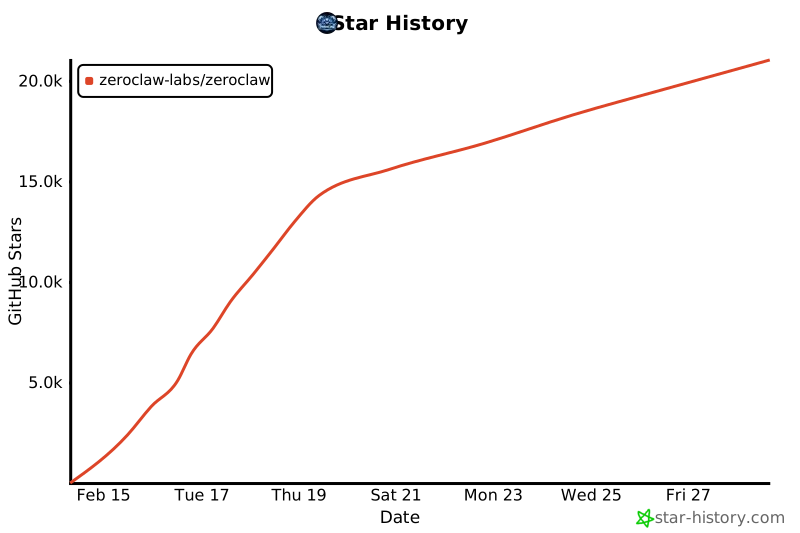
## Star History
### 🙏 Special Thanks
A heartfelt thank you to the communities and institutions that inspire and fuel this open-source work:
- **Harvard University** — for fostering intellectual curiosity and pushing the boundaries of what's possible.
- **MIT** — for championing open knowledge, open source, and the belief that technology should be accessible to everyone.
- **Sundai Club** — for the community, the energy, and the relentless drive to build things that matter.
- **The World & Beyond** 🌍✨ — to every contributor, dreamer, and builder out there making open source a force for good. This is for you.
We're building in the open because the best ideas come from everywhere. If you're reading this, you're part of it. Welcome. 🦀❤️
## License
MIT — see [LICENSE](LICENSE)
## Contributing
See [CONTRIBUTING.md](CONTRIBUTING.md). Implement a trait, submit a PR:
- CI workflow guide: [docs/ci-map.md](docs/ci-map.md)
- New `Provider` → `src/providers/`
- New `Channel` → `src/channels/`
- New `Observer` → `src/observability/`
- New `Tool` → `src/tools/`
- New `Memory` → `src/memory/`
- New `Tunnel` → `src/tunnel/`
- New `Skill` → `~/.zeroclaw/workspace/skills//`
---
**ZeroClaw** — Zero overhead. Zero compromise. Deploy anywhere. Swap anything. 🦀
## Star History